How to Identify a Washington Walleye
You've just hooked into something solid on the Columbia River, and as you reel it in, a long, lean fish with glassy eyes emerges from the depths. Is it a walleye, a sauger, or something else entirely? Many anglers, myself included, have faced that moment of uncertainty, especially when fishing unfamiliar waters or targeting species with look-alikes. This guide is designed to cut through that confusion, helping you confidently identify a Washington walleye so you can comply with regulations and enjoy your catch.
The Distinctive Features of a Washington Walleye
Walleye are truly a unique and sought-after game fish in Washington, particularly in the vast waters of the Columbia River system. Knowing what sets them apart starts with a close look at their overall build and the details of their fins, mouth, and eyes.
Body Shape and Coloration
When you first see a walleye, you'll likely notice its sleek, elongated, and somewhat torpedo-shaped body. It's built for speed and efficiency in its watery habitat, allowing it to ambush prey. The walleye's back is typically an olive green or a rich golden-brown, a perfect camouflage against the riverbed or lake bottom. This color gradually fades along its sides, often displaying a beautiful, mottled pattern of darker blotches or saddles, before transitioning to a creamy white or pale yellow belly. This countershading helps them blend in whether viewed from above or below, making them formidable predators.
The exact shade of their coloration can vary quite a bit depending on the water clarity, depth, and even their diet in a specific area. Fish from murkier, darker waters might have more subdued or darker tones, while those from clearer, shallower areas could display brighter, more vibrant golden hues. Regardless, the general pattern of a darker, mottled back fading to a lighter belly is a consistent identifier that can help you distinguish them from other species that might share similar elongated forms but lack this distinctive color gradient and patterning.
Key Fin Characteristics
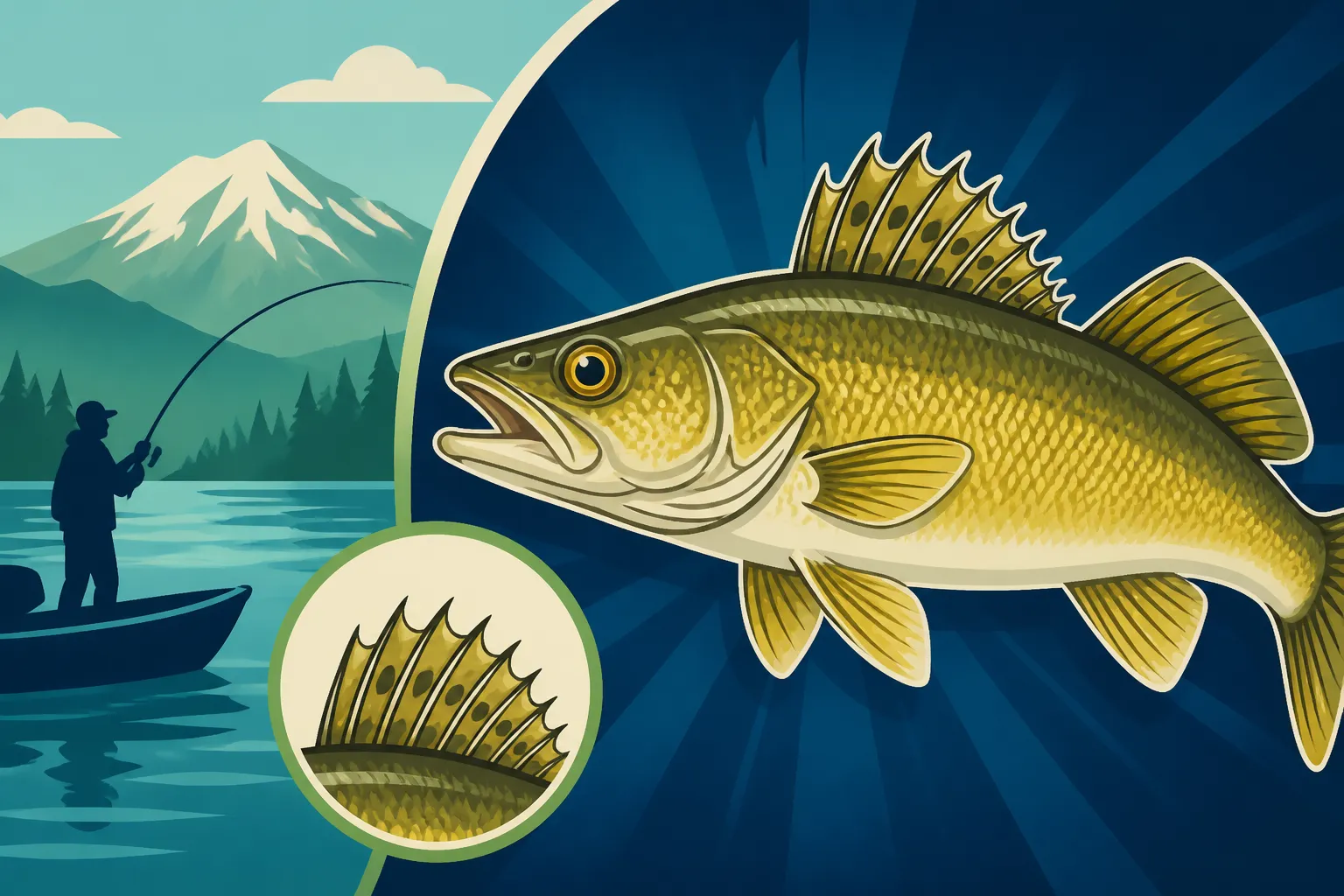
The fins of a walleye offer some of the most reliable identification markers. You'll immediately notice two distinct dorsal fins on its back. The first, located closer to the head, is composed of sharp, spiny rays. It's this spiny dorsal fin that often carries a very noticeable dark blotch at its base, a key characteristic that many anglers use for quick identification. This spot is usually quite prominent and acts like a signature mark. Behind this spiny fin, there's a second dorsal fin, which is softer and made up of flexible rays, often separated by a small gap from the spiny one.
Moving further down the fish, the anal fin, located on the underside towards the tail, is also made of soft rays and is relatively long. The tail fin, or caudal fin, is perhaps one of the most definitive features: the lower lobe of the walleye's tail typically has a distinct white tip. This bright white tip can be seen even as the fish is still in the water, sometimes giving you a hint of what you've hooked before it's fully landed. Pay close attention to these fin characteristics, especially the spiny dorsal blotch and the white tail tip; they are rarely absent on a true walleye.
Mouth and Teeth
The walleye's mouth is unmistakably that of a predator. It's large, extending back to or even past the middle of its eye, indicating its ability to engulf significant prey. Open a walleye's mouth, and you'll be met with a formidable array of sharp, canine-like teeth, often referred to as "fangs." These aren't just small nubs; they are prominent, needle-sharp teeth designed to grip and hold onto slippery fish, their primary food source. These teeth are found on both the upper and lower jaws, as well as on the roof of their mouth, ensuring that anything they grab is unlikely to escape.
When you're handling a walleye, it's crucial to be mindful of these teeth. They can deliver a painful bite or nasty scrape if you're not careful. Using a fish gripper or gloves is highly recommended for safe handling. The presence of these prominent canines immediately sets them apart from many other freshwater species that might have smaller, brush-like teeth or lack them altogether. How Big Columbia River Walleye Get is a testament to the effectiveness of these predatory features, as these fish grow to impressive sizes by consuming other fish.
Spotting the Tells: Eyes and Gill Plates
Beyond the general body shape and fins, two other areas provide crucial clues for walleye identification: their eyes and the often-overlooked details of their gill plates. These features are not just ornamental; they are integral to the walleye's survival and provide the namesake for the fish itself.
The Signature "Glassy" Eye
The most iconic feature of the walleye, and the source of its name, is undoubtedly its eye. Walleye possess large, reflective, and somewhat cloudy or "glassy" eyes. This distinct appearance is due to a special layer of tissue called the tapetum lucidum (the same reflective layer found in cats' eyes that makes them glow in the dark). This layer acts like a mirror, reflecting light back through the retina, significantly enhancing their vision in low-light conditions. It's what makes walleye such efficient hunters at dawn, dusk, and even deep underwater where light penetration is minimal.
When you're out on the water, especially if you catch one in dim light, the walleye's eyes will often seem to glow or reflect light in a very striking way. This isn't just a slight sheen; it's a profound, almost luminescent quality that truly stands out. Compare this to the eyes of a bass or a trout, which are typically clear and dark, without this reflective quality. The glassy eye is almost always the first thing an experienced angler points to when confirming a walleye. It's a fantastic adaptation that makes them perfectly suited for life in turbid rivers and deep lakes.
Operculum (Gill Plate) Markings
While less universally distinctive than their eyes or fin markings, the walleye's operculum, or gill plate, can sometimes offer additional hints. The gill plate itself is generally smooth and somewhat bony, providing protection for the delicate gills underneath. On many walleye, particularly those from certain populations or areas, you might observe a subtle dusky or dark spot on the rear edge of the gill cover. However, this marking isn't as consistently present or as pronounced as the dark blotch on their spiny dorsal fin or the white tip on their tail.
It's important not to rely solely on this gill plate spot for definitive identification, as its presence and intensity can vary. Sometimes it's barely noticeable, while other times it's quite clear. What's more important is understanding the overall structure of the operculum in context with the other features. Unlike some other fish that might have elaborate patterns or spines on their gill plates, the walleye's is relatively plain, with its primary identifying marks found elsewhere. Always use a combination of features for accurate identification, rather than relying on just one, especially if that one is a variable marking like a gill plate spot.
Distinguishing Walleye from Similar Species in Washington
In Washington, particularly on the Columbia River, walleye share their habitat with several other fish that, to an untrained eye, might be confused with them. Correct identification isn't just about curiosity; it's crucial for adhering to specific fishing regulations and size limits. Misidentification can lead to inadvertently breaking rules, which can result in penalties.
Walleye vs. Northern Pike
Northern pike are another elongated, predatory fish found in some Washington waters, primarily in the eastern part of the state. While they share a long body profile and predatory nature with walleye, their differences are quite stark once you know what to look for. The most obvious distinction is the dorsal fin configuration: a northern pike has a single dorsal fin located very far back on its body, almost directly above its anal fin. This is a dramatic contrast to the walleye's two distinct dorsal fins, one spiny and one soft, positioned much further forward.
Beyond the fins, the pike's head and mouth are entirely different. Pike are famous for their "duckbill" snout, a long, flattened, and prominent jaw filled with numerous sharp teeth, but lacking the prominent canines of a walleye. Their coloration also differs significantly, typically featuring light, bean-shaped spots or markings on a darker background, rather than the walleye's mottled pattern. Pike can also grow to considerably larger sizes than walleye, often exceeding them in length and girth. If you're fishing in waters that hold both species, these differences are critical for correct identification.
Walleye vs. Sauger
This is where it gets tricky! Sauger are the closest relatives to walleye in North America and are often found in the same waters, including parts of the Columbia River system. They look so similar that even experienced anglers can pause to consider. The key differences are subtle but consistent. Sauger are generally smaller than walleye and have a more slender body. Their spiny dorsal fin, unlike the walleye's, will typically have distinct rows of small, dark spots rather than one large, solid dark blotch at the base. This spotted dorsal fin is a primary identifier for sauger.
Another crucial difference is the absence of the distinct white tip on the lower lobe of the caudal (tail) fin on a sauger. While a walleye proudly displays this white tip, a sauger's tail will be uniformly colored, without this bright marker. Sauger also have rougher scales and often exhibit a more pronounced, darker blotchy pattern across their entire body, whereas a walleye's mottling tends to be more subdued. Understanding these fine distinctions is paramount, especially since regulations for walleye and sauger can differ. If you encounter a fish that looks like a walleye but lacks the white tail tip and has a spotted dorsal fin, you likely have a sauger. The potential for walleye-sauger hybrids, sometimes called "saugeye," further complicates things, combining features of both parents. For specific rules regarding these species, consulting Washington's Columbia River Salmon and Steelhead Endorsement, Explained can be helpful, as these fish often coexist in the same waters.
Walleye vs. Bass (Smallmouth/Largemouth)
While less likely to be confused by an experienced angler, a novice might occasionally wonder about the difference between a walleye and a bass species like smallmouth or largemouth bass, especially given that all are popular game fish in Washington. The overall body shape is a strong distinguishing factor. Bass tend to have a more robust, "chunkier" or "stockier" body profile compared to the walleye's elongated, cylindrical form. Their dorsal fins are also different; bass have two dorsal fins, but they are typically connected or very close, forming a continuous or nearly continuous ridge, unlike the distinct separation found on a walleye.
The mouth is another clear tell. While smallmouth bass have a relatively large mouth, it usually doesn't extend past the back of the eye, and neither smallmouth nor largemouth bass possess the prominent, sharp canine teeth characteristic of a walleye. Their coloration and patterns also differ; smallmouth bass often have vertical bars or splotches, while largemouth bass are known for their distinct horizontal stripe. The eyes of bass are also clear and dark, lacking the reflective, glassy quality of a walleye's eye. For more on these popular species, check out Smallmouth Bass on Washington's Columbia and Snake Rivers and Largemouth Bass in Western Washington Lakes.
Practical Tips for Anglers
Even with all the knowledge in your head, identifying a fish quickly on the water, especially when conditions aren't ideal, can be a challenge. Having some practical strategies can make all the difference, ensuring you make the right call and stay compliant with Washington's fishing rules.
Handling Your Catch for Identification
The first and most important rule when handling any fish, particularly if you're not entirely sure of its identity or if it's a species you intend to release, is to do so gently and with wet hands. Dry hands can remove the fish's protective slime coat, making it vulnerable to disease. If you need a closer look for identification, try to keep the fish in the water as much as possible or hold it horizontally, supporting its belly, to avoid stressing its internal organs. A good quality rubber-mesh net can also help minimize damage during the landing process.
Take a moment to carefully examine the features we've discussed: the two dorsal fins and the dark blotch, the white tip on the lower caudal fin, the eye's reflective quality, and the presence of prominent canine teeth. If you're considering keeping the fish, always have a tape measure or a designated measuring board ready to ensure it meets any minimum or maximum size limits. Many times, just a few seconds of careful observation will reveal the key identifying markers you need.
Consulting Resources on the Water
Even the most seasoned anglers can occasionally encounter a fish that gives them pause. That's why it's so helpful to have reliable identification resources at your fingertips, even when you're out fishing. The Washington Department of Fish and Wildlife (WDFW) publishes an annual Sport Fishing Regulations Pamphlet that includes detailed descriptions and illustrations of various fish species, often highlighting key identification features. Carrying a physical copy or having access to the digital version on your phone is always a good idea. The Fish Washington App is another fantastic resource that often includes species identification guides and current regulations, accessible right from your smartphone.
For those who prefer a dedicated guide, a waterproof fish identification chart or a small field guide specifically for freshwater fish of the Pacific Northwest can be invaluable. You can often find excellent, laminated charts on Amazon that are designed to withstand the elements of a fishing trip. These visual aids can provide quick side-by-side comparisons that help clear up any doubt. Remember, it's better to be overly cautious and double-check than to make a mistake that could lead to a violation. For general regulatory information, always consult Reading the Washington Sport Fishing Regulations Pamphlet.
When in Doubt, Release
This is perhaps the most important practical tip for any angler: if you are ever unsure about the identity of a fish, especially if it's a species with strict regulations or protected status, the safest and most responsible course of action is to release it. Conservation is paramount, and inadvertently keeping a protected species or exceeding a limit due to misidentification can have serious consequences. Washington has specific rules for many species, and misidentifying a sauger for a walleye, or vice versa, could lead to breaking a rule.
Penalties for fishing violations, even unintentional ones, can include significant fines and even loss of fishing privileges. Fines and Penalties for Common Fishing Violations can illustrate the gravity of such mistakes. By committing to catch-and-release when uncertain, you're not only protecting yourself from potential legal issues but also contributing to the health and sustainability of Washington's fish populations. It's a simple, ethical choice that benefits everyone, especially the fish themselves.
| Feature | Walleye | Sauger | Northern Pike |
|---|---|---|---|
| Body Shape | Elongated, cylindrical | More slender, slightly compressed | Very elongated, torpedo-like |
| Coloration | Olive/golden brown, mottled, white belly | Darker, distinct blotches/saddles, lighter belly | Dark green/brown, light bean-shaped spots |
| Dorsal Fins | 2 distinct; 1st spiny with dark blotch | 2 distinct; 1st spiny with rows of dark spots | 1 single, far back on body |
| Caudal Fin Tip | Lower lobe has distinct white tip | No distinct white tip | No white tip |
| Eyes | Large, prominent, reflective "glassy" eyes | Similar, but often less reflective | Clear, dark, forward-facing |
| Mouth/Teeth | Large mouth, prominent canine-like teeth | Large mouth, prominent canine-like teeth | "Duckbill" snout, many sharp, uniform teeth |
| Size | Generally larger | Generally smaller | Can grow significantly larger |
Disclaimer
This article is for general informational purposes only and does not constitute professional advice. Laws, prices and regulations vary by location and change over time. Consult a qualified professional for guidance on your specific situation.