Sockeye Salmon Identification at Washington’s Baker Lake
For many Washington anglers, the thought of targeting Sockeye salmon at Baker Lake conjures images of vibrant red fish and thrilling battles. But before you even think about reeling one in, there’s a crucial step that often trips people up: accurately identifying them. With other salmon species and their landlocked cousins, Kokanee, sharing these waters, knowing a Sockeye when you see it is absolutely vital for staying within regulations and ensuring a successful trip. This guide will help you confidently identify Sockeye salmon, especially those found in Baker Lake, so you can fish responsibly and with peace of mind.
What Makes Sockeye Salmon Unique
Sockeye salmon, or Oncorhynchus nerka, are truly a marvel among Pacific salmon species. They have a distinct appearance and life history that sets them apart, even if they can be a bit tricky to identify when they're still in their bright, ocean-phase silver. Understanding these key characteristics is your first step to becoming a confident Sockeye identifier.
The Iconic Red Flesh and Lack of Spots
One of the most famous traits of Sockeye salmon, particularly when caught in prime condition, is their deep red, rich-tasting flesh. This vibrant color is due to their diet of krill and other crustaceans high in carotenoids, which they consume in the ocean. While you won't see this until the fish is on the cleaning table, it's a significant marker of a true Sockeye. Externally, when Sockeye are in their marine phase, they are a brilliant, almost iridescent silver along their sides, fading to a darker blue-green back. What truly sets them apart from other salmon species like Chinook or Coho is the absence of significant dark spots on their back or tail. If you see numerous large, irregular spots, you're likely looking at a different kind of salmon.
Their fins are usually dusky or lightly pigmented, not heavily spotted or outlined in black like some other species. This lack of spotting is a major visual cue, though it can be more subtle on smaller, younger fish. As they mature and begin their journey to spawning grounds, this silver body undergoes a dramatic transformation, which we'll delve into later. For now, remember the clean, unspotted appearance as a primary identifier, a detail many anglers often overlook when scanning quickly.
Body Shape and Fin Characteristics
Beyond color and spots, the physical structure of a Sockeye offers important clues. They tend to have a more slender and torpedo-like body shape compared to the bulkier, deeper-bodied Chinook. Their heads are also generally smaller and more pointed in proportion to their bodies. When you look at their fins, pay particular attention to the anal fin. Like all Pacific salmon, it has 13-19 rays. However, it's their gill rakers that provide one of the most definitive ways to identify a Sockeye, something we'll explore in more detail. These are comb-like structures on the gill arch, and Sockeye have a very high count of long, slender, and closely spaced gill rakers—typically 30 to 40 on the first arch. This adaptation is crucial for their primary diet of plankton and small invertebrates.
While counting gill rakers isn't usually a practical method for anglers on the water, understanding this anatomical feature highlights why Sockeye are built differently. On the surface, look for that sleek profile, the relatively small head, and the unspotted body. Even a quick visual check for these features can help narrow down your identification when you're out on the water, potentially saving you from a costly misidentification and ensuring you adhere to local regulations. Remember that even though you might be excited to get a bite, a moment spent observing the fish's characteristics can make all the difference.
Sockeye Salmon at Baker Lake: Special Considerations
Fishing for Sockeye at Baker Lake is a unique experience in Washington, largely because of the specific population that calls it home. The Sockeye here have a distinct story and present particular identification challenges due to their unique environment and the presence of their landlocked relatives. Baker Lake's Sockeye Salmon Fishery in Washington is a topic that draws many anglers, and knowing these nuances is key.
Baker Lake's Unique Sockeye Strain
The Sockeye salmon that return to Baker Lake are part of a very special, managed fishery. Unlike many other Sockeye runs that spawn in larger river systems like the Columbia, the Baker Lake Sockeye are part of a program specifically designed to enhance their numbers for anglers. These fish migrate up the Skagit River system and are then guided into a fish ladder that helps them ascend to Baker Lake. This makes the Baker Lake Sockeye largely a hatchery-supported population, though they retain all the natural Sockeye characteristics.
When these Sockeye return to Baker Lake, especially during the peak of their run, they are often in their pre-spawning phase. This means they are beginning to undergo their iconic color changes, turning from bright silver to that brilliant crimson with greenish heads, though not quite as pronounced as fish actually on the spawning grounds. Anglers targeting them in the lake will see fish that are transitioning, offering a beautiful visual spectacle. Their robust health and impressive fight are a testament to their ocean feeding, before they embark on the final stage of their journey. Being familiar with When Sockeye Salmon Run at Washington's Baker Lake can help you time your trip to see them at their best.
Kokanee: The Landlocked Cousin Confusion
Here's where it gets truly tricky, especially at Baker Lake: distinguishing Sockeye salmon from Kokanee. Kokanee are essentially landlocked Sockeye salmon. They are the same species, Oncorhynchus nerka, but they complete their entire life cycle in freshwater, never migrating to the ocean. Because of this, they rarely grow to the size of their ocean-going relatives. While a returning Sockeye at Baker Lake might be several pounds, a Kokanee from the same lake will typically be much smaller, often under a pound, though some larger specimens can be found.
Both Sockeye and Kokanee will develop that distinctive red spawning coloration. The primary differentiating factor is almost always size. If you catch a fish with Sockeye characteristics – no spots, fine scales, sleek body – but it’s quite small, it’s most likely a Kokanee. This distinction is crucial because bag limits and regulations can differ significantly for Sockeye versus Kokanee, even within the same body of water. Having an identification chart, perhaps one you can even purchase from Amazon for quick reference, can be incredibly helpful for confirming what you're seeing. For a deeper dive, check out Kokanee vs Sockeye: What's the Difference to understand these nuances.
Distinguishing Sockeye from Other Salmon Species
Washington waters are home to several Pacific salmon species, and while Sockeye have their unique traits, they can sometimes be confused with others, particularly when they're still bright and silvery. Knowing the key differences can prevent misidentification, which is crucial for adhering to Washington Fishing Regulations Every Angler Should Know.
Sockeye vs. Chinook Salmon: Size and Spotting
Chinook salmon, often called "King salmon," are typically the largest of the Pacific salmon. This is your first major clue. A mature Chinook can easily weigh into the double digits, with some monsters reaching 30, 40, or even 50 pounds. Sockeye, while respectable, are rarely found in this size class, usually topping out around 10-12 pounds in Washington, with many being smaller.
Beyond size, the spotting pattern is a dead giveaway. Chinook salmon, whether in the ocean or fresh water, almost always have irregular, large black spots on their back, dorsal fin, and both lobes of their tail fin. Remember how Sockeye are relatively unspotted? That's your stark contrast. Chinook also have a dark mouth with black gums, while Sockeye typically have a whitish mouth and gums. The shape of a Chinook is also generally more robust and deeper-bodied than the sleeker Sockeye. If you’re ever unsure, that combination of size, heavy spotting, and mouth color will usually confirm you've got a Chinook. For more details on the big ones, read Chinook Salmon: Washington's King of Fish.
Sockeye vs. Coho and Pink Salmon: Mouth and Gill Raker Differences
Coho salmon, also known as "Silver salmon," are another species that can be mistaken for Sockeye, especially when both are in their bright silver phase. Coho are similar in size to Sockeye, often weighing 6-12 pounds. However, Coho typically have small, distinct spots on their back and the upper lobe of their tail fin. While not as heavily spotted as a Chinook, they are still more spotted than a Sockeye. The mouth of a Coho is also generally white with black gums, or at least a dark line at the gum line, similar to a Chinook, but not the clean white found in Sockeye.
Pink salmon, or "Humpback salmon," are smaller, typically 3-6 pounds, and have very large, oval spots on their back and throughout both lobes of their tail fin. These spots are usually much more pronounced and numerous than on a Coho. They also develop a very distinct humped back in males during spawning. Pink salmon runs occur primarily in odd-numbered years in Washington, making their appearance predictable.
The gill rakers are another key identifier if you can inspect them. Sockeye have many long, slender, and closely spaced gill rakers (30-40 total), designed for filtering plankton. Coho have fewer (20-25) and shorter gill rakers, while Pink salmon have an intermediate number. Again, while you won't be counting gill rakers on every fish you catch, understanding this helps appreciate the biological differences. You can learn more about Coho Salmon Fishing in Washington and Pink Salmon: Washington's Odd-Year Run to further sharpen your identification skills.
Sockeye vs. Chum Salmon: Jawline and Markings
Chum salmon, sometimes unfairly called "Dog salmon," are less likely to be confused with Sockeye in their ocean-bright phase but can become quite distinct as they near spawning. Bright Chum are a bit like Sockeye in their lack of heavy spotting, often showing only a few faint spots, if any. However, their body shape is generally more robust and their jaws are stronger. A key identifier for Chum is their relatively narrow caudal peduncle (the "wrist" of the tail) and, as they mature, the presence of distinct vertical bars or tiger stripes on their sides, which can be shades of green, purple, or red. These bars are completely absent on Sockeye.
When spawning, male Chum salmon develop large, canine-like teeth and a distinctly hooked jaw, giving them their "dog salmon" nickname. While Sockeye males also develop a slight kype (hooked jaw) and some teeth, it's rarely as exaggerated as a spawning Chum. The overall body coloration during spawning is also very different; Sockeye turn entirely red with a green head, while Chum display those striking vertical bars. Check out Chum Salmon Identification and Where They Run in Washington for more on these fascinating fish.
Here's a quick comparison table to help you keep things straight:
| Feature | Sockeye Salmon | Chinook Salmon | Coho Salmon | Pink Salmon | Chum Salmon |
|---|---|---|---|---|---|
| Spotting | Generally unspotted | Large, irregular spots on back & both tail lobes | Small spots on back & upper tail lobe | Large, oval spots on back & both tail lobes | Few, if any, spots; vertical bars when spawning |
| Mouth/Gums | Whitish mouth, white gums | Dark mouth, black gums | White mouth, black gums (often fine line) | Whitish mouth, white gums | Whitish mouth, white gums |
| Body Shape | Sleek, torpedo-like, relatively slender | Robust, deep-bodied, powerful | Streamlined, often slightly deeper than Sockeye | Smaller, distinct hump on males when spawning | Robust, often with narrow caudal peduncle |
| Size (avg.) | 4-12 lbs (ocean) | 15-30+ lbs | 6-12 lbs | 3-6 lbs | 8-15 lbs |
| Spawning Color | Brilliant red body, green head | Dark olive to black, sometimes reddish/purplish | Dark green/black back, reddish sides, dark belly | Olive green back, white belly, pronounced hump | Dark vertical bars (green/purple/red) |
| Gill Rakers | 30-40 (long, slender, closely spaced) | 18-24 (shorter, widely spaced) | 20-25 (medium length) | 25-35 (medium length) | 13-19 (short, stout) |
Life Cycle and Spawning Colors: A Dramatic Transformation
One of the most captivating aspects of Sockeye salmon is their incredible transformation throughout their life cycle, particularly as they transition from ocean dwellers to spawning adults. This metamorphosis greatly impacts their appearance and is a critical factor in How to Identify a Sockeye Salmon in different phases.
Ocean Phase Appearance: Bright Silver
For most of their adult lives, Sockeye salmon are kings of the open ocean, where they feed and grow, building up the energy reserves they'll need for their monumental freshwater journey. During this ocean phase, which can last anywhere from one to four years, they are an absolutely stunning sight. Their backs are a deep, almost metallic blue-green, transitioning seamlessly to brilliant silver sides and a white belly. This countershading helps them blend in with their environment, protecting them from predators both above and below.
Crucially, in this bright silver phase, they retain their lack of prominent spots on their back and tail, a consistent feature regardless of their location or maturity stage. Their scales are relatively fine and tightly packed, giving them a smooth, sleek appearance that perfectly matches their torpedo-like body. If you were to catch a Sockeye in saltwater, say near the mouth of a river before their spawning run truly began, it would likely exhibit these dazzling silver colors. However, once they enter freshwater and begin their upstream migration, that incredible change starts to take hold.
Spawning Phase: The Crimson and Green Shift
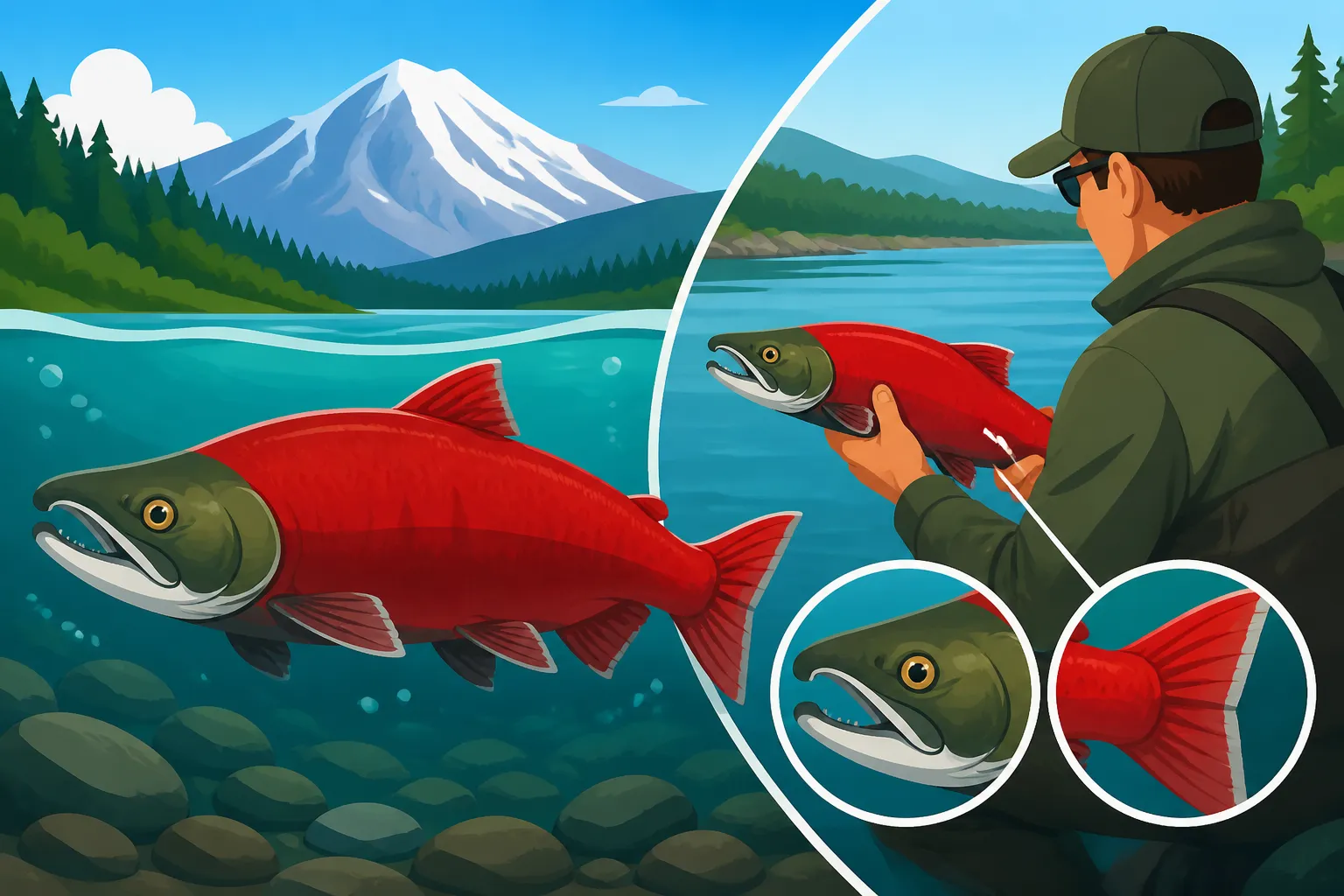
This is perhaps the most famous and easily identifiable stage of the Sockeye's life: their spectacular spawning coloration. As Sockeye salmon leave the saltwater and migrate into rivers and lakes to spawn, their bodies undergo an astonishing change. Their vibrant silver sides turn a brilliant, fiery crimson red, while their heads become a distinct olive green. This dramatic color shift is one of nature's most impressive displays and makes Sockeye salmon unmistakable on the spawning grounds.
The males, in particular, will also develop a noticeable humped back and a slightly hooked jaw (kype), though not as exaggerated as some other salmon species. Their teeth may become more prominent. It's a truly breathtaking transformation, signaling the culmination of their life's journey. At Baker Lake, you'll often see Sockeye in various stages of this color change, from individuals just starting to blush with red to those already fully adorned in their spawning finery. This visual cue is arguably the easiest way to identify a Sockeye, especially when you're looking at them in freshwater where they're preparing to reproduce.
Tools and Tips for Positive Identification
Even with a good understanding of Sockeye characteristics, positive identification on the water can sometimes be challenging, especially for novice anglers. Having some simple tools and knowing specific observation techniques can significantly increase your confidence. It also helps to be prepared with gear that allows for quick assessment, which you can easily find on Amazon or your local tackle shop.
The Role of Gill Rakers and Pyloric Caeca
While not practical for every catch-and-release scenario, understanding gill rakers and pyloric caeca can be incredibly useful for definitive identification, especially if you plan to retain your catch or are performing a study. As mentioned earlier, Sockeye salmon have a unique set of gill rakers: typically 30-40 very long, slender, and closely spaced rakers on the first gill arch. These are designed to efficiently filter the small plankton and crustaceans that make up the bulk of their diet in the ocean. Other salmon species have fewer, shorter, and more widely spaced gill rakers. You can gently lift the gill cover to examine these if necessary, though it's not recommended for fish you intend to release unharmed.
Another internal feature that differentiates Sockeye is their pyloric caeca count. Pyloric caeca are small, finger-like projections at the junction of the stomach and intestine, which aid in digestion. Sockeye typically have 60-115 pyloric caeca, a much higher count than most other salmon species. While you won't be counting these streamside, this anatomical detail underscores the unique digestive system of a Sockeye, adapted to its planktivorous diet. For an angler, it's more of a fun fact than a practical ID tool, but it emphasizes the biological distinctiveness of the species.
Physical Cues and Observation Techniques
For most anglers, identification will rely on external physical cues. Here's a practical checklist you can run through when you land a fish:
- Spotting: Is the back and tail fin free of large, distinct spots? This is your number one visual cue for Sockeye. If you see spots, it's likely a Chinook, Coho, or Pink.
- Coloration: Is the fish silver-sided with a blue-green back (ocean phase)? Or is it turning crimson red with a green head (spawning phase)? The intensity of the red and green is a strong indicator.
- Body Shape: Does it have a sleek, streamlined, torpedo-like body? Compared to the bulkier Chinook or Chum, Sockeye are noticeably more elegant.
- Mouth Color: Check the inside of the mouth and gums. Sockeye typically have a clean white mouth and gums, without the dark or black markings found in Chinook and Coho.
- Tail Shape: While subtle, Sockeye tend to have a slightly forked tail.
- Size: Consider the context of Baker Lake. If it's a small fish (under a pound) with Sockeye characteristics, it's very likely a Kokanee, the landlocked Sockeye.
Carrying a laminated fish identification chart or using a reliable fish ID app on your phone can be immensely helpful. Before your trip, download or print out images of various salmon species, paying close attention to their unique features. This preparation will make on-the-spot identification much quicker and more accurate.
Why Accurate Sockeye Identification Matters
Beyond the simple satisfaction of knowing what you've caught, accurate Sockeye salmon identification is paramount for several critical reasons. Misidentification can lead to legal issues, impact conservation efforts, and even affect the quality of your fishing experience. This is especially true when navigating dynamic rules, such as those related to Emergency Rule Changes: Why Washington's Rules Shift Mid-Season.
Regulatory Compliance and Bag Limits
The most immediate and practical reason for precise identification is to ensure you comply with Washington's fishing regulations. Different salmon species often have different seasons, size limits, and daily bag limits, and Sockeye salmon are no exception. At Baker Lake, for instance, there are specific seasons and limits for Sockeye that can be quite distinct from other salmon species or even their Kokanee cousins. If you accidentally keep a Coho thinking it's a Sockeye, and the Coho season is closed or the bag limit is different, you could face hefty fines and penalties.
The Washington Department of Fish and Wildlife (WDFW) sets these regulations to manage fish populations sustainably. By accurately identifying your catch, you're not only avoiding legal trouble but also contributing to the responsible management of these valuable resources. Always check the current WDFW regulations pamphlet, available online or at license vendors, before you head out. Understanding How Bag and Possession Limits Work in Washington is a fundamental part of being a responsible angler. Never guess; if in doubt, it’s always best to release the fish unharmed.
Conservation Efforts and Ethical Angling
Accurate identification plays a vital role in broader conservation efforts. Many salmon populations, including certain Sockeye runs, face significant challenges from habitat loss, climate change, and other environmental factors. Regulations are designed to protect vulnerable stocks while allowing for sustainable fishing of healthy populations. When anglers mistakenly harvest a species or stock that is protected or experiencing low returns, it can undermine these critical conservation measures.
Ethical angling also extends to how we treat the fish we catch. If you’re targeting Sockeye but inadvertently hook a protected species, quick and accurate identification allows for its immediate and careful release, minimizing harm. By taking the time to learn and practice identification skills, you become a better steward of Washington's natural resources. It's about respecting the fish, the ecosystem, and the future of fishing. Your commitment to proper identification ensures that the Sockeye fishery at Baker Lake and beyond remains a vibrant opportunity for generations of anglers to come.
Disclaimer
This article is for general informational purposes only and does not constitute professional advice. Laws, prices and regulations vary by location and change over time. Consult a qualified professional for guidance on your specific situation.