Legal Dungeness Crab Size
Ever felt that surge of excitement pulling up a crab pot, only for it to be replaced by a wave of anxiety? You've got a beautiful Dungeness, but is it legal? The rules around Dungeness crab size in Washington can feel like a riddle, and nobody wants to accidentally break the law or harm the fishery. This guide is here to clear up all that confusion, walking you through exactly what you need to know to confidently keep your catch and stay compliant with Washington's Dungeness crab regulations.
Why Dungeness Crab Size Limits Are So Crucial for Washington's Fishery
When you're out on the water, whether you're dropping a pot in Puget Sound or setting ring nets off the coast, it's easy to get caught up in the thrill of the catch. But those size limits aren't just arbitrary numbers; they're the backbone of sustainable crabbing in Washington. These regulations are meticulously crafted by fisheries biologists to protect the Dungeness crab population, ensuring there are plenty of crabs for future generations of anglers and for the health of our marine ecosystems.
Think of it this way: if we indiscriminately kept every crab, regardless of size, we'd quickly decimate the breeding stock. Smaller crabs haven't had a chance to reproduce yet, and by protecting them, we allow them to grow to maturity and contribute to the next generation. It’s a bit like farming – you don't harvest all your crops when they're sprouts; you let them grow to their full potential. This principle is especially vital for a popular and delicious species like the Dungeness crab, which is in high demand both recreationally and commercially. Without these rules, the vibrant crabbing seasons we enjoy in Washington would quickly become a thing of the past. It’s a shared responsibility to respect these guidelines and contribute to the long-term health of our beloved resource.
Protecting Juveniles and the Breeding Stock
The primary reason for minimum size limits is to protect juvenile crabs. These smaller crabs are still growing and haven't yet reached their full reproductive potential. By letting them go, we ensure they have the opportunity to mature, mate, and contribute to the overall crab population. This is absolutely critical for maintaining a healthy and robust fishery. If too many young crabs are removed, the population can’t replenish itself effectively, leading to fewer crabs for everyone down the line. It's a long-term investment in our crabbing future. When you're releasing an undersized crab, you're not just following a rule; you're actively participating in conservation, giving that little guy a chance to grow up and potentially become a trophy-sized keeper later on.
Ensuring Future Crabbing Seasons for Everyone
Imagine a world where every time you dropped a crab pot, it came up empty. That's a grim picture, and it’s precisely what size limits help us avoid. By regulating what we can keep, the Washington Department of Fish and Wildlife (WDFW) aims to maintain stable crab populations year after year. This means that not only will you have crabs to catch this season, but your kids and grandkids will too. It’s a commitment to intergenerational enjoyment of one of Washington's most iconic fisheries. These regulations are part of a broader management strategy that includes monitoring crab populations, setting seasons, and sometimes even emergency closures to adapt to changing conditions. You can read more about Washington Fishing Regulations Every Angler Should Know to understand the bigger picture of how our fisheries are managed.
Understanding the Legal Size for Dungeness Crab in Washington
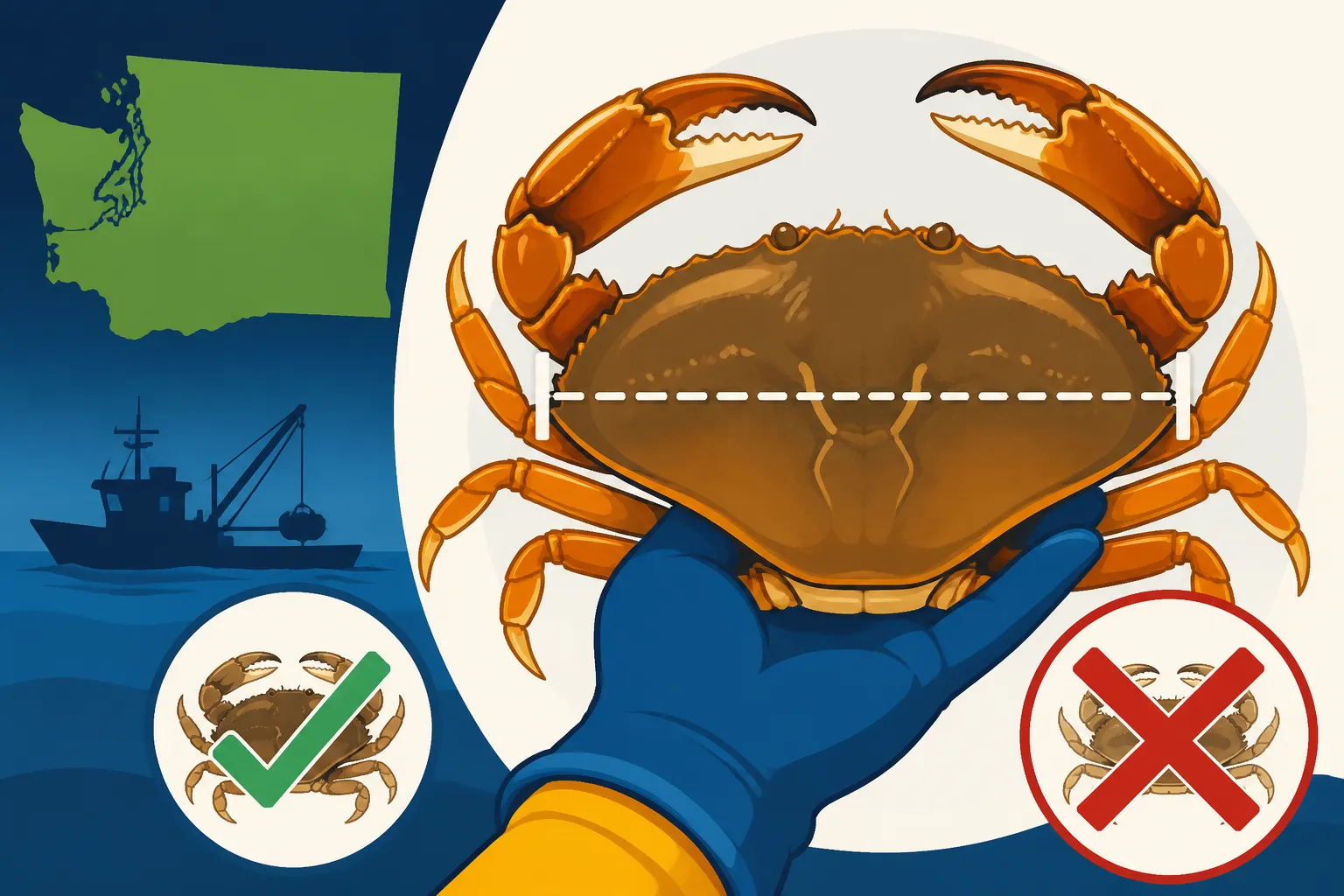
Alright, let's get down to the nitty-gritty: the actual measurements. This is where many folks get a little stressed, especially when they're out on the boat and trying to make a quick decision. The legal size for Dungeness crab in Washington is 6¼ inches (six and one-quarter inches). This measurement applies specifically to the carapace, or shell, and it's measured at the widest part, just in front of the posterior spines. Sounds simple enough, right? But the devil is in the details, and knowing how to measure correctly makes all the difference.
It’s not just about hitting the number; it’s about ensuring you measure accurately and consistently every time. You don't want to get back to the dock only to find out your "legal" crab was actually undersized because of a sloppy measurement. That’s a surefire way to get a citation, and nobody wants that hassle. So, let’s talk tools and techniques to make sure you’re always on the right side of the tape measure. For comprehensive details, check out our guide on Dungeness Crab Identification and Legal Size.
The Exact Measurement You Need to Know
The 6¼-inch rule is unwavering for Dungeness crab. This isn't a suggestion; it's a hard and fast limit. It's important to remember that this size limit is in place to allow crabs to grow to a sufficient size to reproduce before they are harvested. Crabs grow by molting, shedding their old shell and growing a new, larger one. It takes time and several molts for them to reach this legal size. So, when you measure a crab, if it's even a hair under that 6¼-inch mark, it needs to go back into the water, no exceptions. Having a reliable crab gauge is essential for this. You can find excellent, sturdy crab gauges, sometimes called calipers, on platforms like Amazon or at any local sporting goods store. They take the guesswork out of it.
How to Properly Measure Your Dungeness Crab
Measuring a Dungeness crab might seem straightforward, but there's a correct technique that ensures accuracy. You measure the shell width from point to point, just inside the tips of the longest spines that protrude from the sides of the carapace. It's crucial not to include the spines themselves in your measurement, but rather the hard shell portion. Your crab gauge should be placed firmly across the back of the crab, ensuring it touches both sides of the carapace at its widest point.
Here's a step-by-step approach:
- Get Your Gauge Ready: Have your crab measuring gauge or calipers handy and open.
- Hold the Crab Safely: Grasp the crab firmly but gently from the back, avoiding its claws. Some folks wear gloves for extra protection.
- Position the Gauge: Place the fixed jaw of your measuring tool against one side of the crab's carapace, just in front of the lateral spine.
- Extend the Movable Jaw: Carefully extend the movable jaw until it touches the other side of the carapace, again, just in front of the spine.
- Read the Measurement: Read the measurement where the movable jaw aligns with the markings on the gauge. If it falls short of the 6¼-inch line, back in the water it goes!
- Measure on a Firm Shell: Always measure a crab with a hard shell. Soft-shelled crabs (those that have recently molted) are not legal to keep, regardless of size, as their meat quality is poor and they are extremely vulnerable. A good gauge will make this process quick and efficient, minimizing stress on the crab and confusion for you.
The Importance of Identifying Male vs. Female Dungeness Crab
Beyond size, another critical regulation in Washington State is that only male Dungeness crabs can be kept. This is a non-negotiable rule designed to protect the reproductive capacity of the crab population. Female crabs, regardless of their size, must always be released unharmed. This distinction is paramount for maintaining healthy breeding cycles and ensuring the sustainability of the fishery. Many new crabbers, or even seasoned anglers who are just starting with Dungeness, sometimes find this identification a little tricky at first. However, once you know what to look for, it becomes second nature, and it’s a vital skill for responsible crabbing. It’s not just about knowing the size, but truly understanding the species you’re harvesting.
How to Tell a Male From a Female Dungeness Crab
The easiest and most reliable way to differentiate between male and female Dungeness crabs is by examining their abdominal flap, also known as the "apron," located on their underside. This flap is essentially the crab's belly plate.
- Male Crabs: The abdominal flap on a male Dungeness crab is typically narrow and pointed, resembling the shape of a lighthouse or Washington Monument. It’s relatively small and often tucked tightly against the body. This narrow shape allows for easy identification.
- Female Crabs: In contrast, the female Dungeness crab has a much broader, more rounded, and dome-shaped abdominal flap. This wider flap serves a critical biological purpose: it's designed to hold and protect thousands of eggs when she is "in berry" (carrying eggs). This broad shape is unmistakable once you've seen a few.
You will need to gently pick up the crab and flip it over to observe this feature. Always handle crabs carefully to avoid injury to yourself (those claws can pack a punch!) and to the crab. If you're unsure, it's always best to err on the side of caution and release the crab. When you're ready to learn more about this distinction, our guide on How to Tell a Male From a Female Dungeness Crab offers even more detailed insights.
Why Only Male Crabs Can Be Kept
The reason for releasing all female Dungeness crabs is purely for conservation. Female crabs are the literal future of the Dungeness crab population. By protecting them, we ensure they have every opportunity to reproduce, lay eggs, and replenish the stock. A single female Dungeness can carry hundreds of thousands, if not millions, of eggs. Imagine the impact on the population if we started harvesting these breeding females!
This regulation is a cornerstone of responsible fisheries management. It allows anglers to enjoy the thrill of crabbing while safeguarding the species' ability to sustain itself. It also means that when you catch a legal male crab, you're enjoying a harvest that has been carefully managed to ensure minimal impact on the overall health of the Dungeness population. Understanding and respecting this rule is a fundamental part of being a responsible crabber in Washington. For further reading on this specific regulation, our article Can You Keep Female Dungeness Crab in Washington? delves deeper into why this rule is so vital.
What to Do If You Catch an Undersized or Female Crab
So, you've pulled up your crab pot, and you've got a crab. You measure it, check its sex, and lo and behold, it's either too small or it's a female. Don't let that be a moment of frustration! This is a common occurrence, and knowing how to properly handle and release these crabs is just as important as knowing the legal limits. Your actions at this moment directly impact the crab's survival and, by extension, the health of the Dungeness population in Washington. A quick, gentle release ensures that these crabs can go on to grow or reproduce, fulfilling their role in the ecosystem. This is where patience and proper technique truly shine.
Gentle Handling for Release
When you determine a crab needs to be released, whether it's undersized or a female, the goal is to do so with as little stress and injury as possible. Crabs are resilient creatures, but they can be harmed by rough handling, being dropped from a height, or excessive exposure to air.
Here’s how to handle them with care:
- Minimize Air Exposure: Try to keep the crab out of the water for the shortest time possible. Have your measuring device and identification knowledge ready so you can assess quickly.
- Hold Firmly but Gently: Grip the crab firmly by the back of its carapace, just above its swimming legs, or carefully by the side of the shell, well away from its claws. Avoid gripping its legs or claws, as these can be easily damaged or torn off, which hinders their survival.
- Avoid Dropping: Lower the crab gently back into the water, rather than tossing or dropping it. A hard impact on the water's surface or on the bottom can injure the crab.
- Release into Appropriate Depth: Ideally, release the crab back into the same general area and depth from which it was caught, allowing it to quickly return to its natural environment.
Remember, every crab you gently release is an investment in future crabbing success. These aren't just rules; they're best practices for ethical and effective harvesting.
Minimizing Stress and Injury to Ensure Survival
The less stress a crab experiences during capture and release, the higher its chances of survival. This includes being mindful of environmental factors as well. For example, on a hot, sunny day, prolonged exposure to direct sunlight can be particularly harmful to crabs. If you're going through multiple crabs in a pot, consider having a shaded, damp container or a bucket of seawater to temporarily hold those you need to measure, especially if you have several.
Also, be aware of hook and line fishing accidents. While most Dungeness crabbing is done with pots or rings, sometimes a crab might be snagged by accident. If this happens, carefully remove the hook. If it's deeply embedded or the crab is severely injured, it's still best to release it, as its chances of survival are likely compromised, and keeping an injured, undersized, or female crab is still illegal.
By understanding and applying these handling techniques, you contribute directly to the health of Washington’s Dungeness crab fishery. It's a small effort that yields big rewards for the future of crabbing. And always remember to consult the latest WDFW regulations for any updates, as rules can sometimes change to adapt to scientific findings or environmental shifts.
Here's a quick reference table to help keep things clear when you're checking your catch:
| Feature | Legal Dungeness Crab | Illegal Dungeness Crab |
|---|---|---|
| Sex | Male Only | Female (Always) |
| Carapace Width | 6¼ inches (15.9 cm) or larger | Under 6¼ inches (15.9 cm) |
| Abdominal Flap | Narrow, pointed "lighthouse" shape | Broad, round "dome" shape (for egg protection) |
| Shell Condition | Hard shell | Soft shell (recently molted, regardless of size) |
| Disposition | Vigorous, healthy appearance | Severely injured, sickly, or weak |
Disclaimer
This article is for general informational purposes only and does not constitute professional advice. Laws, prices and regulations vary by location and change over time. Consult a qualified professional for guidance on your specific situation.