How Far Offshore to Find Albacore Tuna
There's nothing quite like the thrill of chasing albacore tuna off the Washington coast, but it often brings a common question that can really stump anglers: just how far out do you have to go to find these speedy, delicious fish? It's not a simple answer, and the uncertainty can make planning an offshore trip feel incredibly daunting. This guide is here to demystify the journey, giving you a clear picture of what to expect when heading offshore in pursuit of Washington's albacore.
Understanding the Albacore's Offshore Home
Albacore tuna are pelagic fish, meaning they live in the open ocean, far from coastal waters. They're highly migratory, always on the move, chasing baitfish and warm water. For us anglers in Washington, this means a deep-sea adventure is almost always on the cards if you want to target them. They aren't going to be swimming alongside your dock in Puget Sound!
Their preference for specific oceanic conditions dictates their location more than any fixed mileage from shore. We're talking about ocean currents, temperature breaks, and the distribution of their food sources, primarily small schooling fish like anchovies and sardine. They need that open, nutrient-rich water where the food chain is thriving. Understanding this fundamental preference is key to wrapping your head around why these fish can be so far offshore, and why that distance can change from one week to the next.
Why Albacore Travel Far Offshore
Albacore tuna are creatures of comfort, specifically when it comes to water temperature. They thrive in warmer waters, typically above 58-60 degrees Fahrenheit (around 14-15 degrees Celsius). The problem for Washington anglers is that these warm water masses often originate far offshore in the Pacific Ocean and only occasionally push closer to our coast.
These fish are also incredibly efficient predators, constantly on the hunt. Their food sources – often vast schools of baitfish – also prefer specific water conditions and migratory paths that can lead them hundreds of miles from land. The albacore simply follow their dinner plate wherever it leads. This pursuit of ideal temperature and abundant food is the primary driver for their extensive offshore movements. It means that the best fishing isn't always a straight line from your port; it's about finding where the ocean conditions align perfectly for them. You might be interested in Time of Year Albacore Season Runs in Washington to better understand these movements.
Key Oceanographic Features
When you're scanning marine forecasts and talking to other anglers, you'll hear a lot about "temperature breaks" and "current lines." These aren't just fancy terms; they're vital clues for locating albacore. A temperature break is exactly what it sounds like: a boundary where warmer offshore water meets cooler coastal water. These interfaces often concentrate baitfish, which in turn attracts hungry tuna.
Current lines, or "color changes," are similar. They mark the boundary between different water masses, often indicated by a distinct change in water color or clarity. These lines can also create eddies and upwellings, bringing nutrients and baitfish to the surface. Savvy tuna captains spend countless hours studying satellite imagery that shows these oceanographic features, much like a hunter studies deer trails. These dynamic oceanic highways and feeding grounds are the real targets, not just a set point on a compass.
Typical Offshore Distances for Washington Albacore
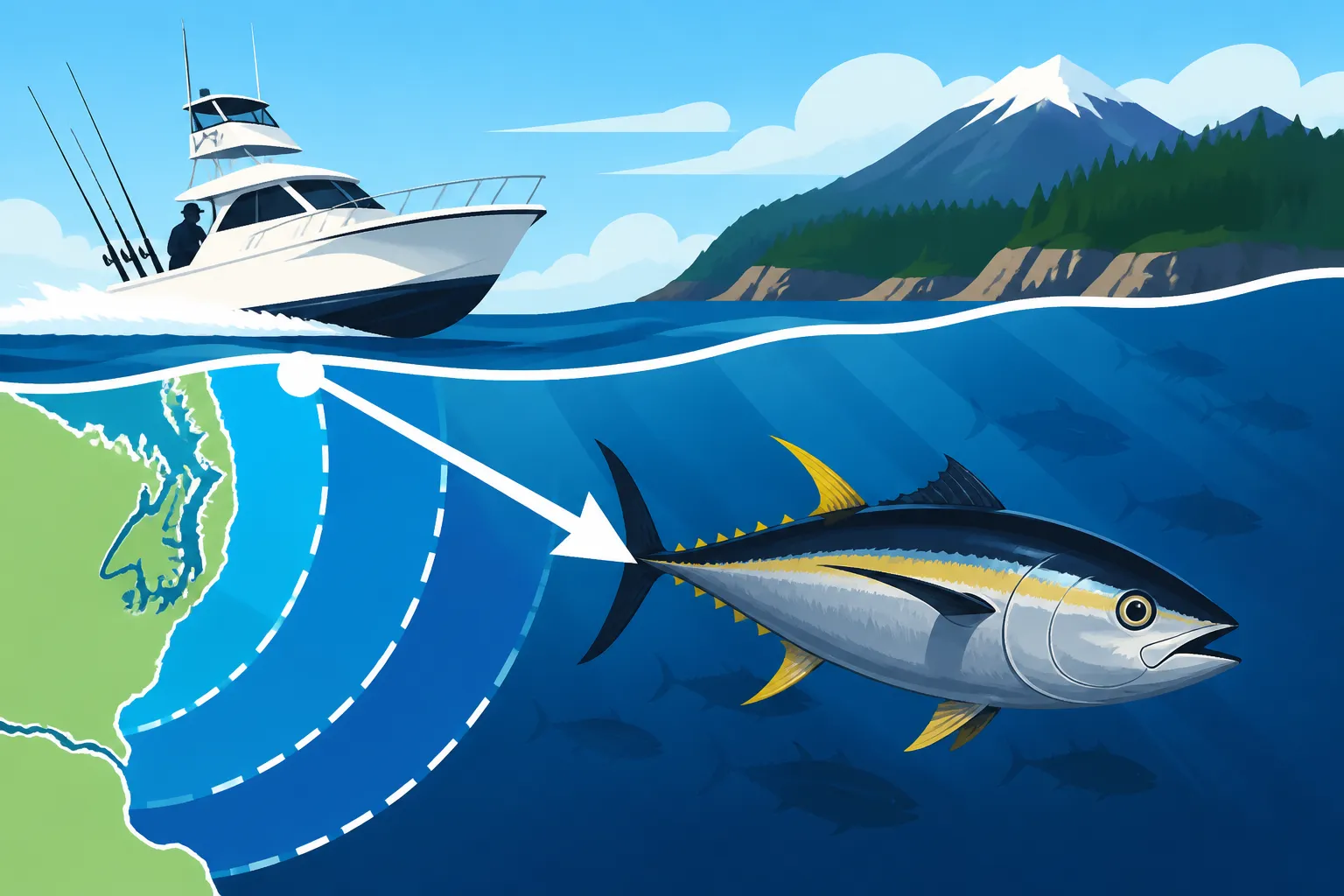
Alright, let's get to the brass tacks: how far out are we really talking? While there's no single, fixed answer, the general range for finding albacore tuna off the Washington coast typically starts around 20-30 miles offshore, extending out to 60-80 miles, and sometimes even beyond 100 miles.
This is a significant commitment in terms of fuel, time, and safety. It's not like running out to a buoy in Puget Sound for salmon. You're entering a different realm of fishing, one that demands robust boats, proper safety equipment, and a keen eye on the weather forecast. The "edge" of the continental shelf, where the ocean floor drops off dramatically, is often a hotspot, and that shelf can be anywhere from 30 to 60 miles out, depending on your departure point along the coast.
Seasonal Variations in Distance
The offshore distance for albacore isn't static; it shifts throughout their migration season. Early in the season, typically in late June and July, when the first waves of tuna push north, they might be found further offshore, perhaps 50-80 miles out, as they seek those warmer, stable ocean currents. They're still on their big northern push from warmer waters.
As the season progresses into August and September, and the Pacific high-pressure system strengthens, often pushing warmer water closer to the coast, we sometimes see tuna within 20-40 miles of shore. This is often when the bite gets really hot and accessible for more boats. However, a strong upwelling event, where cold, deep water rises to the surface, can quickly push them back out again. So, it's a dynamic game, and you need to be prepared for variability. If you're considering a charter, checking out Westport, Washington Halibut and Tuna Charters or Booking a Charter for Albacore Tuna might give you insights into typical ranges.
Examples from Washington Ports
Let's look at a couple of Washington's primary offshore fishing ports to give you a more concrete idea:
- Westport: From Westport, one of Washington's busiest charter ports for offshore trips, you can expect to run anywhere from 30 to 70 miles to reach productive albacore grounds. On a really good year with strong warm water pushes, they might be closer, even as little as 20 miles. But you should always plan for a longer run. The journey past Grays Harbor bar alone can take some time before you even clear the coastal stretch.
- Ilwaco/Columbia River Mouth: Similar to Westport, trips out of Ilwaco, near the mouth of the Columbia River, will often involve runs of 30-70 miles. Sometimes, early season fish might be found even further south and west of the mouth, requiring a substantial run to intercept them.
These distances mean significant travel time, typically 2-4 hours one-way to the fishing grounds, even in a fast boat. This is why many trips start well before dawn.
Here’s a general idea of typical ranges:
| Departure Port | Early Season (June-July) | Mid-Season (Aug-Sept) | Late Season (Oct) |
|---|---|---|---|
| Westport | 50-80+ miles offshore | 30-70 miles offshore | 20-60 miles offshore (weather dependent) |
| Ilwaco | 50-90+ miles offshore | 30-80 miles offshore | 20-70 miles offshore (weather dependent) |
| Neah Bay / Sekiu | Generally less consistent, but can be 60-100+ miles offshore | Potentially 50-80 miles, but highly variable | Rare, very far offshore if present |
Note: These are general ranges and can vary wildly based on ocean conditions year to year, and even day to day.
Factors Influencing Tuna Location Day-to-Day
Knowing the general distances is one thing, but pinpointing exactly where the albacore are on any given day is the real challenge. It's a dynamic puzzle that seasoned captains and successful private boaters work constantly to solve. The ocean is a vast and ever-changing place, and several key factors dictate where those elusive tuna will be.
Ignoring these daily changes is a sure-fire way to spend a lot of fuel and time without a single bite. This is where understanding the science of the ocean truly pays off, turning a blind search into a strategic hunt.
Water Temperature Breaks
As mentioned, temperature is paramount. Albacore are often found along "breaks" where warmer water meets cooler water. A difference of even a few degrees can concentrate baitfish and, consequently, tuna. These aren't always sharp lines visible on the surface; sometimes they are subtle thermal gradients.
Anglers use satellite sea surface temperature (SST) charts to identify these breaks before heading out. They look for areas where the isotherms (lines connecting points of equal temperature) are tightly packed or show significant changes. Many online services provide this data, sometimes with a small subscription fee, but they are invaluable. Without this kind of intel, you're essentially looking for a needle in a haystack, or rather, a school of tuna in an ocean of water that's either too hot or too cold for them.
Baitfish Concentrations
You've heard the saying "find the bait, find the fish." This couldn't be truer for albacore tuna. These torpedoes of the sea are constantly on the move, chasing down schools of anchovies, sardines, squid, and other small forage fish. When you find large concentrations of bait, especially bait that's acting skittish or getting pushed to the surface, you're likely in the strike zone.
Look for signs of feeding activity: diving birds, especially shearwaters and gulls, are often a dead giveaway. They're feeding on the same baitfish that the tuna are pushing up from below. Similarly, looking for "foaming" water or disturbances on the surface can indicate a feeding frenzy. While you're trolling, keep a sharp eye on your fish finder, too; dense schools of bait will show up as significant marks. Having a quality fish finder is almost as important as the boat itself for this type of fishing.
Current Lines and Ocean Eddies
Ocean currents play a massive role in concentrating both bait and tuna. Upwellings, where nutrient-rich cold water rises to the surface, can create biological hotspots. Strong currents can also form eddies, which are circulating masses of water. The edges of these eddies, where different water masses collide, are often prime real estate for albacore.
These current lines can sometimes be visible as a distinct change in water color, clarity, or even a line of debris on the surface. Debris lines, in particular, often hold baitfish seeking shelter and cover, which then attracts tuna. Paying attention to what the ocean is doing – the color, the temperature, the birds, the bait – is far more effective than just blindly heading a certain number of miles out. Every piece of information helps you refine your search.
Preparing for an Offshore Albacore Trip
Venturing far offshore for albacore is not a decision to be taken lightly. These aren't casual day trips; they require serious preparation, the right boat, and a keen focus on safety. The ocean off Washington can be unforgiving, and being 50+ miles from shore means you need to be self-sufficient and well-equipped for any eventuality. Don't let the excitement of the catch overshadow the importance of thorough planning.
A successful and safe trip is built on preparation, not just luck. For more general advice, you might check What to Check Before a Washington Halibut Trip Offshore as much of the preparation is similar.
The Right Vessel and Its Range
First and foremost, you need a boat capable of safely making long offshore runs. This means a vessel that can handle varying sea conditions, has redundant systems, and, crucially, has the fuel capacity to get you to the fishing grounds and back, with a significant reserve. It's not uncommon for boats to carry extra fuel in bladders or auxiliary tanks for these trips. Calculate your fuel burn carefully, considering potential rough seas and a longer-than-expected run to find fish.
A reliable engine (or twin engines for true redundancy) is non-negotiable. Regular maintenance is key. Your vessel should also be equipped with proper navigation electronics, including a reliable GPS chartplotter and a quality fish finder. You'll be relying on these heavily to find your way and locate fish.
Essential Safety Gear
Given the distances involved, offshore safety gear goes beyond the basics. You absolutely need:
- VHF Radio: For ship-to-shore and ship-to-ship communication. A good quality, high-power unit is essential.
- Satellite Communication Device: A satellite phone or a device like a Garmin InReach or Spot device is highly recommended for communication beyond VHF range, especially in an emergency.
- EPIRB or PLB: An Emergency Position Indicating Radio Beacon (EPIRB) or Personal Locator Beacon (PLB) is crucial. These devices transmit distress signals that can be picked up by search and rescue forces, providing your exact location.
- Life Raft: While not legally required for all recreational boats, if you're going 50+ miles offshore, a properly serviced life raft is a very smart investment.
- Flares, First Aid Kit, PFDs (Life Jackets): These are standard, but ensure they are current, well-stocked, and easily accessible.
- Sea Anchor/Drogue: Can be invaluable in rough seas or if you lose power.
- Spare Parts & Tools: Basic engine spares, tools for common repairs, extra line, etc.
Thinking through worst-case scenarios and having the gear to handle them is just being a responsible captain. On Amazon, you can find many of these safety items, from first aid kits to personal locator beacons, to help ensure you're prepared.
Navigation and Communication
While your GPS chartplotter will be your primary navigation tool, always have a backup. A handheld GPS and paper charts are sensible redundancies. Knowing how to read a chart and navigate without electronics is a skill that could save your life if electronics fail.
For communication, beyond the VHF and satellite devices, make sure someone on shore knows your float plan: where you're going, your estimated return time, and who is with you. Cell service drops off very quickly once you're a few miles offshore, so don't count on it for emergencies. Having a reliable means to call for help or simply check in is peace of mind for both you and those back home. Many captains also utilize marine weather forecasting services that provide detailed offshore forecasts, which are crucial for planning your trip and making decisions while out there. A lot of anglers rely on specific weather apps or websites, and some even get their marine-grade binoculars or waterproof cases for their phones on Amazon to keep their communication devices safe.
Recommended Gear and Tackle
Trolling is the most common and effective method for albacore off Washington, so you'll need the appropriate gear. This means robust trolling rods and reels capable of handling powerful, fast-running fish. A good quality level-wind reel spooled with strong braided line and a fluorocarbon leader is standard.
Lures typically include brightly colored plastic squids, cedar plugs, and diving plugs. Have a variety of colors and sizes. Don't forget a gaff (a sturdy one!) for bringing those tuna into the boat, and a large cooler or fish bag to keep your catch on ice immediately. Tuna spoil quickly in the sun, so bringing plenty of ice is critical for quality. For a full breakdown of gear, you might also find value in How Far Offshore to Troll for Washington Albacore Tuna. Many anglers stock up on their favorite lures, hooks, and line through online retailers like Amazon before heading out on a trip.
Disclaimer
This article is for general informational purposes only and does not constitute professional advice. Laws, prices and regulations vary by location and change over time. Consult a qualified professional for guidance on your specific situation.