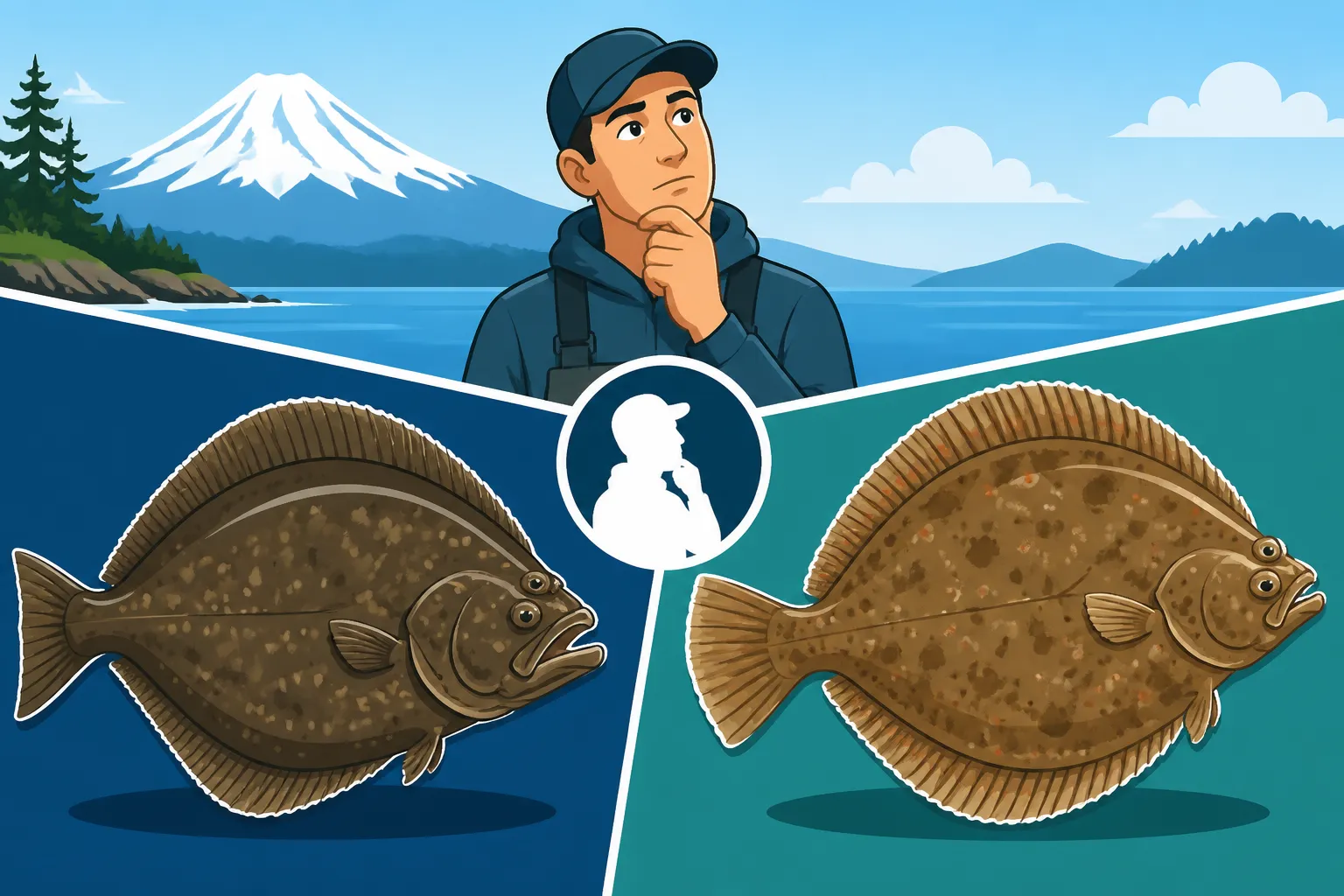
How to Tell a Halibut From a Flounder
There’s nothing quite like the thrill of feeling a strong tug on your line when you’re bottom fishing in Washington waters, but for many anglers, especially those new to the game, a common moment of confusion follows: Is this a halibut or a flounder? These two flatfish can look deceptively similar at first glance, leading to uncertainty and, sometimes, incorrect identification. This guide is here to clear up that mystery, helping you confidently distinguish between a Pacific Halibut and its numerous flounder cousins, ensuring you stay within regulations and truly appreciate your catch.
The Peculiar Anatomy of Flatfish: What Even Is a Flatfish?
Before we dive into the nitty-gritty of telling them apart, let's talk about what makes both halibut and flounder so unique in the first place. They both belong to a fascinating group of fish known as flatfish, and their anatomy is quite literally a marvel of evolution.
The Peculiar Anatomy of Flatfish
Imagine a fish that starts its life swimming upright, just like a salmon or a trout, with an eye on each side of its head. Now, picture that fish gradually transforming, with one eye migrating over its forehead to join the other on one side of its body. Its mouth twists, its bones restructure, and it flattens out to spend its life lying on the seafloor. That, in a nutshell, is the incredible journey every flatfish, whether a massive halibut or a small sand dab, undergoes. They are born symmetrical, but as they mature, they undergo metamorphosis, adapting perfectly for a bottom-dwelling existence.
This radical shift in their physical structure allows them to be masters of camouflage and ambush predation. By lying flat on the ocean floor, often partially buried in sand or mud, they become almost invisible to both prey and predators alike. Their flattened bodies present a minimal profile, and their top side is typically camouflaged to blend in with the substrate, while their underside remains unpigmented, usually white or pale. It’s a brilliant survival strategy, but it’s also what makes them a little tricky to identify quickly.
Why the Confusion? Shared Habits and Habitats
The reason so many anglers get these two mixed up is completely understandable. Both halibut and flounder are bottom-dwelling predators that share similar marine environments throughout Washington's diverse waters. You might find a flounder scuttling across a sandy flat in Puget Sound, and not far away, a younger halibut might be doing the exact same thing. Their general "flatness" and propensity for hanging out on the bottom create an immediate, superficial resemblance.
They often feed on similar things too, especially when smaller. Crabs, shrimp, worms, and small baitfish are on the menu for both. When you pull up a small flatfish from the depths, especially in areas where both thrive, that initial moment of "what have I got here?" is perfectly natural. It's only when you start looking closer at the specific, defining characteristics that their differences truly come into focus. Their shared lifestyle and general body plan are the root of the confusion, but thankfully, nature has given us some clear markers to differentiate them.
Key Distinctions: Eyes, Mouth, and Body Shape
When trying to figure out if you’ve got a halibut or a flounder on your line, there are three primary features that are usually the most telling: the placement of their eyes, the size and shape of their mouth, and their overall body build. These are your go-to indicators for a quick and accurate ID.
Eye Placement: The Ultimate Giveaway
This is hands down the most consistent and definitive characteristic when trying to distinguish between a Pacific Halibut and most common flounders you'll encounter in Washington. Halibut are, almost without exception, right-eyed. What does that mean? If you hold the fish with its unpigmented (white) side facing down, and its head pointing away from you, both of its eyes will be on the right side of its head. The dark, camouflaged side will be on top, and its eyes will be looking up and to the right. To clarify this, if you lay the fish on its white side, its eyes will be looking up. If you then turn the fish so its dark side is facing up, its mouth will be pointing to the right, and both eyes will be on the right side of the head. This trait is consistent for all Pacific Halibut. For more detail on this specific feature, you might find Which Side a Halibut's Eyes Are On helpful.
Flounder, on the other hand, are a mixed bag when it comes to eye placement. While some species are right-eyed, many common flounders in Washington, such as the Starry Flounder, are left-eyed. Using the same method of holding the fish (white side down, head pointing away), their eyes would be on the left side of their head. So, if you catch a flatfish and its eyes are clearly on the left side, you can be fairly certain you've got a type of flounder, and not a Pacific Halibut. This is often the first and most reliable diagnostic feature to check.
Jaw and Mouth Size: Predator vs. Forager
Another crucial difference lies in their mouths, which are perfectly adapted to their primary diets. The Pacific Halibut is a top-tier predatory fish, and its mouth reflects this. It possesses a very large, gaping mouth that extends well past the middle of its eye, often reaching back to the rear edge of the eye or even beyond. This substantial maw is lined with numerous sharp, conical teeth, perfectly designed for engulfing and holding onto larger prey like other fish (cod, hake, rockfish), octopus, and squid. When you look at a halibut's mouth, you see a powerful, efficient eating machine.
Flounders generally have much smaller, more delicate mouths. Their jaws typically do not extend past the front edge of their eye, and often barely reach the pupil. Their teeth are usually smaller, blunter, and more suited for picking up benthic invertebrates such—worms, small crustaceans, and clams—from the seafloor, rather than actively pursuing and swallowing large prey. While some flounder species will eat small fish, their overall mouth structure signals a more generalized diet focused on foraging. So, a quick glance at the size of the mouth relative to the eye can give you another strong clue.
Overall Body Shape and Size
While both are flat, there's a significant difference in their overall physique, especially as they grow. Pacific Halibut are known for their impressive size and robust build. They have a thicker, more elongated oval to diamond-shaped body that is quite broad and muscular. Even younger halibut tend to be thicker and more substantial than a comparably sized flounder. When you consider their potential, How Big Pacific Halibut Get Off Washington is truly remarkable; they can grow to be massive, weighing hundreds of pounds and reaching lengths of eight feet or more. A mature halibut will feel incredibly heavy and stout.
Flounder, on the other hand, are typically much thinner and less robust. Their bodies are usually more rounded or broadly oval, and they rarely achieve the imposing dimensions of a halibut. While some flounder species can reach a decent size, a 10-pound flounder is considered quite large, and most are significantly smaller. They generally have a more delicate bone structure and a flatter profile. If you've caught something that feels exceptionally heavy and thick for its length, you're likely holding a halibut, whereas a lighter, thinner flatfish points towards a flounder.
Coloration, Fin Structure, and Scale Texture
Beyond the primary indicators of eyes, mouth, and body, subtle differences in coloration, the shape of their fins, and even the texture of their scales can help cement your identification. These are often secondary checks but can be quite reliable.
Color and Pattern: Camouflage Cues
Both halibut and flounder employ camouflage to blend with their surroundings, but their specific patterns differ. Pacific Halibut are typically quite uniform in their dorsal (top) coloration. They range from a dark brown to an olive green, sometimes with subtle mottling, but generally, the color is consistent across their entire top side. The ventral (bottom) side is almost always a stark, pure white, with a very clean, distinct line separating the dark top from the white bottom. There's a minimal transition zone; it's a clear cut.
Flounder species tend to exhibit a much wider variety of camouflage patterns, often with more distinct spots, bars, or intricate mottling to match very specific bottom environments. For instance, the Starry Flounder, a common catch in Washington, gets its name from prominent, star-like rough spots and often has alternating dark and light bands on its fins. Other flounders might have more pronounced splotches or even faint stripes. Furthermore, the unpigmented underside of some flounder species might not be pure white; it can sometimes have hints of yellow, gray, or even a few darker spots, and the transition from dark to light on their sides might be more gradual or irregular. Keeping a good fish identification guide, perhaps one you ordered from Amazon, can be incredibly helpful here.
Tail Fin Shape and Lateral Line
The tail fin (caudal fin) and the lateral line (a sensory organ running along the side of the fish) also offer clues. A Pacific Halibut's tail fin is usually quite powerful, often straight across or slightly crescent-shaped, built for strong bursts of speed to ambush prey or evade predators. It's not typically rounded. Furthermore, if you look closely at a halibut, its lateral line has a very distinct and pronounced high arch that curves sharply upward over its pectoral (side) fin. This arch is a very reliable characteristic.
Many flounder species, by contrast, often have a tail fin that is more rounded, tapered, or even pointed. Their tail fins are generally less formidable than a halibut's, reflecting their often slower, more scuttling mode of movement. The lateral line on most flounders is usually straighter or has a much less dramatic arch, sometimes a gentle curve but nothing as sharply defined as the halibut's prominent arch. Observing these finer details can often be the final confirmation you need for a positive identification.
Scale Texture and Slime Coat
While not always immediately obvious, the texture of a fish's skin and scales can also provide a hint. Pacific Halibut generally have fairly small, smooth scales, and their skin doesn't feel overly slimy to the touch. When you run your hand along their body (from tail to head, against the grain), you'll feel a slight roughness from the scales, but it's not abrasive.
Flounder species exhibit a greater variation in scale texture. Some, like the aforementioned Starry Flounder, can have quite rough, almost sandpaper-like scales, especially on their pigmented side. Others might be smoother. What's often noticeable with many flounders, however, is a thicker, more pervasive slime coat. This protective layer can make them feel quite slippery when handled. While not a foolproof method on its own, when combined with other features, the tactile experience can contribute to your overall assessment.
Practical Identification for Washington Anglers
For those of us hitting the waters in Washington, accurate identification isn't just a matter of curiosity; it's crucial for compliance with fishing regulations and ensuring the sustainability of our fisheries.
When to Pay Close Attention: Size and Depth
One of the most practical pieces of advice is to consider the size of the flatfish you've caught and the depth from which it came. If you've just reeled in a flatfish that's only a few pounds and was caught in relatively shallow water (say, under 100 feet), it's far more likely to be a flounder. There are many species of flounder that thrive in shallower, nearshore environments. However, if you've hooked into something substantial—a fish that feels like it could pull you overboard, coming from 200, 300, or even 500 feet down—you've got a much higher chance of having a halibut on the end of your line. Pacific Halibut Fishing on the Washington Coast is typically a deep-water endeavor.
Always remember that regulations, including size limits, bag limits, and seasons, are dramatically different for Pacific Halibut compared to most flounder species. Washington Fishing Regulations Every Angler Should Know are very specific, and mistaking a small halibut for a flounder could lead to serious consequences, including Fines and Penalties for Common Fishing Violations. When in doubt, it’s always better to assume it might be a halibut and carefully check all the identifying features.
Common Washington Flounder Species to Know
While this guide focuses on distinguishing halibut from flounder generally, it's good to be aware of some of the more common flounder species you might encounter in Washington. Knowing a few of these by name can help you recognize characteristics common to flounders.
- Starry Flounder: A very distinctive flounder with rough, star-like scales and often dark bands on its fins. They are left-eyed.
- Dover Sole: A relatively large flounder with a soft body, typically uniform dark brown on top, found in deeper waters. They are right-eyed.
- Petrale Sole: Another popular food fish, known for its smooth skin and light brown color. Also right-eyed.
- Sand Dab: Smaller, thin-bodied flounders with mottled brown coloration, commonly found on sandy bottoms.
Each of these, and many others, will still share the fundamental flounder characteristics that set them apart from halibut: generally smaller mouths, thinner bodies, and varied eye placement. While all are good to know, your primary goal is the halibut vs. flounder distinction.
Double-Checking Your Catch: Tools and Resources
In the moment of excitement, it can be tough to remember every detail. That’s why having resources at your fingertips is invaluable.
First, consider carrying a waterproof fish identification guide. There are many excellent regional guides available that specifically cover Pacific Northwest species, often with clear photos and diagrams highlighting key features. You can often find a great selection of these on Amazon, making it easy to grab one before your next trip. Having it right there with you allows for a quick visual comparison, especially for subtleties like fin shape or color patterns.
Secondly, the Washington Department of Fish and Wildlife (WDFW) website and their excellent Fish Washington app are indispensable tools. The app, available for smartphones, allows you to look up regulations and, often, species identification right on the water. Does Washington Have a Mobile Fishing License App? provides more information on how to use this valuable resource. Before you head out, familiarize yourself with the current regulations for both halibut and various flounder species in your intended fishing area. Regulations can change, and staying informed is key.
Finally, if you're truly uncertain, especially with a fish that might be a small halibut, take a few quick photos from different angles (top, bottom, head close-up showing eyes and mouth) before deciding whether to keep or release it. This allows you to consult with more experienced anglers or online resources later, and it can also serve as proof if ever questioned. The bottom line is: when in doubt, release the fish carefully. It’s better to be safe than sorry, ensuring you’re always adhering to the rules and doing your part for conservation.
Disclaimer
This article is for general informational purposes only and does not constitute professional advice. Laws, prices and regulations vary by location and change over time. Consult a qualified professional for guidance on your specific situation.