How to Identify Coho Salmon in Washington’s Puget Sound
It's a common dilemma many Washington anglers face: you've got a salmon on the line, and as it gets closer to the boat or the bank, a flicker of doubt creeps in. Is it a keeper Chinook, or that feisty Coho you've been hoping for? Identifying Coho salmon, especially when they're fresh out of the ocean and still silvery, can be tricky business, but knowing the distinct markers is crucial for staying within regulations and properly enjoying your catch. This guide will walk you through the precise characteristics to help you confidently identify Coho salmon in Washington's Puget Sound and surrounding waters.
The Basics: What is a Coho Salmon?
Before we dive into the nitty-gritty of identification, let's establish a foundational understanding of the Coho salmon itself. Known scientifically as Oncorhynchus kisutch, Coho are often affectionately called "silver salmon" due to their brilliant chrome appearance when fresh from the saltwater. They're a favorite among anglers for their acrobatic fights and delicious, orange-red flesh.
Coho salmon have a fascinating life cycle, starting in freshwater streams where they spend their first year or two before migrating to the ocean. They then spend about a year and a half growing and maturing in marine environments, often traveling considerable distances, before returning to their natal rivers and streams to spawn. In Washington, particularly in areas like Puget Sound, these runs provide incredible fishing opportunities, but they also bring with them the challenge of distinguishing them from other salmon species that might be present in the same waters at similar times. Understanding this basic biology helps put their physical traits into context.
The Lifecycle of a Puget Sound Coho
A Puget Sound Coho's journey is truly remarkable. After hatching from eggs laid in gravel beds, juvenile Coho, known as parr, spend their early lives in the freshwater tributaries, feeding on insects and growing. This freshwater rearing period is vital for their survival and contributes to their robust nature. As they mature into smolts, their bodies undergo physiological changes, preparing them for the saltwater environment.
Once they migrate to Puget Sound, the Strait of Juan de Fuca, and out to the Pacific, they feed voraciously, gaining significant size and strength. During this ocean phase, their bodies are streamlined and covered in reflective scales, perfectly adapted for life in the open water. When the time comes, typically in late summer and fall, they begin their arduous migration back to their spawning grounds, transforming both internally and externally as they transition back to freshwater and prepare to reproduce. These transformations are key to understanding why their appearance can vary so much, especially when comparing an ocean-caught fish to one caught further upriver.
Key Physical Characteristics for Identification
When you're trying to identify a Coho salmon, you need to become a detective. Look beyond the initial flash and pay close attention to specific details that set them apart. These characteristics are consistent enough to be reliable, even when dealing with fish that might be slightly discolored or stressed. The key is to examine several features in combination, rather than relying on just one.
Tail Fin and Spotting Patterns
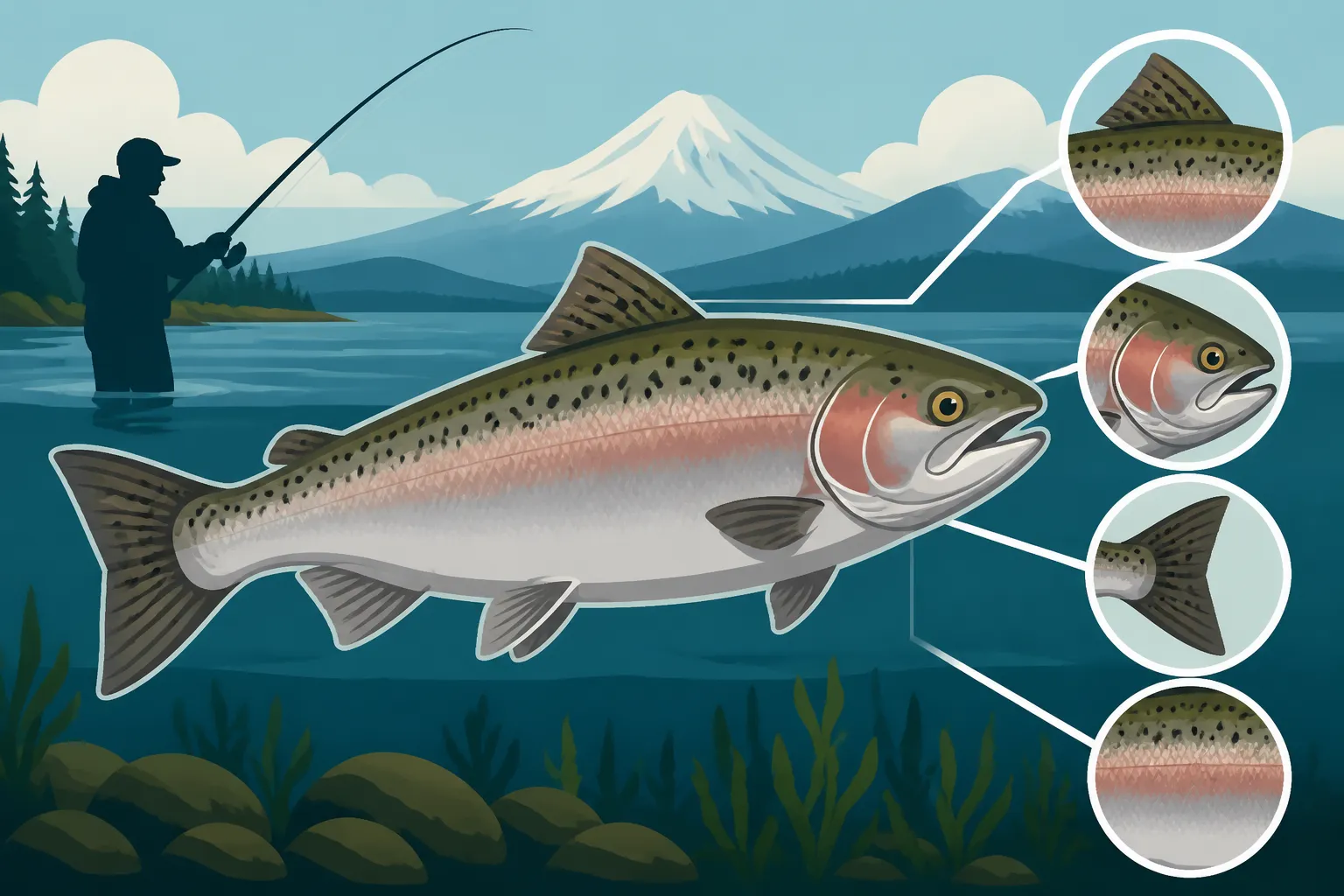
One of the most telling features of a Coho salmon, especially when compared to a Chinook, is its tail fin. Coho typically have an all-dark tail fin, or at least a tail fin that lacks the heavy spotting found on a Chinook. While they might have some spots, these are usually limited to the upper lobe of the tail and are much sparser. The overall shape of the tail fin on a Coho is also often described as slightly more forked than the fuller, fan-like tail of a mature Chinook, though this can be subjective depending on the fish.
Beyond the tail, Coho salmon also have spots on their backs. These spots are typically small, irregularly shaped, and primarily located on the upper half of their body, above the lateral line. In contrast, Chinook salmon often have larger, more distinct spots that are present on both the upper and lower halves of their body, extending well below the lateral line, and often including a heavy array of spots on both lobes of the tail fin. This distinction in spotting, particularly on the tail, is a critical identifier.
Mouth, Gums, and Teeth
Another crucial area for identification lies within the fish's mouth. This is often the most definitive way to tell a Coho from a Chinook. When you open a Coho's mouth, you'll typically see that the gum line along the base of the lower teeth is white or very light in color. It might have some gray or dusky areas, but it will lack the solid black gum line that is characteristic of a Chinook salmon.
The teeth of a Coho are also generally smaller and less robust than those of a Chinook. While they still possess sharp teeth, especially those in the front, they don't have the same imposing dental array. Always remember to exercise caution when examining the mouth of any salmon, as even smaller teeth can deliver a nasty cut. A quick, careful peek at the gum line is often all it takes to confirm your suspicions and can be a real game-changer when you're trying to fill out your Washington Catch Record Card.
Body Shape and Coloration
When Coho salmon are fresh from the ocean, they live up to their "silver salmon" moniker. Their bodies are typically slender, sleek, and adorned with bright, iridescent silver scales. This chrome appearance is striking and can be quite beautiful. As they spend more time in freshwater, preparing for spawning, their coloration begins to change dramatically. Their sides often turn a reddish-maroon or brownish-red, and their backs darken significantly. Males, in particular, will develop a pronounced hooked snout, known as a kype, and their bodies become deeper and more compressed, almost slab-sided.
The overall body shape, even in their silvery phase, tends to be more torpedo-like than a Chinook, which often appears bulkier and more powerful, particularly around the head and shoulders. While color can be a tricky indicator because it changes so much with time in freshwater and individual fish variation, the combination of body shape and the progression of color from silver to red is a useful part of the identification puzzle.
Distinguishing Coho from Other Salmon Species
Washington's waters, especially in Puget Sound, are a veritable melting pot of salmon species. This makes accurate identification not just an academic exercise, but a regulatory necessity. Misidentifying a salmon can lead to fines or penalties, so it's vital to know how to pick out a Coho from the crowd. Washington Fishing Regulations Every Angler Should Know are complex, and species identification is at the heart of many rules.
Coho vs. Chinook Salmon
This is perhaps the most common identification challenge for Puget Sound anglers. Both Coho and Chinook can be found in similar areas and can be of comparable size when younger. However, several key differences can help you tell them apart. We've already touched on the most definitive one: gum color. Coho have white or light-colored gums, while Chinook have entirely black gums along the lower jaw. This is almost a foolproof identifier.
Beyond the gums, consider the spotting. As mentioned, Coho usually have small, sparse spots on their back, primarily above the lateral line, and often only on the upper lobe of their tail. Chinook, the Chinook Salmon: Washington's King of Fish, tend to have large, irregular spots covering their entire back and both lobes of their tail fin. Their tails are also typically broader and more squared-off, whereas a Coho's tail can be slightly more forked. Furthermore, Chinook often have a heavier, more robust build compared to the sleeker Coho. It's truly worth studying Chinook vs Coho in Washington: Telling Them Apart to master this distinction.
Coho vs. Chum Salmon
Chum salmon, sometimes called "dog salmon" due to their impressive canine-like teeth during spawning, are less frequently confused with Coho, especially when mature. When fresh from the ocean, Chum can appear silvery, but they lack the distinct spots of a Coho. Their key identifiers are often much more pronounced in their spawning phase.
Spawning Chum develop vertical bars or stripes of green, purple, and red along their sides, a very distinct pattern that no other salmon species exhibits so dramatically. Their teeth also become incredibly prominent. While ocean-fresh Chum might be more challenging, their lack of significant spotting and generally less streamlined profile compared to a Coho are good initial clues. Their overall body shape is also typically thicker and more robust than a Coho, particularly around the midsection.
Coho vs. Pink Salmon
Pink salmon, also known as "humpy" salmon due to the pronounced hump males develop during spawning, are probably the easiest to distinguish from Coho. They are the smallest of the Pacific salmon species, and they have very large, oval-shaped spots on their backs and on both lobes of their tail fins. These spots are much larger and more widely spaced than anything you'd see on a Coho.
Another dead giveaway is their size; Pink salmon rarely exceed 10 pounds, with most being in the 3-5 pound range, whereas Coho can easily exceed that, with larger ones reaching 15-20 pounds or more, as detailed in How Big Washington Coho Salmon Get. Pink salmon also have a much finer scale pattern than Coho, almost appearing scaleless to the casual observer. And of course, the humped back of the spawning male Pink is unmistakable.
Here's a quick comparison table to help differentiate Coho from other common Washington salmon:
| Feature | Coho Salmon | Chinook Salmon | Chum Salmon | Pink Salmon |
|---|---|---|---|---|
| Gum Line | White or light-colored (lower jaw) | Solid black (lower jaw) | White/light, no distinct black | White/light, no distinct black |
| Tail Spots | Small, sparse spots, usually only upper lobe | Heavy, irregular spots on both lobes | Generally unspotted | Large, distinct oval spots on both lobes |
| Body Spots | Small, sparse, mostly above lateral line | Large, irregular spots, above and below lateral line | Generally unspotted, may have faint bars (spawning) | Large, distinct oval spots on back |
| Body Shape | Slender, streamlined, deeper body (spawning male) | Robust, powerful, thick at shoulders | Thick, more cylindrical, deep body (spawning male) | Smaller, thin, pronounced hump (spawning male) |
| Tail Shape | Slightly forked or relatively square | Broad, typically more squared-off | More rounded or slightly forked | Moderately forked |
| Scales | Medium size, prominent silver | Large, heavy scales | Fine scales, appear smooth | Very small scales, feel smooth |
Habitat and Behavior Clues
Beyond the visual cues, understanding where and how Coho salmon behave can also give you hints about their identity. While not definitive on their own, these contextual clues can support your visual assessment and help you narrow down the possibilities. Knowing the right fishing spots and techniques can also boost your chances of finding them, such as Trolling for Salmon in Washington's Puget Sound.
Preferred Puget Sound Waters
Coho salmon in Puget Sound have some preferred haunts. They are often found in the upper layers of the water column, frequently chasing baitfish like herring or anchovies. You'll find them in marine areas with strong currents and baitfish concentrations, such as around points, islands, and river mouths. Marine Area 9, for example, is famous for its Coho fishing during peak season. They tend to be more active and aggressive feeders than some other salmon species, often striking lures or flies with gusto.
While Chinook might hold deeper or closer to structure, Coho are often more nomadic, roaming in search of food. During their freshwater migration, they will hold in pools, riffles, and behind structure, just like other salmon and steelhead, but their aggressive nature often makes them eager to strike a well-presented lure or fly. Familiarizing yourself with When Coho Salmon Run in Washington will also help you target them effectively.
Fight Style on the Line
One of the most thrilling aspects of catching a Coho salmon is their fighting style. They are renowned for their acrobatic jumps and powerful, erratic runs. When you hook a Coho, don't be surprised if it immediately launches itself out of the water, shaking its head violently to try and throw the hook. They are also known for rapid changes in direction and making multiple short, powerful bursts.
This differs somewhat from the more bulldogging, deep-diving fight of a large Chinook salmon, or the often more predictable runs of a steelhead. A Coho's fight is typically characterized by speed, agility, and aerial displays, which is why many anglers specifically target them. Observing how the fish behaves on the end of your line can offer a subtle, but often accurate, clue to its identity before you even see its fins or gums.
Identifying Coho at Different Life Stages
Salmon, including Coho, undergo significant physical changes throughout their lives, especially as they transition from ocean to freshwater for spawning. Recognizing these transformations is key to accurate identification, as a fresh ocean Coho can look quite different from one that has been staging in a river for several weeks.
Ocean-Phase Coho Appearance
When Coho are living in the saltwater, before they've begun their spawning migration, they are truly spectacular specimens. Their bodies are a brilliant, almost mirror-like silver, with a darker, bluish-green back. They are sleek and streamlined, with firm flesh and strong fins. At this stage, their small, sparse spots are most visible on their backs, typically above the lateral line, and on the upper lobe of their tail. Their white gum line is also most pronounced and easy to distinguish.
These ocean-phase Coho are highly sought after by anglers in Puget Sound and along the Washington coast because of their pristine condition and excellent eating quality. Many anglers will try to target them during these early runs, often using methods like trolling with bait or lures, which are effective for active, pelagic feeders. Keeping these vibrant, silver beauties separate from other species is critical for legal compliance. Puget Sound Salmon Closures: What Washington Anglers Need to Know often delineate rules specific to certain species during certain times.
Spawning-Phase Coho Transformations
As Coho salmon enter freshwater and move towards their spawning grounds, their bodies undergo dramatic transformations, often referred to as "spawning coloration." The brilliant silver begins to fade, replaced by shades of red, maroon, and brown on their sides, while their backs become very dark, almost black. Males, in particular, develop a deeply hooked snout, or kype, and their jaws become elongated and filled with larger, more fearsome teeth. Their bodies also become noticeably deeper and more compressed laterally.
Females also change color, though their kypes are less pronounced. Their bodies become swollen with eggs. While these changes make them look quite different from their ocean counterparts, the key identifying features — such as the white gum line (though it may become a bit more dusky with age) and the sparse spotting pattern — generally remain consistent. It’s important to remember these changes and not let the dramatic shift in color and shape throw you off your identification game.
Practical Tips for Anglers
For the angler out on the water, the moment of truth often happens quickly. Having a plan and knowing what to look for can make all the difference between a confident identification and a moment of uncertainty.
What to Look For on the Boat
When you land a fish and bring it aboard, quickly scan for those key identification markers. First, always check the gum line by gently lifting the gill plate and looking at the lower jaw. This is your most reliable "tie-breaker" between Coho and Chinook. Next, examine the tail fin for spotting. Are there heavy spots all over, or just a few small ones on the upper lobe? Then, quickly assess the body spotting – is it sparse and mostly above the lateral line, or does it cover the entire body?
Also, take note of the overall body shape and coloration, understanding that color can vary significantly. If you're fishing a marine area where both Coho and Chinook are prevalent, like many spots in Puget Sound, this quick checklist becomes second nature. Many experienced anglers keep a laminated guide or even a small book of regulations easily accessible on their boat. Carrying Your Washington Fishing License: Paper, Phone or the MyWDFW App also applies to having handy reference materials.
Tools and Resources for Better Identification
While your eyes and knowledge are your primary tools, a few items can assist you. A good quality camera on your phone can capture details for later review if you're truly stumped (though you must make an identification before deciding to keep or release). A fish measuring tape, like those often available on Amazon or at local tackle shops, can help gauge size, which can sometimes provide clues.
Perhaps the most critical resource is the official Washington Department of Fish and Wildlife (WDFW) fishing regulations pamphlet. This document, updated annually and often with emergency rule changes, contains detailed illustrations and descriptions of each salmon species, alongside all relevant rules. Knowing Washington Sport Fishing Seasons and Emergency Closures is paramount, as different seasons and areas have different rules for different species. It's truly your Bible on the water. Make sure you understand Reading the Washington Sport Fishing Regulations Pamphlet thoroughly.
Catch and Release Considerations
Sometimes, despite your best efforts, you might accidentally catch a species you didn't intend to, or one that is outside the legal size or retention limits for Coho. In such cases, quick and responsible catch and release is paramount to the fish's survival. Have a pair of long-nosed pliers or a de-hooking tool ready to remove hooks cleanly. Avoid handling the fish unnecessarily, especially touching its sensitive slime coat. If you must handle it, do so with wet hands and support its body horizontally.
Understanding the difference between wild and hatchery fish can also be critical, as many areas have retention rules specific to hatchery-origin salmon, often identified by a missing adipose fin (a small fleshy fin on their back). If you're unsure, or if the fish is prohibited for retention, release it as quickly and gently as possible. This practice helps conserve fish populations and ensures future fishing opportunities for everyone.
Disclaimer
This article is for general informational purposes only and does not constitute professional advice. Laws, prices and regulations vary by location and change over time. Consult a qualified professional for guidance on your specific situation.