How to Fish a Slow-Moving Pool for Steelhead
We often picture steelhead fishing as a high-octane battle against powerful fish in raging currents, where heavy gear and aggressive presentations are the norm. But what happens when you encounter those tantalizing, slow-moving pools or backwaters that look absolutely perfect but don't seem to hold fish, or at least not the ones biting? It can be incredibly frustrating to see prime water go untouched because your usual tactics just aren't cutting it. This guide is all about equipping you with the knowledge and techniques to unlock the secrets of these slower sections and successfully fish for steelhead where the current barely whispers.
Understanding the Steelhead's Behavior in Slow Water
Steelhead are incredible fish, adapting their behavior and holding patterns based on countless factors, with current speed being a major one. When the water slows down, their priorities shift, and so must our approach as anglers. Ignoring these changes means missing out on potential hook-ups.
Why Steelhead Hold in Slow Pools
It’s easy to assume steelhead only hang out in the fast, oxygen-rich riffles, but that's not always the case, especially in certain conditions or at specific times of the year. Steelhead will often use slower pools for several reasons. Firstly, they offer a reprieve from the constant battle against strong currents, conserving energy. This is particularly true for fish that have been in the river for a while, perhaps waiting for water conditions to improve or for their spawning window to open. These deep, calm areas provide a safe haven where they can rest and recover without expending precious energy. Think of it as their living room – a comfortable, low-effort place to just be.
Furthermore, slow pools can offer thermal refuge during colder temperatures. Slower moving water often retains heat better than fast water, making it a more comfortable spot for steelhead when river temperatures drop. Conversely, in the heat of summer (though we rarely target steelhead during high summer temps in Washington rivers, this applies to resident trout), deeper, slower pools can provide cooler, more stable temperatures. These pools also provide excellent cover from predators, both avian and terrestrial. The deeper water offers concealment, and the lack of strong current means they don't have to fight to stay hidden. You'll often find them tucked against structure like submerged logs, large boulders, or under cut banks, using the slow current to their advantage to remain out of sight.
Reading the Water: Identifying Key Holding Lies
Just because a pool is slow doesn't mean steelhead are scattered indiscriminately throughout it. You still need to be a savvy water reader. When you're looking at a slower pool, scan for anything that breaks the current or offers depth and cover. The "seams" are crucial, even in slow water. Look for subtle current differentials, where the slightly faster main flow meets the calmer edge. Steelhead will often hold in these seams, allowing food to drift by with minimal effort.
Deep pockets, especially those created by fallen trees, large rocks, or changes in the riverbed contour, are prime targets. Undercut banks are classic steelhead lies, providing overhead cover and a dark, secure feeling. Look for subtle disturbances on the surface, which might indicate submerged structure. Sometimes, a slow pool will have a "tailout" that gradually shallows and speeds up, or a "head" where faster water pours in and then dissipates. The transition zones at the very head and tail of these pools can be incredibly productive, as fish move into and out of them. Pay attention to how the light hits the water, as shadows cast by trees or bankside vegetation can also create appealing cover. Mastering the art of reading water is essential for any angler, and it's no different when approaching a slow-moving pool for steelhead.
Gear and Tackle for Slow-Moving Pools
Fishing slower water effectively requires a subtle shift in your gear choices compared to bombing heavy weights through rapids. The goal is finesse, stealth, and a natural presentation. You need tackle that allows you to deliver your offering gently and detect the most delicate of bites.
Rod, Reel, and Line Selection
For slow-moving pools, a longer, more sensitive rod is often your best friend. A rod in the 9 to 11-foot range, with a medium-light to medium action, will give you better line control for long, drag-free drifts and help cushion light leaders. Think about how a longer rod helps keep more line off the water, reducing drag – this is paramount in slow, clear conditions. When looking at options on Amazon or your local tackle shop, consider rods designed for float fishing or even some lighter salmon rods that have a softer tip.
Your reel choice depends on your preferred technique. For traditional drift fishing or float fishing, a good quality spinning reel or a centerpin reel (if you're into that game, and many Washington steelhead anglers are!) is ideal. The key is a smooth drag and the ability to cast light presentations. Match your reel with a mainline that's relatively thin but strong. A high-visibility braided line around 20-30 lb test, backed by a fluorocarbon leader of 8-12 lb test, is a common setup. The braid offers sensitivity and castability, while the fluorocarbon leader provides invisibility and abrasion resistance. Remember, in slower, clearer water, fish have more time to inspect your offering, so line shyness can be a real issue. For more general guidance, check out our piece on the right line weight for Washington Steelhead.
Terminal Tackle: Adapting for Subtlety
This is where your finesse truly comes into play. Heavy lead weights and bright, flashy gear that works in fast, turbid water can be a massive turn-off in a slow, clear pool. You want to downsize and lighten up.
- Weights: Instead of large cannonball sinkers, opt for smaller split shot, slinky weights, or pencil lead. The goal is just enough weight to get your bait or lure to the desired depth without hindering its natural drift. You might even use no weight at all if the current is slow enough and your presentation is light enough.
- Floats/Bobbers: If float fishing, choose a float that is sensitive and appropriately weighted for your bait and the minimal current. A Drennan Puddle Chucker or a Raven float, available through retailers like
Amazon, can be excellent choices as they are designed for subtlety. The float should stand upright with minimal resistance, signaling even the slightest take. - Hooks: Go smaller and sharper. Sizes #4 to #1 are often appropriate for steelhead in slow water, depending on your bait. Barbless hooks are mandatory in many Washington steelhead fisheries, so ensure your hooks comply. A sharp hook means less force is needed for a solid hookset, which is crucial with light leaders.
- Swivels & Leaders: Use small, high-quality barrel or coastlock swivels to prevent line twist. Your leader material should be fluorocarbon, as it's nearly invisible underwater. The length can vary, but generally, a longer leader (3-5 feet) allows for a more natural presentation, especially when choosing a leader length for clear water steelhead in Washington.
Techniques for Slow-Water Steelhead
Fishing slow pools demands patience and precision. You can't just power through with your usual high-current tactics. Here, subtlety, deliberate presentation, and understanding how to keep your offering in the strike zone for as long as possible are key.
The Art of the Slow Drift (Float Fishing)
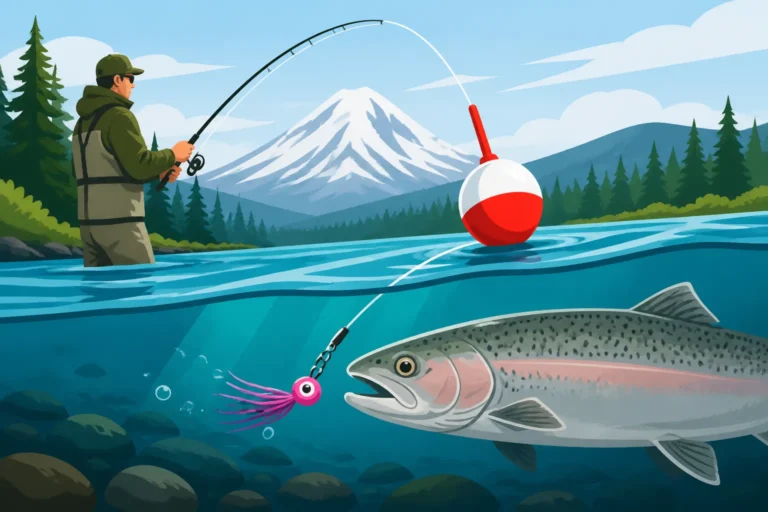
Float fishing, also known as bobber dogging or suspension fishing, is arguably one of the most effective ways to fish a slow pool for steelhead. The idea is to present your bait or lure at a controlled depth, allowing it to drift naturally with the subtle current, much like a piece of dislodged salmon egg or an insect would. This technique works wonders because it keeps your offering in the fish's face for an extended period, giving even lethargic steelhead ample time to decide to strike.
To execute a perfect slow drift, cast upstream of your target area, allowing your float to land gently on the water. Keep your rod tip high, mending your line regularly to prevent drag and ensure your float travels at the same speed as the current. This "drag-free drift" is paramount; any unnatural pulling or speeding up of your float will signal to the fish that something is amiss. As your float drifts over known holding lies – like those deep pockets, logjams, or undercut banks we discussed – be hyper-alert. Steelhead takes in slow water can be incredibly subtle, sometimes just a slight dip or hesitation of the float, or even a slow disappearance. A common setup involves using a slip float rig with a small jig tipped with bait, or a cluster of salmon eggs. When choosing a float, consider models like the Aero Floats found on Amazon, known for their sensitivity. If you're looking to refine your drift fishing skills, our guide on Drift Fishing for Steelhead in Washington Rivers is a great resource.
Bottom Bouncing and Back-Trolling
While often associated with faster water, modified versions of bottom bouncing and back-trolling can be effective in slow pools, particularly when targeting fish holding tight to the bottom or structure.
- Bottom Bouncing: In a slow pool, you'll need significantly less weight than in a faster current. The goal is to tick the bottom occasionally, not drag heavily. Use a slinky weight or a small pencil lead to keep your offering just off the bottom. Cast slightly upstream and across, letting the current carry your gear downstream. Maintain a semi-slack line, feeling for those tell-tale taps that signal bottom contact or a fish. Your bait (roe, worms, or even a small cluster of beads) should be drifting freely, just above the snags. This method is excellent for probing deep channels and depressions within a slow pool where fish are likely to be hunkered down. Learning bottom bouncing for steelhead is a foundation that can be adapted to these slower conditions.
- Back-Trolling: If you're fishing from a boat, back-trolling can be a deadly tactic for slow pools. Instead of moving forward, you use your motor in reverse (or let the current gently push you backwards), slowly presenting lures or baits upstream of the boat. This allows for a very controlled, slow presentation. Small diving plugs, wobblers, or even heavily weighted jigs can be back-trolled effectively. The key is to match your speed to the current (or just slightly slower) to allow your lure to work naturally and remain in the strike zone. This technique is especially good for covering a lot of water in a slow pool, systematically probing different depths and holding lies.
Jigging and Swinging Lures (When to Use)
Jigging and swinging lures are active fishing methods that can entice a strike from an otherwise lethargic steelhead in a slow pool, especially when they are looking for a reactionary bite.
- Jigging: Small, compact jigs, often tipped with a piece of prawn, shrimp, or a scented soft plastic, can be highly effective. The key is to use a light jig head – perhaps 1/8 to 1/4 ounce, depending on depth and current – to allow for a slow, fluttering fall. Cast your jig into a prime lie, let it sink, and then work it with a series of subtle lifts and drops of your rod tip. The idea is to make the jig "dance" enticingly near the bottom or in the mid-column, mimicking an injured baitfish or a drifting invertebrate. Many anglers find the classic Marabou jigs or even small Trout Magnets from
Amazoncan be killers in these situations. This method is particularly effective when fish are holding tight to structure and won't move far to chase a meal. Our guide on How to Fish a Bobber and Jig for Steelhead details how effective this simple setup can be. - Swinging Lures: While more commonly associated with fly fishing or larger spoons in faster water, swinging smaller spoons or spinners can work in slow pools too, especially if there's a slight current to activate the lure. Cast your spoon or spinner across and slightly downstream, then allow it to swing through the current arc. The key is a slow retrieve, just fast enough to get the lure to wobble or spin. The slow, broad swing can often elicit a strike from a steelhead that might ignore a straight retrieve. Opt for smaller, lighter spoons (like a 1/4 or 3/8 oz Little Cleo or a Kastmaster) and spinners (like a #3 or #4 Mepps Aglia or Blue Fox Vibrax). The flash and vibration can be just enough to grab a steelhead's attention in the quiet water.
Presentation and Stealth
In slow, clear water, steelhead are incredibly wary. Every detail of your approach and presentation matters. Forget crashing through the brush or making sloppy casts; here, stealth is non-negotiable.
The Importance of a Natural Presentation
Steelhead in slow pools have more time to scrutinize your offering. They are not in a hurry to grab something that rushes by in a blur. This means your bait or lure needs to look and act as naturally as possible.
- Weighting: As mentioned, use just enough weight to get to the desired depth. Too much weight will make your bait drag unnaturally or plummet to the bottom, signaling an artificial presentation. Too little, and it won't get into the strike zone. It's a delicate balance.
- Line & Leader: Keep your mainline as light as practical and use a long, light fluorocarbon leader. Any glint or unnatural thickness of line can spook fish. The length of your leader allows your bait to drift more freely from your main line, further enhancing the natural look.
- Bait Selection: Natural baits like cured salmon roe, prawns, or sand shrimp are often incredibly effective. If using artificial baits, choose realistic colors and profiles. Scent can also play a huge role; adding Pro-Cure or Mike's Lunker Lotion to your jigs or plastic baits can make a big difference, especially in slow, still water where scent trails linger. The goal is to make your offering irresistible, not suspicious.
Approaching the Pool with Care
Your approach to a slow-moving pool is just as important as your casting technique. These fish are alert, and any disturbance can send them scattering.
- Walk Softly: Avoid heavy footsteps on the bank. Vibrations travel through the ground and into the water, alarming fish.
- Stay Low: Keep a low profile. If you can see the fish, chances are they can see you. Wear drab, natural colors that blend with the surroundings.
- Cast from a Distance: Whenever possible, make long casts to avoid getting too close to the fish. The less disturbance you create near their holding lies, the better your chances.
- Sun Position: Pay attention to the sun. Casting your shadow over the water can immediately put fish down. Try to cast with the sun behind you or to your side.
- First Cast Advantage: Your first cast into a promising lie is often your best. Make it count. Place your offering precisely where you believe a steelhead is holding, with minimal splash. Multiple casts into the same spot can quickly put wary fish on edge.
By paying meticulous attention to these details, you significantly increase your odds of tempting a steelhead from its slow-water sanctuary. Remember, patience and a subtle touch are your most valuable tools when the current takes a breather.
| Technique | Recommended Gear Adjustments | Ideal Conditions | Notes |
|---|---|---|---|
| Slow Float Drift | Long, sensitive rod; sensitive float; light leader; small jig/bait | Slow current; clear to slightly off-color water | Maintain drag-free drift; subtle takes common. |
| Bottom Bouncing | Light slinky/pencil lead; durable leader; natural bait (roe/worm) | Deeper sections of slow pools; slightly turbid water | Keep minimal bottom contact; feel for subtle taps. |
| Back-Trolling | Boat (drift boat/motorized); small diving plugs/wobblers/jigs | Covering large slow pools; targeting specific depths | Match speed to current for natural lure action; excellent for boat anglers. |
| Jigging | Light jig head (1/8-1/4 oz); marabou or plastic jig; scent added | Fish holding tight to structure; lethargic fish | Active presentation with subtle lifts/drops; good for reactionary strikes. |
| Swinging Lures | Small spoons/spinners (1/4-3/8 oz); slow retrieve | Slight current present; fish willing to chase a bit | Cast across/downstream; allow natural swing; minimal retrieve speed. |
Disclaimer
This article is for general informational purposes only and does not constitute professional advice. Laws, prices and regulations vary by location and change over time. Consult a qualified professional for guidance on your specific situation.