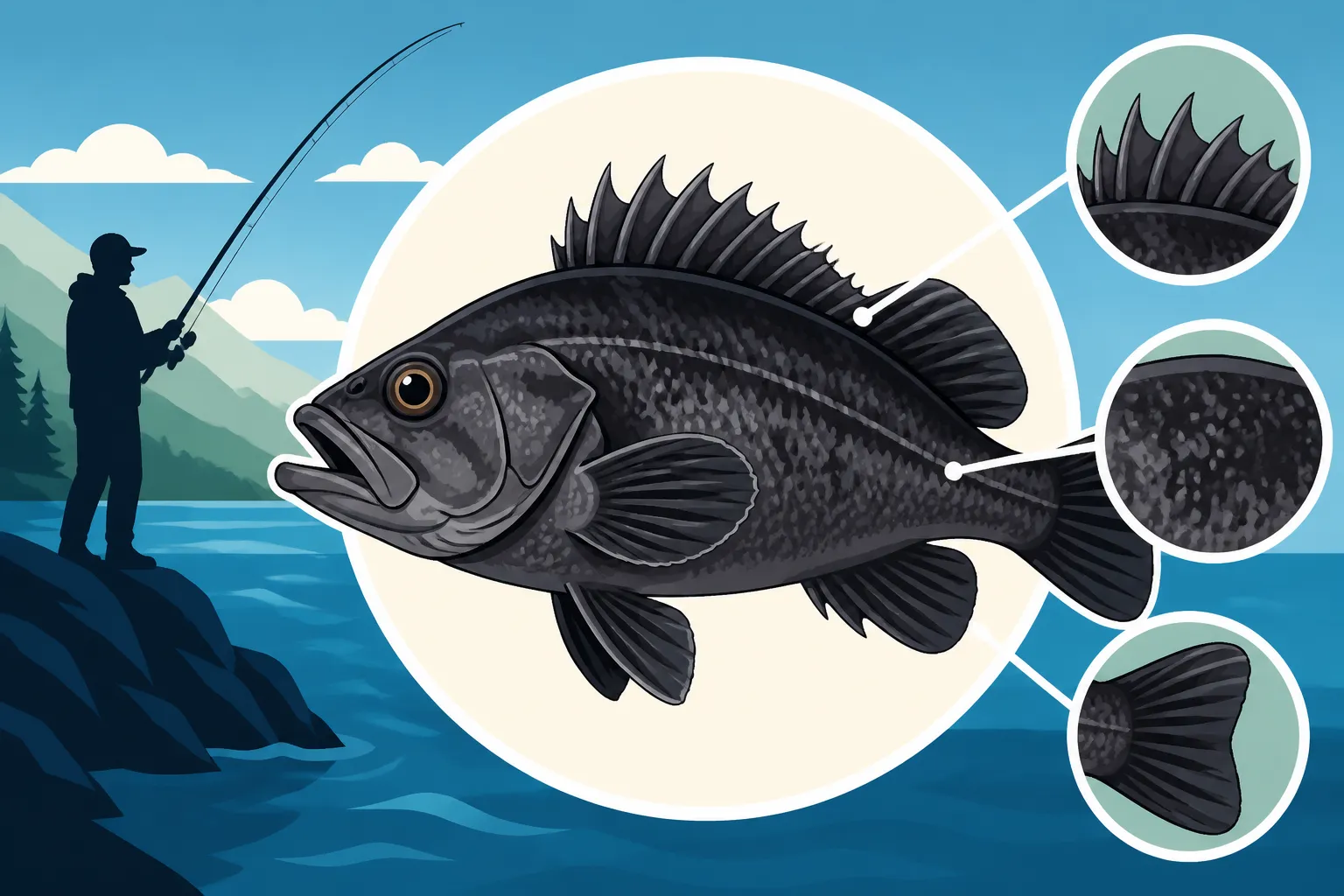
How to Identify a Black Rockfish
One of the most common frustrations for anglers hitting the Washington coast or Puget Sound is telling apart the myriad of rockfish species. They can look so similar, especially when you're excited and trying to keep track of regulations! This guide is here to cut through that confusion, helping you confidently identify a black rockfish (and avoid mistaking it for something else) so you can enjoy your fishing trip without the stress of an accidental violation.
The Basics of Black Rockfish Identification
Let's dive right into the key features that scream "black rockfish" when you pull one out of the water. Think of these as your go-to checklist for a positive identification. It's not just about a dark color; there are distinct anatomical markers that set them apart.
Overall Body Shape and Coloration
When you first look at a black rockfish, you'll generally see a fish that's fairly robust and football-shaped, though perhaps a bit more elongated than some other rockfish species. They're built for speed and maneuvering in rocky reefs. Their color is where things get a bit tricky because, despite the name, they aren't always uniformly black. They can range from a very dark, almost charcoal gray, to a lighter gray or even a brownish hue on their backs and sides. What's often most distinctive is the lighter, sometimes white or cream-colored, belly. This countershading helps them blend in, whether they're looking down into the darker depths or up towards the lighter surface.
A critical identifying feature is the presence of faint, dark blotches or mottling on their sides, which often form a kind of diffuse, horizontal banding pattern. These aren't always super obvious, especially on darker individuals, but if you look closely, you can usually spot them. These markings can really help distinguish them from other solid-colored rockfish. Sometimes, you might even notice a subtle greenish or bluish tint, especially on freshly caught specimens, adding to the visual complexity.
Beyond the blotches, pay attention to the overall texture and sheen of their skin. Black rockfish tend to have fairly smooth scales, and their skin can have a somewhat iridescent quality when wet, reflecting light in subtle ways. This isn't a definitive ID factor, but it contributes to their overall appearance. Remember, conditions like light, water clarity, and even the fish's stress levels can slightly alter how their colors present, so always look for a combination of features rather than relying on just one.
Fin Characteristics and Spines
The fins of a black rockfish offer some excellent clues. Start with the dorsal fin, which is split into two parts: a spiny anterior section and a soft-rayed posterior section. The spiny part usually has 13 sharp spines, and the soft-rayed part will have 13 to 16 rays. What's particularly helpful is that the membrane between the spines in the dorsal fin is often notched, giving it a somewhat serrated appearance rather than a smooth, continuous line. This notching can be a key differentiator.
Next, look at the anal fin. This fin typically has 3 spines followed by 7 to 10 soft rays. The caudal (tail) fin is usually quite large and distinctly forked, almost like a salmon's tail, which is a big hint. Many other rockfish have a more truncated or slightly emarginate (shallowly notched) tail, but the black rockfish's prominent fork is a reliable feature. The pectoral fins are also quite large and fan-shaped, helping them navigate swiftly through rocky terrain.
Finally, don't forget the pelvic fins, located just behind the pectoral fins. These fins are generally moderate in size, with 1 spine and 5 soft rays. While fin ray and spine counts can be a bit tricky to do accurately on a wriggling fish, the overall shape and the distinctly forked tail are much easier to spot. Always handle rockfish carefully, especially those with sharp spines, to protect both yourself and the fish if you plan to release it.
Mouth and Jaw Structure
The mouth and jaw of a black rockfish are perhaps one of the most reliable and easy-to-spot distinguishing features. They have a relatively large mouth, which is typical for a predatory fish that feeds on smaller fish and crustaceans. However, the key lies in how the lower jaw protrudes beyond the upper jaw, giving them a distinct "underbite." This isn't just a subtle difference; it's usually quite pronounced.
When you look at the fish from the side, the tip of the lower jaw clearly extends past the tip of the upper jaw. This characteristic helps them ambush prey from below or in mid-water. Many other rockfish have jaws that are either equal in length or where the upper jaw extends slightly over the lower, making this underbite a very strong indicator for black rockfish.
Another important detail is the symphyseal knob. This is a small, bony protuberance or knob at the very tip of the lower jaw. On a black rockfish, this knob is present but typically not overly large or prominent. It’s there, but it doesn't create a massive bump on the chin. This, combined with the protruding lower jaw, forms a distinct profile that, once you've seen it a few times, becomes instantly recognizable. Make sure to gently open the mouth to get a good look at this feature, remembering that a clear view of the overall jaw structure will likely be your best bet.
Distinguishing Black Rockfish from Lookalikes
This is where the real challenge often lies! Many rockfish species share similar colors or habitats, making positive identification crucial to stay within Washington's complex fishing regulations. Mistaking a black rockfish for a protected species or one with different limits could lead to unintended issues. Let's break down the most common lookalikes you'll encounter.
Black Rockfish vs. Copper Rockfish
Copper rockfish are perhaps the most frequently confused species with black rockfish, and for good reason—they often inhabit similar waters and can appear somewhat similar in shape from a distance. However, there are very clear differences if you know what to look for. The primary distinction is their coloration. While black rockfish are generally dark gray to black with faint mottling, copper rockfish, as their name suggests, typically have a more reddish-brown or "copper" hue on their sides. This copper color often blends into a lighter, white belly, much like the black rockfish.
However, copper rockfish almost always have distinct, vertical banding patterns, often three or four bars, that are much more prominent than the diffuse blotches on a black rockfish. Another key identifier for copper rockfish is a pale, often white or yellowish, stripe that runs along their lateral line. This stripe is usually quite noticeable and is a dead giveaway for a copper. Black rockfish do not have this lateral line stripe. Furthermore, copper rockfish often have white or pale patches on their back and head, particularly around the gill plate.
When it comes to jaw structure, copper rockfish typically have an upper jaw that extends slightly beyond the lower jaw, or the jaws are roughly equal in length. They lack the distinct underbite of a black rockfish. Also, the symphyseal knob on a copper rockfish's lower jaw is often less pronounced or absent compared to a black rockfish. If you're struggling to decide, ask yourself: Is there a clear copper tint? Is there a pale stripe along the lateral line? Are the vertical bands distinct? If yes to these, you likely have a copper rockfish. You can dive deeper into the differences by checking out Black Rockfish vs Copper Rockfish.
Black Rockfish vs. Blue Rockfish
Blue rockfish are another species that can cause confusion, primarily because they can share a similar dark overall coloration with black rockfish. However, "blue" rockfish truly live up to their name more often than not. They tend to have a much more noticeable bluish-gray to deep blue color on their backs and sides, sometimes even displaying iridescent blue scales. They generally lack the faint, dark mottling or blotches seen on black rockfish. Their belly is usually paler, but the vibrant blue is the defining feature.
A significant anatomical difference is the mouth and jaw. Blue rockfish have a smaller mouth compared to black rockfish, and their lower jaw typically does not protrude beyond the upper jaw. Instead, their jaws are usually equal, or the upper jaw extends slightly. They also lack the distinct symphyseal knob on the lower jaw that is present on black rockfish. Their body shape tends to be a bit more slender and elongated than the more robust black rockfish.
Another subtle but helpful clue for blue rockfish is their fins. While both have spiny dorsal fins, the blue rockfish's fins might appear slightly darker or have a deeper blue tint consistent with their body color. If you're catching a fish that's distinctly blue rather than dark gray, has a smaller mouth, and lacks the underbite, you're likely looking at a blue rockfish. Being able to correctly identify these is critical for proper catch reporting and adherence to specific regulations, as some rockfish species have more stringent limits or are entirely protected.
Other Common Washington Rockfish to Watch Out For
Washington waters are home to numerous rockfish species, and while black rockfish, copper rockfish, and blue rockfish are the most commonly confused, a few others warrant a quick mention to avoid complete mix-ups. For instance, the Yellowtail Rockfish can sometimes be mistaken due to its schooling behavior in mid-water, similar to black rockfish. However, yellowtail are typically lighter in color, often olive green to brownish, and, as their name implies, have a distinctly yellowish caudal (tail) fin—a feature absent in black rockfish. Their jaw structure is also different, with the lower jaw not protruding significantly.
Another one to be aware of is the Widow Rockfish. These fish are also dark, often purplish-brown, and have a relatively slender body, but they lack the distinct underbite of a black rockfish. Their fins, especially the pectoral and pelvic fins, tend to be darker, often with a purplish tinge, which differentiates them from the more uniformly colored fins of a black rockfish. Widows also often have a more compressed body shape, appearing flatter from side to side.
Finally, keep an eye out for the Puget Sound Rockfish, though these are less likely to be confused with blacks due to their smaller size and more mottled, often reddish-brown to olive coloration, which allows them to blend into kelp beds. They also have smaller mouths and generally do not exhibit the pronounced underbite. Knowing that Rockfish Species That Must Be Released in Washington exists underscores the importance of correctly identifying every fish you catch. When in doubt, it's always best to release, or at least double-check your fish identification guide.
| Feature | Black Rockfish | Copper Rockfish | Blue Rockfish |
|---|---|---|---|
| Primary Color | Dark gray to black, often with faint mottling | Reddish-brown to copper, blending to white belly | Bluish-gray to deep blue |
| Lateral Line | No distinct stripe | Often a pale, white/yellowish stripe present | No distinct stripe |
| Body Markings | Faint, diffuse dark blotches/mottling, subtle bands | Distinct vertical copper/brown bars | Generally uniform blue/gray, no distinct markings |
| Lower Jaw | Protrudes beyond upper jaw (distinct underbite) | Equal to or slightly shorter than upper jaw | Equal to or slightly shorter than upper jaw |
| Symphyseal Knob | Present, but not overly large | Less pronounced or absent | Absent or very small |
| Caudal (Tail) Fin | Distinctly forked | Slightly forked to emarginate | Slightly forked to emarginate |
| Habitat Preference | Mid-water, structure, rocky reefs, kelp edges | Rocky reefs, kelp beds, shallower structure | Mid-water, kelp beds, rocky outcrops |
Habitat, Behavior, and Fishing Considerations
Understanding where and how black rockfish live can not only help you identify them but also make you a more successful and responsible angler. Knowing their typical hangouts and habits is half the battle in finding them.
Where You'll Find Black Rockfish in Washington
Black rockfish are incredibly adaptable and can be found throughout Washington's marine waters, from the Puget Sound to the outer coast. They are particularly fond of structure, which means you'll often find them congregating around rocky reefs, kelp beds, jetties, pilings, and even artificial reefs like sunken boats. They aren't strictly bottom dwellers; you'll often find them suspended in mid-water, especially where there's a current or baitfish schooling. This makes them a prime target for anglers who enjoy fishing different depths.
In areas like the San Juan Islands, you might find them lurking around the edges of rocky drop-offs, ambushing baitfish like herring or anchovies. Along the outer coast near Westport or La Push, they'll often be found in relatively shallow, rocky areas where the waves break, creating ideal feeding opportunities. They're highly migratory within their local areas, moving with the tides and baitfish concentrations, but they rarely venture far from their preferred rocky habitats. This makes them fairly predictable once you've located a good spot. Checking out Where Rockfish Bite Near Sekiu, Washington can give you an idea of specific locations.
Many anglers target them from boats, drifting or slow-trolling near structure. However, they're also a favorite for shore-based anglers fishing from jetties or rocky shorelines that drop into deeper water. They're often found in schools, so where you catch one, you're likely to find more. This schooling behavior is part of what makes them such a popular sportfish – a single spot can yield multiple catches if you're on a good bite.
Why Accurate Identification Matters
Beyond the sheer satisfaction of knowing what you've caught, accurate identification of black rockfish is absolutely critical for compliance with Washington's fishing regulations. These regulations are designed to protect fish populations, and they vary significantly between species. For instance, while black rockfish might have a fairly generous daily bag limit, other rockfish species, particularly those in the Puget Sound complex, might be entirely protected or have much stricter limits. Mistaking a protected species for a black rockfish could lead to substantial fines or penalties.
The Washington Department of Fish and Wildlife (WDFW) has very specific rules for rockfish, often distinguishing between "pelagic" rockfish (like black and blue rockfish, which spend more time in the water column) and "non-pelagic" or "demersal" rockfish (like copper or vermilion rockfish, which stick closer to the bottom). Bag limits and seasons can differ for these groups. Understanding these nuances, such as those covered in Rockfish Species That Must Be Released in Washington, is your responsibility as an angler. This isn't just about avoiding trouble; it's about being a responsible steward of the resource, ensuring these populations remain healthy for future generations.
Moreover, if you are planning to participate in a fishing derby or competition, correct species identification is paramount. Misidentifying your catch could disqualify you or, worse, lead to accusations of cheating. Taking the time to learn the specific features of black rockfish and their lookalikes is an investment in stress-free, ethical, and legal fishing.
Tools for Better Identification on the Water
Let's be realistic: when you've got a fish on the line, the adrenaline is pumping, and the boat is rocking, positive identification can be tough. That's why having the right tools at hand is invaluable. First and foremost, a good, waterproof fish identification guide for Washington marine species is a must-have. You can find excellent options on platforms like Amazon that are compact enough to fit in your tackle box or boat bag, providing clear photos and descriptions of key features.
Another incredibly useful tool is a measuring device that's clearly marked and easy to use. Many regulations include size limits, so having a reliable ruler or measuring tape readily accessible helps you quickly determine if your catch is legal to keep. Some anglers even affix stick-on rulers to their coolers or boat gunwales for quick checks. A headlamp or a good waterproof flashlight can also be a lifesaver, especially if you're fishing in low light conditions or trying to identify a fish after dark. The subtle color variations or fin notching can be much harder to spot without proper illumination.
Finally, consider a fish-friendly camera. Taking a quick photo of an unfamiliar fish can be incredibly helpful for later identification, or even for sharing with a more experienced angler for their input. Just be sure to handle the fish as little as possible and return it to the water quickly if you plan to release it. Modern smartphones often have excellent cameras, but a dedicated waterproof action camera can be even better for life on the water. Many of these identification tools and accessories are readily available for purchase on Amazon, making it easy to prepare for your next trip.
Responsible Angling and Conservation
Being a good angler goes beyond just catching fish; it involves understanding and respecting the resource. Especially with species like rockfish, which can be vulnerable to overfishing or improper handling, responsible practices are paramount.
Understanding Regulations and Bag Limits
Washington's fishing regulations are a cornerstone of fisheries management, and understanding them is crucial for any angler. For black rockfish and other rockfish species, these regulations often include daily bag limits, which dictate how many fish of a particular species you can keep in a single day. There might also be possession limits, which dictate the total number of fish you can have in your possession, including those at home. These can differ for residents and non-residents, as detailed in Resident vs Nonresident Fishing Licenses in Washington. It's essential to check the current Washington Sport Fishing Regulations Pamphlet or the WDFW website before every trip, as rules can change seasonally or even with emergency closures.
Beyond just numbers, there can also be size restrictions, often a minimum length, to ensure fish have a chance to spawn before being harvested. Sometimes, there are "slot limits" which mean you can only keep fish within a certain size range, releasing both very small and very large individuals. Specific areas, such as particular marine areas in Puget Sound, may have different rules, so always know the regulations for the exact location you're fishing. Being aware of How Bag and Possession Limits Work in Washington and Understanding Washington's Daily Bag Limits by Species will equip you with foundational knowledge. Ignorance of the law is not an excuse, so make it a habit to confirm the rules before your line hits the water.
Best Practices for Handling and Release
Rockfish, including black rockfish, are particularly susceptible to barotrauma when brought up from deeper water. Barotrauma occurs when the fish's swim bladder expands due to the rapid change in pressure, making it difficult for the fish to swim back down. If you're catching fish from depths greater than 30 feet and planning to release them, using a descending device is not just a good idea, it's often a legal requirement or highly recommended by WDFW. A descending device allows you to quickly and safely return the fish to the depth from which it was caught, recompressing its swim bladder and significantly increasing its survival rate.
Even when fishing in shallower water, careful handling is key. Avoid excessive handling, especially touching the gills or eyes. Use wet hands when holding the fish to protect its slime coat, which is a vital defense against disease. If using a net, choose one with knotless, rubberized mesh to minimize damage to fins and scales. Barbless hooks are also highly recommended, as they make hook removal much easier and faster, reducing stress on the fish. For more on this, check out Descending Devices for Rockfish and How to Use One. By practicing these responsible handling techniques, you're actively contributing to the health of Washington's rockfish populations.
Contributing to Rockfish Conservation
Every angler has a role to play in conservation. Beyond following regulations, there are several ways you can contribute to the long-term health of Washington's black rockfish populations. One simple act is to accurately report your catch if required on a catch record card, or by using the Fish Washington app. This data is invaluable to WDFW scientists who manage the fisheries, helping them assess populations and set appropriate limits.
Consider participating in citizen science programs if any are available in your area. These programs often involve collecting data on catch rates, sizes, or even reporting tagged fish, providing crucial information that complements official surveys. Spreading awareness among fellow anglers about responsible fishing practices, such as proper identification and the use of descending devices, also makes a significant difference.
Finally, support organizations and initiatives that advocate for marine conservation and sustainable fisheries. Whether it's through volunteering, donations, or simply staying informed about local conservation efforts, your engagement helps ensure that black rockfish, and all of Washington's marine life, thrive for generations to come. Your passion for fishing can be a powerful force for good when channeled into conservation.
Disclaimer
This article is for general informational purposes only and does not constitute professional advice. Laws, prices and regulations vary by location and change over time. Consult a qualified professional for guidance on your specific situation.