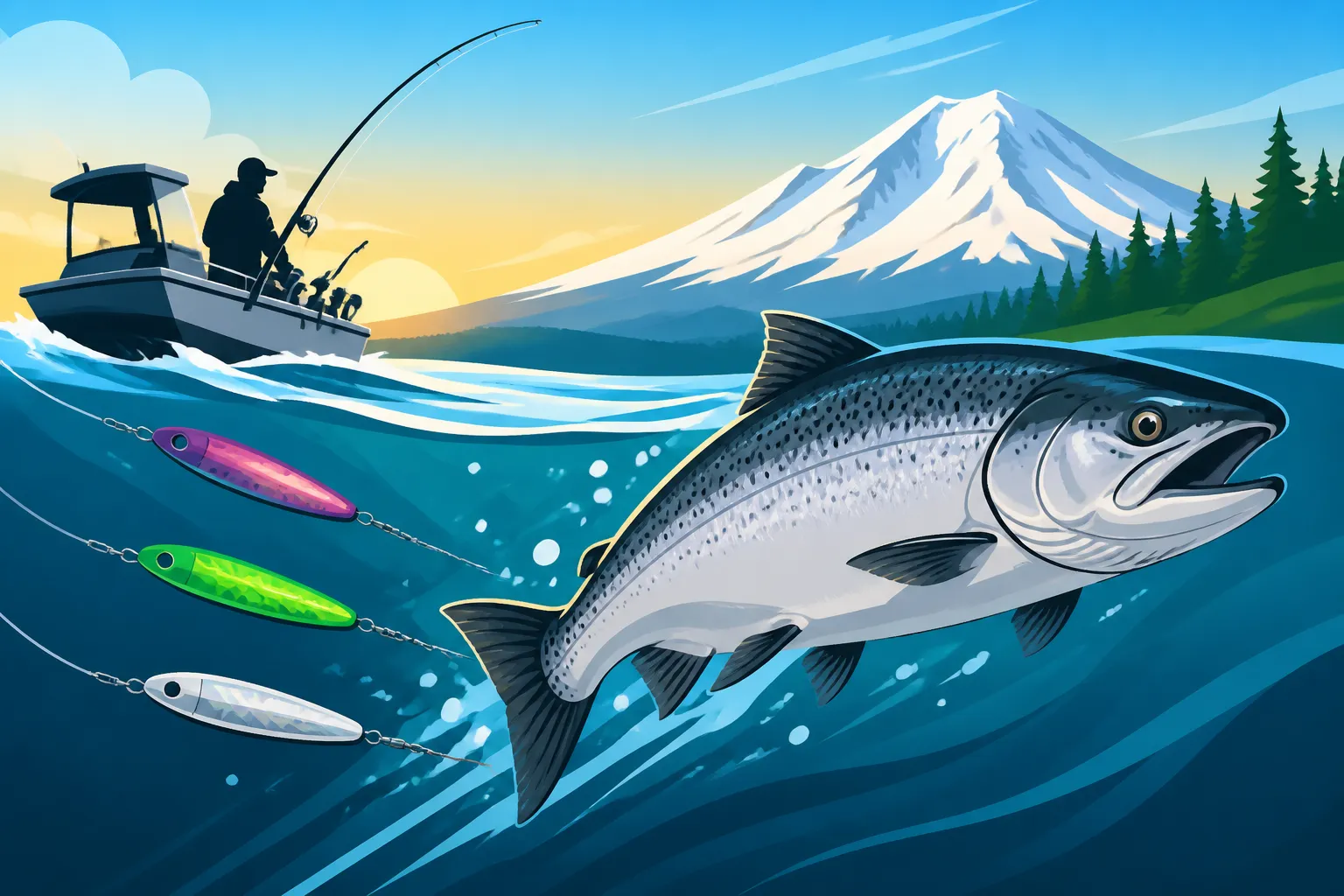
Best Trolling Speed for Chinook
There’s almost nothing more frustrating for a salmon angler than spending hours on the water, trolling all your favorite gear, only to watch other boats consistently hook up while your lines remain slack. Often, the hidden culprit isn't your bait, your lure, or even the depth, but a subtly incorrect trolling speed. Dialing in the best trolling speed for Chinook salmon in Washington waters is a game-changer, and this guide will break down exactly how to find that elusive sweet spot.
The Science Behind Chinook Trolling Speed
Understanding why trolling speed is so crucial for Chinook salmon isn't just about going fast or slow; it's about connecting the dots between how your gear performs, how baitfish behave, and what the salmon are looking for. It's a dynamic puzzle, and getting one piece wrong can mean the difference between an empty cooler and a day to remember.
Why Speed Controls Lure Action
Every lure, from a simple spoon to a complex flasher-and-hootchie combo, is designed to perform optimally within a specific speed range. When you drag a lure through the water, the speed dictates its wobble, its dart, its spin, and its overall "life." If you’re going too fast, a spoon might spin uncontrollably, looking unnatural and even tangling your line. Too slow, and that same spoon might just glide listlessly, lacking any enticing action. Think about it: a wounded baitfish isn't just floating there; it's struggling, twitching, and darting in an irregular, vulnerable way. Your lure needs to mimic that.
The same goes for flashers. These aren't meant to catch fish themselves, but to create attraction, mimicking the flash and vibration of a school of baitfish. Their action – the way they kick and rotate – is entirely dependent on your boat speed. A flasher designed to thump hard at 2.5 mph will barely wobble at 1.5 mph, reducing its effectiveness dramatically. Getting the right speed allows your entire presentation to work in harmony, creating the illusion of irresistible prey that even the most finicky Chinook can't ignore. It’s a subtle but powerful difference that often separates the successful angler from the one just burning fuel.
Matching the Hatch: Baitfish Dynamics
Chinook salmon are apex predators, and their entire existence revolves around finding and eating baitfish. In Washington's rich waters, from the Puget Sound to the Strait of Juan de Fuca, these baitfish often include herring, anchovies, candlefish, and even juvenile salmon. Each of these species has a characteristic swimming pattern and speed. A healthy herring moves with purpose, but a struggling one might be slower, or dart erratically.
Your trolling speed directly affects how well your presentation imitates these natural movements. If you're using real bait, like a whole herring, the speed will dictate how naturally it swims. Too fast, and it might spin unnaturally; too slow, and it lacks the energetic twitch that screams "meal time." For artificial lures, the goal is the same: to create an action that looks so convincingly like a real, vulnerable baitfish that a Chinook can't help but strike. This often means finding a speed that makes your lure "swim" with a lifelike wobble, subtle dart, or enticing vibration, rather than just being dragged along. Understanding the typical speed and behavior of the forage in the area you're fishing is paramount to "matching the hatch" with your trolling speed.
The Role of Water Temperature and Current
Water temperature plays a significant role in where Chinook salmon hold and how actively they feed. Generally, salmon are more active in cooler water, and their metabolism speeds up or slows down with temperature changes. This means their willingness to chase a fast-moving lure can fluctuate. In colder water, Chinook might be more sluggish and prefer a slower, easier meal. In warmer, more active water, they might be willing to chase something moving a bit faster. Keeping an eye on your water temperature gauge is another crucial piece of the puzzle for the avid salmon angler.
Current is another massive factor that often gets overlooked. If you’re trolling with the current, your boat speed needs to be adjusted significantly to achieve the desired lure speed through the water. For example, if you want your lure moving at 2.5 mph through the water, but you have a 1 mph current with you, your boat's GPS speed might only read 1.5 mph. Conversely, if you’re trolling against a 1 mph current, your boat's GPS speed might need to be 3.5 mph to achieve that same 2.5 mph lure speed through the water. Ignoring current means your lures could be moving much faster or slower than you intend, drastically affecting their action and your success. This is why paying attention to the tide and currents, especially in areas like Puget Sound, is non-negotiable for effective salmon fishing. For more on this, check out our guide on the Best Tide for Puget Sound Salmon Fishing in Washington.
Dialing In Your Speed for Different Gear
The "best" trolling speed isn't a single number; it's a range that fluctuates based on the type of gear you're deploying. What works perfectly for a flasher and hootchie might be entirely wrong for a cut-plug herring. Understanding these nuances is key to optimizing your presentation.
Flashers, Hootchies, and Spoons
These are some of the most popular and effective gear choices for Chinook salmon in Washington, particularly when Trolling for Salmon in Washington's Puget Sound. The common setup involves a large flasher (like a Hot Spot or Pro-Troll) followed by a leader to a hootchie, spoon, or fly.
- Flashers: The primary purpose of a flasher is to create attraction through erratic movement and vibration. Most flashers are designed to perform best between 1.8 to 2.8 mph through the water. At these speeds, they "kick" and spin with the specific action that entices salmon. Too slow, and they don’t kick properly; too fast, and they might spin too violently or even blow out, losing their attractive action. You want a consistent, rhythmic throb from the flasher.
- Hootchies: Hootchies are soft plastic squid imitations that are typically trolled behind a flasher. The flasher's action imparts the movement to the hootchie. At the ideal flasher speed, a hootchie will dart, wiggle, and pulsate in a very lifelike manner, mimicking a small squid or baitfish struggling to escape. Generally, speeds in the 2.0 to 2.5 mph range work well, allowing the hootchie to dance enticingly without looking unnatural.
- Spoons: Spoons, like those from Silver Horde or Luhr Jensen, are designed to wobble and flash. They have their own inherent action. When trolling spoons without a flasher, you often want to go a bit faster to get that enticing side-to-side swim. Speeds from 2.5 to 3.5 mph can be very effective, making the spoon flash and vibrate aggressively. If you're running a spoon behind a flasher, you'll still typically stick to the flasher's optimal speed range (1.8-2.8 mph), letting the flasher do most of the work in imparting motion. A popular combo often involves a flasher with a spoon on a longer leader, which allows the spoon to have more of its own action while still benefiting from the flasher's attraction. Remember, the goal is often a tight, tantalizing wobble, not a frantic spin.
Natural Bait: Herring and Anchovies
Using natural bait, especially whole or cut-plug herring and anchovies, is incredibly effective for Chinook. The challenge here is presenting the bait in a way that makes it "swim" as naturally as possible, mimicking a wounded or healthy baitfish.
- Cut-Plug Herring: This is a classic for a reason. A properly cut-plug herring should spin in a tight, helical corkscrew motion. The ideal speed for this mesmerizing spin is often between 1.5 to 2.2 mph through the water. If you go too fast, the herring can spin too wildly, looking unnatural, or even "wash out" and lose its action. Too slow, and it just wobbles weakly. Getting the right cut on the herring is crucial, but so is the speed. Experimentation is key; a slight increase or decrease in speed can transform a lifeless bait into a fish-catching machine. Many anglers find their "magic speed" for cut-plug herring and stick to it. For tips on how to rig this effectively, check out our guide on the Best Way to Rig Herring for Puget Sound Chinook.
- Whole Herring/Anchovies: When trolling whole bait, especially behind an attractor like a "dummy flasher" or a dodger, the goal is often a more subtle, natural swimming motion. These baits usually perform best at slightly slower speeds, perhaps in the 1.0 to 1.8 mph range. The speed allows the bait to weave and undulate, appearing as a lone, vulnerable fish. The beauty of natural bait is that its scent trail is a powerful attractant, so you don't always need super-aggressive action. The slow, natural swimming motion combined with the scent is often enough to draw in hungry Chinook. Again, observe your rod tip for the tell-tale throb of a well-swimming bait, and don't be afraid to make micro-adjustments.
The Importance of Downrigger Control
Downriggers are indispensable for consistently getting your lures and bait down to the precise depth where Chinook are holding. While they don't directly influence lure action, they allow you to maintain your chosen depth and therefore, indirectly, your optimal trolling speed at that depth. Without downriggers, your gear would rise and fall with boat speed and current, making consistent speed control for your lure action almost impossible.
When using downriggers, keep these points in mind:
- Blowback: The faster you troll, the more "blowback" you'll experience. This is the angle your downrigger wire makes behind the boat. More blowback means your cannonball (and thus your lure) is actually shallower than what your downrigger counter indicates. You might think you’re fishing at 100 feet, but at 3 mph, you could easily be at 80-90 feet. Slower speeds reduce blowback, keeping your gear closer to the desired depth. This is why knowing Depth Washington Chinook Hold at in Summer is crucial, and adjusting speed accordingly to keep your gear there.
- Maintaining Depth: If you find you need to troll faster for certain lure actions, compensate for increased blowback by letting out more downrigger cable to achieve the target depth. Conversely, if you slow down, reel in a bit to avoid hitting bottom.
- Consistency: Downriggers allow for incredible consistency. Once you've found the right depth and speed for your lures to perform, the downrigger keeps them there, increasing your time in the strike zone. You can find excellent downriggers and accessories on Amazon to help manage your depth and speed effectively.
Reading the Conditions and Your Gear
Fishing isn't just about setting a speed and forgetting it. The most successful anglers are constantly adjusting, observing, and reacting to what the water, their electronics, and even their rod tips are telling them. This dynamic approach is what truly allows you to dial in that perfect Chinook trolling speed.
Using Your Electronics and GPS
Modern marine electronics are powerful tools that provide critical data for speed control. Your GPS, in particular, is your best friend when it comes to trolling speed.
- GPS Speed Over Ground (SOG): This is the speed your boat is moving relative to the earth. While useful, remember it doesn't always reflect your lure's speed through the water, especially in strong currents.
- GPS Speed Through Water (STW): Many boats have a paddlewheel transducer that measures speed through the water. This is often more valuable for trolling, as it directly correlates to how your lures are performing. If you don't have this, you'll need to learn to compensate for current when looking at your SOG.
- Fish Finder/Sonar: Your fish finder not only shows you where the salmon are holding but can also reveal bait balls. If you mark a lot of bait, adjust your depth and speed to mimic how those baitfish are moving. Are they scattered? A faster, more aggressive lure might work. Are they tight-balled? A slower, more wounded presentation could be the ticket. While primarily for finding fish, a good Can a Fish Finder Help You Locate Kokanee? or salmon can inform your speed choices.
- Autopilot/Troll Motor: Modern autopilots and electric troll motors (like those from Minn Kota or Garmin) are fantastic for maintaining a precise speed and course. They counteract wind and current, allowing you to lock in that exact 2.2 mph that your cut-plug herring loves, even when conditions are choppy. These can be easily found on Amazon and make a huge difference in consistency.
Observing Rod Tip Action and Lure Performance
Your fishing rods are incredibly sensitive instruments, and they can tell you a lot about what your lures are doing.
- Flasher Throb: If you're using a flasher, the rod tip should have a noticeable, rhythmic throb or pulse. This indicates the flasher is kicking correctly. If the rod tip is barely moving, you're likely too slow. If it's vibrating wildly or continuously bent over, you might be too fast, or have weeds on your gear. A consistent, steady beat is what you're after.
- Lure Wobble/Spin: For spoons or natural bait, the rod tip should have a lively, consistent wobble or subtle bounce. For cut-plug herring, you should see a smooth, even spin. If the tip is dead still, your lure isn't working right. If it's shaking violently, it could be spinning too fast or fouling. Watching the rod tip is a crucial way to visually confirm your lure's performance. Consider a high-quality Rod and Reel You Need for Washington Puget Sound Salmon for maximum sensitivity.
- Checking Your Gear: Don't hesitate to reel in your gear periodically to check its action right beside the boat. It's the best way to visually confirm that your chosen speed is making the lure perform as intended. Watch how your flasher kicks, how your hootchie dances, or how your herring spins. Sometimes, what you think is happening at depth is different from reality.
Adapting to Wind, Tide, and Structure
Washington's waters are rarely still. Wind, tide, and underwater structure constantly influence your boat and, therefore, your lure presentation.
- Wind: Wind acts on your boat like a sail, pushing you faster or slower, regardless of your engine's throttle setting. A strong headwind means you'll need more throttle to maintain speed through the water; a tailwind means less. Again, relying on your GPS speed through water (STW) or observing your rod tips is more important than your engine's RPMs.
- Tide: As discussed, tide and current are massive. Trolling with the tide generally means a slower GPS speed to maintain the same lure speed through the water. Trolling against the tide means a faster GPS speed. Many successful anglers in areas like the Strait of Juan de Fuca or Puget Sound prefer to troll across the current, which minimizes its effect on their lure speed and provides a more consistent presentation. Others will actively use the current to slow down their boat's speed over ground while maintaining good lure action.
- Structure: When fishing near underwater humps, drop-offs, or reefs, you might need to adjust your speed to navigate these features while maintaining depth. Sometimes, slowing down around structure can entice a fish that's holding tight to the bottom and less willing to chase. Other times, a quick burst of speed as you come off a structure can trigger a reaction strike, mimicking a baitfish trying to escape. Understanding the Washington Fishing Regulations Every Angler Should Know around specific structures is also important.
Troubleshooting and Advanced Tips
Even with the best intentions and gear, sometimes the fish just aren't biting. That's when it's time to troubleshoot your approach, starting with your trolling speed.
When to Speed Up or Slow Down
Knowing when to adjust your speed is a skill honed over many hours on the water.
- Speed Up When:
- No Bites, but Marking Fish: If you're seeing salmon on your sounder but getting no takers, they might be lethargic. Sometimes, a slight speed increase can trigger a reaction strike, as it makes the lure appear more frantic and difficult to catch. It's often worth trying a subtle increase first.
- Aggressive Baitfish Activity: If you're seeing baitfish actively fleeing or busting the surface, the salmon are likely in a feeding frenzy. A faster, more aggressive retrieve can mimic this frantic activity.
- Trying a Different Lure: Some lures, particularly certain spoons or larger plastic squids, are designed for higher speeds to achieve their optimal action.
- Slow Down When:
- Getting Bites, but Missing: If you're getting hits but not hooking up, your speed might be too fast. Salmon might be swatting at the lure without fully committing. Slowing down can give them more time to engulf the bait.
- Cold Water/Lethargic Fish: As mentioned, colder water or tough conditions often mean salmon are less active. A slower, more tantalizing presentation is often preferred.
- Near Structure/Bottom: When fishing close to the bottom or complex structure, slowing down gives you more control over your depth and allows you to present your lure longer in the strike zone. This also helps prevent snagging.
A general rule of thumb: if you're not getting bites and you've tried different depths and lures, change your speed. Don't be afraid to deviate from your "go-to" speed. Often, a change of just 0.2 mph can make all the difference.
Experimentation and Keeping a Log
The absolute best way to truly master trolling speed for Chinook is through diligent experimentation and meticulous record-keeping. Every day on the water is a learning opportunity.
- Vary Your Speed: Don't just pick a speed and stick to it. Troll in S-curves; as your boat turns, the inside lines will slow down, and the outside lines will speed up. Often, strikes occur on the curve, telling you that a speed change was the trigger.
- Keep a Fishing Log: This is gold. Note down:
- Date, time, location (e.g., "Mid-Channel Bank, Puget Sound")
- Water depth, water temperature
- Tide direction and strength
- Wind conditions
- Lure type, color, and depth
- Crucially: GPS speed over ground (SOG) AND speed through water (STW) when you get a bite.
- Species caught and size.
- Any other observations (e.g., baitfish visible, seals, birds).
Over time, you'll start to see patterns. You might notice that on an outgoing tide at Mid-Channel Bank, your most consistent bites come at 2.1 mph through the water with a green label herring. This invaluable data will inform your future trips and reduce the guesswork, helping you find the Best Time to Fish for Chinook in Washington's Puget Sound.
The Human Element: Feel and Finesse
Ultimately, while electronics and data are incredibly helpful, fishing for Chinook salmon, especially trolling, still has a significant "human element." It's about developing a feel for what's happening beneath the surface.
- Listen to Your Gut: Sometimes, you just get a feeling that something needs to change. Trust that intuition, even if your log says otherwise. Conditions are rarely identical from one day to the next.
- Observe Other Anglers: While you should never crowd another boat, observing successful anglers can provide clues. Are they moving faster or slower than you? What types of gear are they using? You can often learn a lot just by watching, but always be respectful and keep your distance.
- Confidence: Trolling with confidence, knowing you've done your homework and are presenting your lures at their optimal speed, can genuinely make a difference. It helps you stay focused and attentive, ready to react when that rod tip finally buries.
Mastering the best trolling speed for Chinook salmon in Washington is a journey, not a destination. It requires patience, observation, and a willingness to experiment. But when you finally dial it in and feel that rod double over, all the effort will be worth it.
Disclaimer
Fishing regulations and seasons in Washington State can change frequently, often with little notice due to emergency rule changes. It is the angler's responsibility to check the latest regulations before heading out on the water. Always consult the official Washington Department of Fish and Wildlife (WDFW) website or their most current pamphlet for up-to-date information.