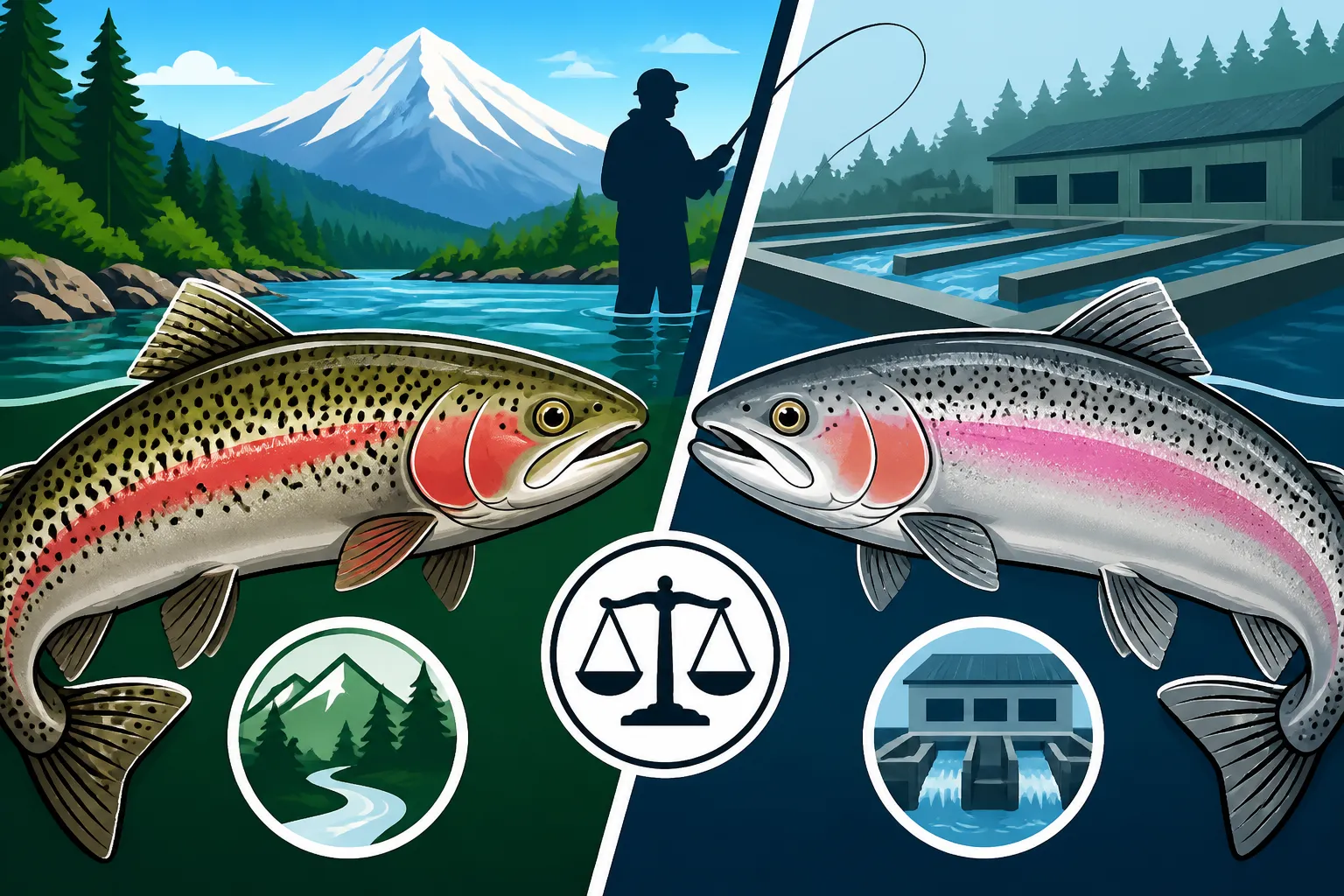
How to Tell Wild Steelhead From Hatchery Steelhead
One of the most anxiety-inducing moments for any angler pursuing steelhead in Washington isn't the fight of the fish itself, but the split-second decision you have to make once it's in your net: is this a wild fish or a hatchery fish? The consequences of misidentification are severe, ranging from hefty fines to the loss of your fishing privileges, and it can truly take the joy out of an otherwise perfect day on the river. This guide aims to clear up that confusion, offering clear, actionable ways to confidently distinguish between wild and hatchery steelhead so you can fish responsibly and within the law.
The Critical Importance of Identification for Washington Anglers
For many who love chasing steelhead in Washington, the distinction between a wild fish and a hatchery fish isn't just about curiosity; it's a fundamental aspect of conservation and adherence to regulations. The future of these incredible fish depends on us knowing the difference, and the rules are often set up specifically to protect the wild populations. It's a weight many anglers carry, especially when you're out on a beautiful river like the Sol Duc or the Skagit, knowing that a simple mistake can have big repercussions.
Regulatory Implications and Penalties
Washington's fishing regulations are incredibly specific when it comes to steelhead, and for good reason. Wild steelhead populations face significant challenges, and strict rules are in place to help them recover and thrive. This often means that while you might be allowed to keep a certain number of hatchery steelhead, all wild steelhead must be released unharmed. There's no wiggle room here; if you accidentally (or purposefully) keep a wild fish in a release-only area, you're looking at a serious violation. Penalties can include substantial fines, confiscation of your gear, and even the suspension of your fishing license for a period of time. It's not just a slap on the wrist; it's a real hit to your wallet and your ability to enjoy the sport you love. Understanding Washington Fishing Regulations Every Angler Should Know is paramount, and this specific identification skill is at the top of the list for steelhead anglers.
Conservation Efforts and Ethical Angling
Beyond the legal aspect, distinguishing between wild and hatchery steelhead speaks to a deeper commitment to ethical angling and conservation. Hatchery programs play a vital role in providing fishing opportunities and supplementing natural runs, but they are designed to be distinct from the wild genetic stock. Wild steelhead have adapted over millennia to their specific river systems, developing unique genetic traits that make them incredibly resilient. Protecting these genetic strongholds is crucial for the long-term health of the species. When you release a wild steelhead, you're not just following a rule; you're contributing directly to the perpetuation of a magnificent natural resource. It's about respecting the fish and the delicate ecosystems they inhabit. Many passionate anglers even buy books on fish identification, which you can often find on platforms like Amazon, to deepen their understanding of these nuances.
Key Physical Characteristics to Look For
When a steelhead hits your net, the clock starts ticking. You need to make a quick, accurate identification. Thankfully, Washington's hatchery system employs a very clear and consistent method to mark hatchery-origin steelhead, making it relatively straightforward once you know what to look for.
The Adipose Fin: The Number One Indicator
This is the golden rule, the absolute first thing you should check, and it's almost foolproof for identifying hatchery-origin steelhead in Washington. The adipose fin is a small, fleshy fin located on the fish's back, positioned between the dorsal fin (the large one in the middle of its back) and the tail fin. Hatchery steelhead in Washington are almost universally marked by having their adipose fin clipped off when they are juveniles.
When you bring a fish to hand, gently cradle it and locate this small fin area.
- Hatchery Steelhead: The adipose fin will be completely absent. It'll look like a smooth, clean space where the fin should be. There might be a slight scar or discoloration, but the fin itself will not be there. This is a deliberate mark to differentiate them from wild fish. You can find more detail on this in What a Clipped Adipose Fin Means.
- Wild Steelhead: The adipose fin will be present, fully formed, and intact. It might be small, but it will be there.
It's important to remember that sometimes, a fish might have a naturally damaged or partially torn adipose fin from an injury in the river or an encounter with a predator. However, a clipped adipose fin from a hatchery is a very clean, deliberate cut, not a jagged tear. If there's any doubt about whether it's a natural injury or a clip, it's always safer to assume it's a wild fish and release it. This simple check is your primary tool in avoiding a potential violation.
Fin Condition and Shape
While the adipose fin is the primary indicator, other fins can offer supporting clues, especially when you're looking at the fish's overall appearance. Hatchery environments, by their nature, are different from wild rivers. Fish are raised in concrete raceways with many other fish, which can affect their fin development.
- Hatchery Steelhead: Often exhibit fins that are worn, rounded, or even damaged. This is due to rubbing against concrete walls, jostling with other fish in crowded conditions, or nipping during their time in the hatchery. Their fins might look less perfect, a bit stubbier or frayed at the edges.
- Wild Steelhead: Typically have fins that are much more pristine, sharply pointed, and fully intact. Their fins are a testament to their life in the wild, navigating currents and avoiding obstacles without the constant physical contact of a hatchery environment. They are usually more elongated and paddle-shaped, designed for efficient movement in diverse river conditions.
This isn't a definitive rule like the adipose fin clip, but it's a helpful secondary characteristic that can reinforce your identification, especially if you're trying to quickly assess a fish from a distance or when the light isn't perfect.
Body Markings and Coloration
While steelhead are known for their incredible variability in coloration based on their time in freshwater vs. saltwater, their diet, and their spawning phase, there can be subtle differences between wild and hatchery fish that experienced anglers pick up on.
- Hatchery Steelhead: May sometimes appear a bit more uniform in color, or perhaps a bit duller, especially if they haven't spent much time in the ocean or have just recently returned. Their spots might be less distinct, and their overall chrome might not be as vibrant as a truly wild ocean-fresh fish. This is not always the case, but it's a trend sometimes observed.
- Wild Steelhead: Often boast incredibly vibrant, iridescent colors – a dazzling chrome when fresh from the ocean, transitioning to rich reds, purples, and olive tones as they near spawning. Their spots tend to be more numerous, distinct, and sometimes extend further down their bodies and onto their fins. The patterns of spots can be quite unique, almost like a fingerprint for individual fish, and their overall physique tends to be more torpedo-shaped and muscular, a result of battling currents and foraging in the wild.
Again, these are generalizations, and a hatchery fish that has spent a good deal of time in the ocean can certainly become just as chrome and vibrant as a wild one. But when combined with the adipose fin check, these observations can provide a more complete picture. Observing fish in person and comparing them is the best way to train your eye, and you can even find detailed identification guides on Amazon to study photographs when you're off the water.
Behavioral Differences and Habitat Clues
Beyond the physical tells, there are also behavioral and habitat-related cues that can sometimes hint at whether you're dealing with a wild or hatchery steelhead. These aren't as definitive as the adipose fin, but they contribute to a holistic understanding.
Differences in Spawning Habits
Wild and hatchery steelhead, while biologically the same species, often exhibit different behaviors when it comes to spawning, primarily due to their upbringing.
- Hatchery Steelhead: While many hatchery fish do attempt to spawn, their success rate in contributing to self-sustaining wild populations is often lower. They may sometimes stray to non-natal rivers more frequently or struggle with the rigors of natural spawning if their instinctual behaviors were dampened by a captive upbringing. They are primarily introduced to provide harvest opportunities for anglers rather than to naturally reproduce and build wild runs.
- Wild Steelhead: These fish are masters of their environment. They undertake epic migrations, navigate complex river systems, and seek out specific gravel beds with optimal water flow and temperature for spawning. Their entire life cycle is geared towards successful natural reproduction. When you encounter a wild steelhead on the redds (spawning beds) or exhibiting strong territorial behavior, you're witnessing the pinnacle of natural adaptation. Recognizing these behaviors underscores why Wild Steelhead Release Rules on Washington's Olympic Peninsula Rivers and other areas are so crucial.
Understanding these inherent differences can help you appreciate the specific role each type of fish plays in Washington's fisheries and conservation efforts.
Where You're Likely to Find Each Type
The location where you hook a steelhead can sometimes offer a subtle clue, though this is far from a hard and fast rule.
- Hatchery Steelhead: These fish are released from specific hatchery facilities, often in predictable locations and times. You'll frequently find them concentrated near release points, below dams with fish ladders, or in rivers known for strong hatchery returns. They might be more willing to bite in areas with higher angling pressure, as they are often raised in environments where human interaction is more common. Rivers like the Cowlitz or the Lewis are well-known for their hatchery programs and thus higher concentrations of fin-clipped fish.
- Wild Steelhead: While wild steelhead can certainly be found alongside hatchery fish, they tend to occupy more diverse habitats throughout a river system. They're often found in less disturbed sections of rivers, in deeper pools, behind complex structure, or in areas that require more effort to access. They are inherently shier and more attuned to their natural surroundings. On certain rivers, specific sections are managed as "wild steelhead gene banks," where only wild fish are permitted, and strict Catch-and-Release Rules During Wild Steelhead Closures apply. It's vital to Reading the Washington Sport Fishing Regulations Pamphlet to understand these unique river-specific rules.
What to Do If You're Unsure
Let's be honest: sometimes, in the heat of the moment, with adrenaline pumping and perhaps less-than-ideal lighting, identification can be tricky. Even seasoned anglers can occasionally second-guess themselves. When in doubt, there's a golden rule that applies universally: prioritize the resource.
Err on the Side of Caution
If you're ever on the fence about whether a steelhead is wild or hatchery, the answer is always to treat it as if it's wild and release it immediately and carefully. This isn't just a suggestion; it's the safest and most responsible course of action. Releasing a hatchery fish by mistake has no negative consequence for the ecosystem or for you legally. Keeping a wild fish mistakenly, however, can have significant legal ramifications and is a blow to conservation efforts.
Remember the strict rule: if you can't definitively identify it as a hatchery fish by its clipped adipose fin, it's a wild fish. Period. This proactive approach ensures you stay within the law and contribute to the health of Washington's wild steelhead populations. Knowing Can You Keep a Wild Steelhead in Washington? is critical, and the answer is often "no" depending on the location and season.
Utilizing Resources
Before you even head to the river, make sure you're armed with the latest information. Regulations can change frequently, especially with emergency rule updates.
- WDFW Regulations Pamphlet: Always carry a current copy of the Washington Department of Fish and Wildlife (WDFW) sport fishing regulations pamphlet. Whether it's the physical booklet or a digital version on your phone, this is your bible on the water. It details specific rules for each river and species, including daily limits and whether wild steelhead must be released. You might even find helpful diagrams showing fin identification.
- Fish Washington App / MyWDFW App: Washington offers mobile apps that can be incredibly useful. The Fish Washington app, for example, often has real-time regulation updates and identification tools. While it won't physically inspect your fish, it's a great digital resource to confirm rules for your specific area. These apps can be downloaded from your app store, similar to how you'd get other outdoor apps from Amazon's app store or Google Play.
- Knowledgeable Fellow Anglers: Don't be afraid to ask for help! If you're fishing with more experienced anglers, they can often provide guidance. However, always verify any advice against the official regulations.
Table: Wild vs. Hatchery Steelhead Key Identification Points
| Feature | Wild Steelhead | Hatchery Steelhead |
|---|---|---|
| Adipose Fin | Present and intact | Absent (clipped), often a clean cut |
| Other Fins | Sharp, pointed, fully formed, often elongated | Worn, rounded, sometimes frayed or damaged |
| Body Shape | Generally more streamlined, powerful, torpedo-like | Can be slightly less streamlined, sometimes a bit 'blockier' |
| Coloration | Vibrant, often iridescent chrome, distinct spots | Can be vibrant after ocean time, but sometimes duller, less distinct spots initially |
| Spots | Often numerous, distinct, and extend onto fins | May be fewer, less distinct, less extensive |
| Snout | Usually slender and pointed | Can sometimes be a bit blunter or rounded |
| Overall Impression | A true product of nature, resilient, powerful | Raised for harvest, still powerful, but bears hatchery marks |
This table provides a quick reference for the most common differences. Always remember the adipose fin is your primary diagnostic tool. Fishing for Steelhead: Washington's Ocean-Run Rainbow Trout is a challenging and rewarding pursuit, and part of that reward comes from being a responsible steward of the resource.
Disclaimer
This article is for general informational purposes only and does not constitute professional advice. Laws, prices and regulations vary by location and change over time. Consult a qualified professional for guidance on your specific situation.