Dungeness Crab Identification and Legal Size
There's nothing quite like the excitement of pulling up a crab pot, that anticipation building as the cage breaks the surface, hoping to see those tell-tale Dungeness claws waving back at you. But that thrill can quickly turn to frustration and even confusion if you're not absolutely sure what you're looking at, or if that beautiful crab is actually a legal keeper. It's a common dilemma, and one that can lead to disappointment or, worse, a run-in with the rules. This guide is here to walk you through everything you need to know about identifying Dungeness crabs in Washington waters and, crucially, making sure your keepers are legal.
The Thrill and the Rules: Why Dungeness Crab Identification Matters
Crabbing in Washington is a beloved pastime, a connection to the bounty of Puget Sound and the coast. But it’s not just about catching dinner; it's about respecting the resource and understanding the intricate ecosystem we're tapping into. Knowing your crabs isn't just a nicety; it's a fundamental part of being a responsible angler.
More Than Just a Meal: The Importance of Conservation
Think about it: every Dungeness crab you pull from the water represents part of a larger population that needs to sustain itself year after year. The rules, including those around identification and size, aren't there to make your life harder. They're carefully crafted by biologists and fisheries managers to ensure that there are plenty of crabs for future generations to enjoy. By correctly identifying Dungeness crabs and adhering to the legal requirements, you're directly contributing to the health and longevity of this incredible fishery. It means more crabs for everyone, year after year, which is a goal we can all get behind. We want our kids, and their kids, to experience the same joy of a successful crab pot pull.
The Cost of a Mistake: Penalties and Disappointment
Mistakes happen, especially when you're new to crabbing or when the adrenaline is pumping. However, keeping an illegal crab, whether it's undersized or the wrong sex, can have real consequences. Beyond the personal disappointment of having to return a crab you thought was a keeper, there can be fines and penalties. Wildlife enforcement officers are out there, and they're serious about protecting the resource. Imagine spending hours on the water, only to have your catch confiscated and receive a citation because you didn't quite grasp the difference between a male and a female, or you mismeasured. It’s a frustrating scenario that's entirely avoidable with a little knowledge and care. Understanding How Bag and Possession Limits Work in Washington is key to avoiding these kinds of errors.
Dungeness Crab: Getting to Know Our Prized Shellfish
The Dungeness crab, Metacarcinus magister, is truly a star of Washington's seafood scene. Known for its sweet, succulent meat, it’s what most people are dreaming of when they drop a crab pot. But how do you pick it out from the crowd of other crabs? It's all in the details.
What Makes a Dungeness Look Like a Dungeness?
Dungeness crabs have a distinct appearance that, once you know what to look for, makes them fairly easy to identify. Their overall color tends to be a mottled purplish-brown to grayish-brown on top, sometimes with hints of orange or red. The underside, however, is often a creamy white or yellowish color. This contrast is a key identifier. They blend in remarkably well with sandy or muddy bottoms, which is where they love to hang out.
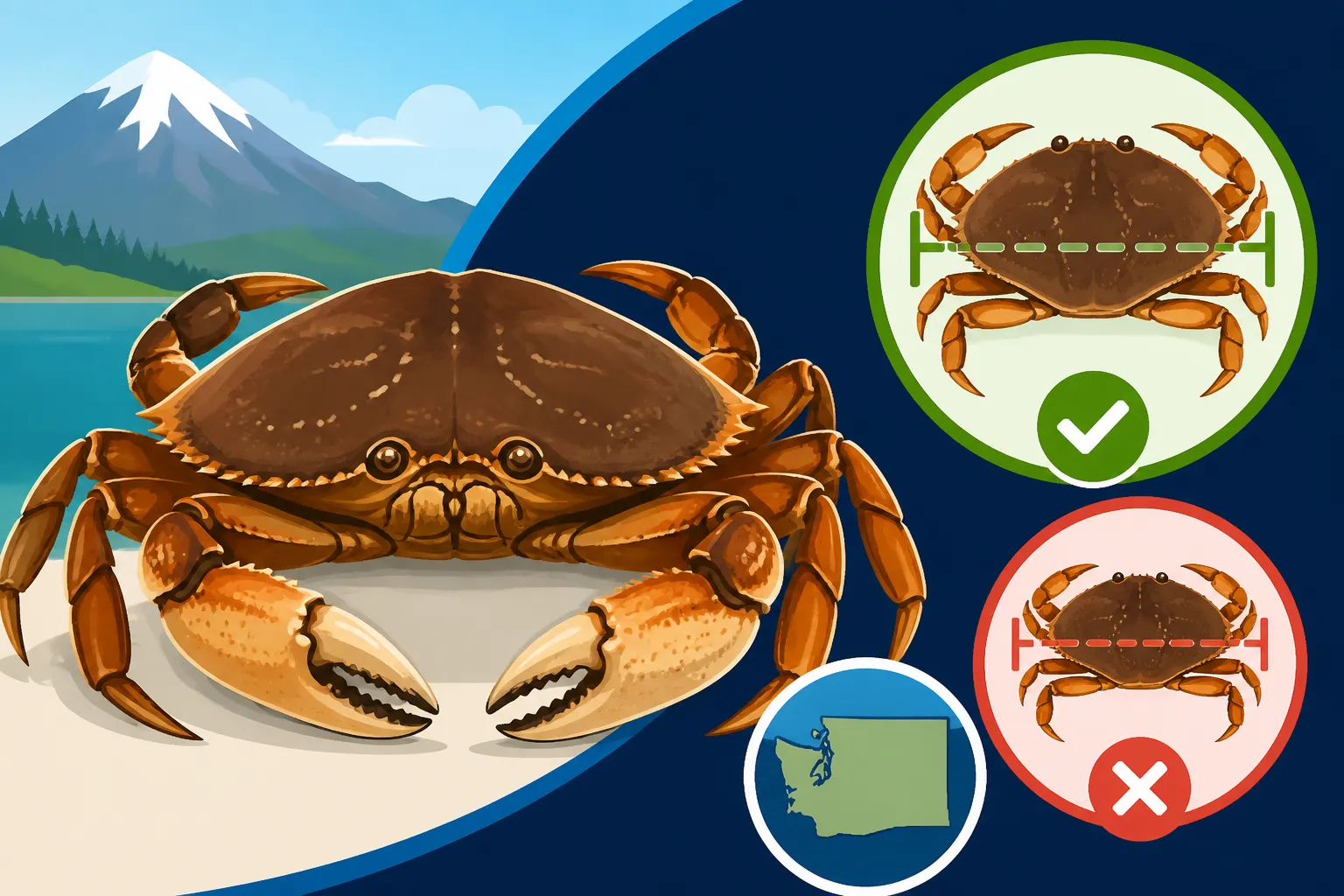
The carapace, or shell, is broad and oval-shaped, almost like a shield. A tell-tale feature is the ten saw-toothed points along the front edge of the shell, between the eyes and the widest part of the shell. These points aren't just decorative; they're quite sharp and a crucial characteristic to note. When you hold one, you'll also notice the smooth, almost slick texture of its shell, especially compared to some of its more textured cousins. This distinctive shell shape is often the first thing experienced crabbers notice.
Their claws are formidable, designed for crushing prey like small shellfish and worms. What's particularly striking about Dungeness claws are the white tips. This is a very reliable visual cue that sets them apart from other species. While they can deliver a powerful pinch, it's those white tips that really scream "Dungeness" to an experienced eye. You'll definitely want to handle them carefully with gloves when you're checking them over! For more on this prized catch, check out Dungeness Crab and Washington Shellfish.
Dungeness vs. Other Washington Crabs: A Visual Guide
In Washington's waters, you're likely to encounter a few other crab species that might end up in your pot. The most common contenders for confusion are the Red Rock Crab and, less frequently, some of the smaller, less desirable species. Knowing the differences is vital for adhering to regulations and ensuring you're only keeping what's legal and intended.
The Red Rock Crab (Cancer productus) is probably the most common "imposter" you'll find in your Dungeness pots. As the name suggests, they are typically a striking reddish-brown or brick-red color all over, often with black-tipped claws. This is a huge contrast to the Dungeness's purplish-brown top and white underside with white-tipped claws. Red Rocks also have a much broader, fan-shaped carapace with more pronounced, sharper points along the edges and a rougher texture. While Red Rocks are also delicious and legal to keep (within their own specific regulations), you don't want to mistake one for an undersized Dungeness. Their meat yield is generally lower, and their claws are often disproportionately large for their body.
| Feature | Dungeness Crab | Red Rock Crab |
|---|---|---|
| Carapace Color | Mottled purplish-brown/grayish-brown (top), creamy white/yellow (bottom) | Uniform reddish-brown to brick-red (top & bottom) |
| Carapace Shape | Broad oval, smooth, 10 saw-toothed points on front edge | Broad fan-shaped, rougher, more pronounced, sharper points |
| Claw Tips | White | Black |
| Overall Size | Generally larger, heavier for their shell size | Smaller, very stout, dense for their size |
| Habitat Preference | Sandy or muddy bottoms | Rocky areas, often around piers and jetties |
Another species you might encounter, though less frequently in recreational pots, is the Tanner Crab (Chionoecetes bairdi), sometimes mistakenly called Snow Crab. These are usually found in deeper, colder waters, but sometimes show up. They have a more triangular, spiny carapace and long, slender legs. Their overall color is typically orange to brownish-red. They are quite distinct from Dungeness with their spidery appearance and lack the characteristic smooth, oval shell or white-tipped claws.
The All-Important Legal Size: Measuring Your Catch Accurately
Once you've confidently identified your crab as a Dungeness, the next, and equally critical, step is to measure it. This isn't just a suggestion; it's a strict requirement to ensure the sustainability of the crab population. Knowing Legal Dungeness Crab Size is essential before you even drop your pot.
Understanding the Measurement: Carapace Width is Key
When we talk about legal size for Dungeness crabs in Washington, we're specifically referring to the carapace width. This is a straight-line measurement across the widest part of the shell, not including the points (spines) on the sides. It's a precise measurement that needs to be taken correctly every time. Many new crabbers make the mistake of measuring across the points, which can lead to keeping an undersized crab without realizing it.
To get an accurate measurement, you'll need a crab gauge. These are simple, often plastic or metal, tools designed specifically for this purpose. They have a fixed jaw and a sliding jaw, allowing you to quickly and accurately measure the crab's carapace width. The key is to place the fixed jaw against one side of the carapace, just behind the point, and then slide the movable jaw across until it firmly touches the other side, again just behind the point. Make sure the crab is relaxed and flat against the gauge. You can find reliable crab gauges at most sporting goods stores or online retailers like Amazon, making it easy to grab one before your next trip.
The Magic Number: Washington's Minimum Legal Size
For Dungeness crabs in Washington, there is a specific minimum legal size that must be met for a crab to be kept. While the exact number can sometimes be subject to minor adjustments based on management decisions, historically, this has been 6¼ inches (6 and 1/4 inches). This means the straight-line measurement across the widest part of the carapace, not including the points, must be at least 6¼ inches. It's crucial to always check the most current regulations pamphlet from the Washington Department of Fish and Wildlife (WDFW) before heading out, as rules can occasionally change. Even a slight miss on this measurement means the crab must go back.
Why Size Limits Exist: Protecting the Future of Crabbing
The 6¼-inch size limit isn't an arbitrary number. It's based on scientific understanding of Dungeness crab biology. This size allows male crabs to reach maturity and, importantly, to participate in at least one breeding season before they are harvested. Larger, older crabs are generally more successful breeders, ensuring a robust population. By letting the smaller crabs grow, we ensure they have a chance to reproduce, which directly contributes to healthy crab stocks for years to come. It’s a conservation strategy that works, protecting both the crabs and our ability to enjoy crabbing. This is similar to the rationale behind Slot Limits and Why Some Fish Must Go Back in fin fish fisheries.
Male vs. Female: The Gender Rule in Washington Crabbing
Beyond size, there's another absolutely critical rule for Dungeness crab: only male Dungeness crabs can be kept. This is a universal conservation measure in Washington and understanding how to tell the difference is non-negotiable for any crabber.
Identifying the Sex: It's All in the Apron
Thankfully, telling a male Dungeness from a female Dungeness is quite straightforward once you know where to look. You need to examine the crab's underside, specifically the abdominal flap, often called the "apron." Gently turn the crab over (being careful of those claws!) and look at the flap tucked between its legs on its belly.
On a male Dungeness crab, this apron is narrow and typically shaped like a "T" or a tall, slender triangle. It looks like a thin strip of shell. This narrow apron doesn't fully cover the underside of the crab's body. Sometimes, especially on larger males, you might see barnacles or other growths on it, but the narrow shape remains consistent.
Conversely, on a female Dungeness crab, the apron is much broader and more rounded, resembling a wide "U" or a dome. This broad apron completely covers most of the underside of her body. This wider shape is designed to protect her eggs, which she carries underneath this flap when she's "berried." If you see a crab with a wide, U-shaped apron, it's a female, and it must be released, regardless of its size.
The "Males Only" Rule: Why It's Critical
The rule about only keeping male Dungeness crabs is perhaps the single most important conservation measure in the entire Dungeness fishery. It's all about protecting the breeding stock. Female crabs are the egg-producers, the ones who ensure the next generation of crabs. If too many females are harvested, the reproductive capacity of the entire population is severely diminished.
By only allowing the harvest of males, fisheries managers ensure that a healthy population of breeding females remains in the water to continue the cycle of life. It’s a highly effective way to manage the resource sustainably. This also allows male crabs to mate multiple times before they are caught. When you encounter a female Dungeness in your pot, you are literally holding the future of the fishery in your hands. Releasing her unharmed is paramount to a successful and sustainable crabbing future for everyone. It's a powerful reminder of our role as stewards of the environment.
Soft-Shell Crabs: A Seasonal Consideration
Sometimes, you might pull up a Dungeness crab that feels unusually soft. These are known as "soft-shell" crabs, and they are typically not good to eat because their meat yield is very low, and they can be mushy. Crabs grow by molting, shedding their old, hard shell and growing a new, larger one. Immediately after molting, their new shell is soft and pliable. It takes some time, usually a few weeks, for the new shell to harden completely and for the crab to "fill out" with meat. While not a strict legal rule against keeping them if they are legal size and sex, it's generally considered poor etiquette and wasteful to keep a soft-shell Dungeness. They offer very little meat and are vulnerable during this period. The best practice is to gently release them so they can harden up and grow into a delicious, full crab.
Tools and Techniques for Responsible Crabbing
Being a successful and responsible crabber isn't just about knowing the rules; it's about having the right gear and using proper techniques to minimize stress on the crabs you release.
Essential Gear for Measuring and Handling
First and foremost, you absolutely need a reliable crab gauge. We've discussed its importance for accurate measurement, but it's worth reiterating. You can't eyeball 6¼ inches and expect to be right every time. Having a gauge is non-negotiable. Many are specifically designed for Dungeness crab measurements and are durable enough to withstand the marine environment. They are widely available at tackle shops, outdoor retailers, and online stores like Amazon, so there's no excuse not to have one clipped to your pot puller or tackle box.
Gloves are another crucial piece of gear, both for your safety and the crab's. Dungeness crabs have powerful claws, and even a small pinch can be painful. A good pair of work gloves or even specialized crab-handling gloves will protect your hands. When handling crabs, always try to hold them by the back of the shell, keeping your fingers away from those formidable pincers. A firm, confident grip is best, but always be gentle and quick when checking sex and size. The less stress the crab endures, the better its chances of survival once released.
Practicing Proper Release: Giving Them the Best Chance
Releasing an undersized or female Dungeness crab correctly is just as important as identifying it. Don't just toss them back into the water from a height. This can injure them, especially if their shell is still a bit soft or they land awkwardly. Instead, gently lower the crab back into the water at the surface. If you're crabbing from a boat, get as close to the water as possible, or use a net to carefully place them back.
The goal is to minimize stress and trauma. Crabs are resilient creatures, but a rough re-entry can disorient them or cause physical harm. If you're setting pots, try to check them fairly regularly, especially in warmer weather, so crabs aren't out of the water for too long. For tips on pot soaking times, you might want to read How Long to Soak a Crab Pot in Puget Sound. Taking these extra few seconds for a proper release ensures that those crabs have the best possible chance to continue growing and reproducing.
Staying Updated: Where to Find the Latest Rules
Washington's fishing and crabbing regulations are dynamic. They can change not just year-to-year, but sometimes even mid-season due to conservation needs, population assessments, or other factors. Staying informed is a key responsibility for any ethical crabber.
The Official Source: WDFW Regulations
The absolute best and most reliable place to get the current regulations for Dungeness crabbing is directly from the Washington Department of Fish and Wildlife (WDFW). They publish comprehensive sport fishing regulations pamphlets annually, which include all crabbing rules, season dates, bag limits, and legal sizes for specific marine areas. These pamphlets are available at most license vendors, tackle shops, and often online as a downloadable PDF on the WDFW website. Make it a habit to pick up a new pamphlet each season or download the latest version. This will ensure you're always operating with the most up-to-date information. Learning Reading the Washington Sport Fishing Regulations Pamphlet will be incredibly helpful.
Emergency Rules and In-Season Changes
Sometimes, unforeseen circumstances or real-time data from test fisheries might necessitate a change in regulations in the middle of a season. These are called "emergency rules," and they can affect anything from season closures to changes in bag limits or specific gear restrictions. For example, if crab populations are lower than expected in a certain area, WDFW might implement an emergency closure to protect the stock.
It’s crucial to be aware that these changes can happen. WDFW typically announces emergency rules through press releases, their website, and often via email newsletters if you sign up. Before every crabbing trip, especially if you haven't been out in a while, it's wise to check the WDFW emergency rules page. A quick five-minute check can save you from inadvertently violating a new regulation. Understanding Emergency Rule Changes: Why Washington's Rules Shift Mid-Season can help you prepare for these possibilities. This diligence is part of being a truly responsible and successful crabber in Washington.
Disclaimer
This article is for general informational purposes only and does not constitute professional advice. Laws, prices and regulations vary by location and change over time. Consult a qualified professional for guidance on your specific situation.