How Deep to Run Downriggers for Washington Halibut
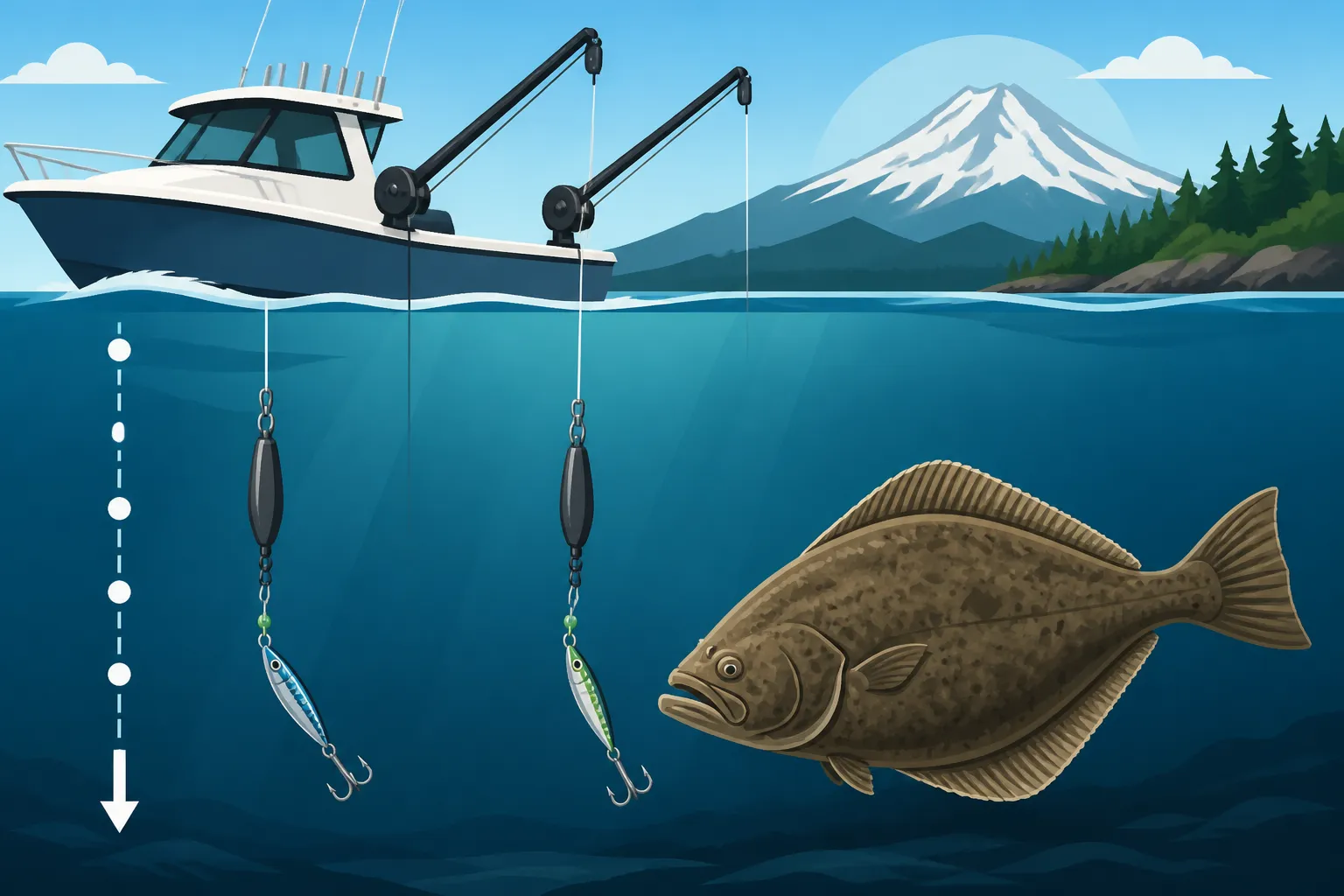
Trekking out past the ocean jetties of Westport or dropping lines in the deep trenches of the Strait of Juan de Fuca presents a specific, grueling challenge: targeting Pacific halibut stuck right to the ocean floor under relentless tidal flow. If you run your downrigger cannonballs too high, your bait rides dozens of feet above the feeding zone; drop them too low, and you risk slamming heavy gear into rocky ledges and losing hundreds of dollars in tackle. Mastering downrigger depth for Washington halibut requires understanding water column physics, drift blowback, and local bottom structures to consistently put your hooks in the strike zone.
The Physics of Downrigger Depth for Deepwater Halibut
When bottom-fishing for salmon or bottomfish in shallow inland bays, managing a downrigger cable is relatively simple. However, targeting Pacific halibut off the Washington coast often means working in depths ranging from 150 to over 500 feet, where massive underwater currents act on both your vessel and your gear. The primary force standing between your counter reading and your actual lure depth is blowback.
Understanding Cable Blowback in Heavy Coastal Currents
Blowback occurs when water resistance pushes your downrigger cable, cannonball, and trailing gear backward at an angle as your boat drifts or trolls. A digital counter on your downrigger spool measures the exact length of wire or braided line pushed out into the water—it does not tell you vertical depth.
If your line counter reads 300 feet of deployed cable, but strong tides off Neah Bay push your downrigger wire back at a 45-degree angle, your cannonball is actually suspended at approximately 212 feet vertically. In deepwater Pacific environments, failing to account for this angle means your bait is suspended far above the mud, gravel, or shale bottoms where halibut spend their lives staging ambushes.
Several factors compound blowback on the water:
* Drift Speed: A drift rate over 1.5 knots dramatically increases drag on your cable.
* Cable Material: Traditional steel wire creates significant drag due to its thicker diameter and rough texture. High-visibility braid options—which many anglers order on Amazon when replacing their spool line—reduce drag substantially, allowing weight to drop straight with far less resistance.
* Cannonball Weight: Standard 10-pound or 12-pound salmon weights are completely ineffective for deep coastal halibut. You need heavy, streamlined weights to maintain vertical presentation.
Calculating Target Depth Against Cable Angles
To accurately position your terminal gear near the sea floor, you must constantly monitor your downrigger cable angle where it pierces the surface. While precise math relies on trigonometry, veteran Pacific Northwest anglers rely on simple conversion factors to make quick adjustments without pulling out a calculator.
At a 30-degree cable angle, multiply your desired vertical depth by 1.15 to determine how much line to drop on your spool counter. For instance, if sonar displays bottom structure at 200 feet and your cable cuts into the water at 30 degrees, you need to let out roughly 230 feet of downrigger line.
When tides pick up along Swiftsure Bank or near the mouth of the Columbia River, cable angles frequently reach 45 degrees. At a 45-degree angle, multiply your target depth by 1.41. Reaching a 200-foot bottom under these severe conditions requires releasing nearly 282 feet of downrigger line to keep your lead ball near the mud.
Selecting Weight Sizes for Ocean Downriggers
To keep your downrigger line as vertical as possible, selecting the proper cannonball weight is essential. Standard downrigger setups designed for inland lakes will strain under the weight required for ocean halibut. You need commercial-grade or heavy-duty electric downriggers paired with weights between 15 and 25 pounds.
Finned pancake weights or pancake-style lead balls slice through sweeping tides much better than standard spherical lead balls. The rear fin stabilizes the weight in high-volume water currents, keeping it tracking straight behind the boat rather than spinning and twisting your leader into a bird’s nest.
Learning Halibut Fishing Techniques for the Washington Coast involves recognizing that gear weight directly impacts how effectively you can track depth on your marine electronics. Lighter weights create unpredictable bow curves in your line, rendering sonar readings inaccurate.
Determining How Deep to Run Your Cannonballs Across Key Marine Areas
Depth strategy varies dramatically depending on whether you are working the exposed coastal shelves off Western Washington or fishing deep inland waterways. Understanding regional topography helps dictate how close to the bottom you dare run your gear.
Deep Ocean Fishing: Westport, Ocean Shores, and La Push
Along the outer coastal marine areas, halibut ground often consists of broad, sandy plateaus interspersed with dangerous gravel ridges and sudden rock outcrops. Depths here routinely hover between 250 and 500 feet.
When fishing these open ocean waters, the goal is to keep your cannonball hovering between 3 and 8 feet off the sea floor. Because ocean swells continually lift and drop your vessel by 4 to 8 feet, running your weight directly on the bottom will cause the lead ball to violently bounce, pounding into sediment and potentially snapping your downrigger boom or snagging structure.
When planning trips out of the coastal ports, understanding regional logistical hubs can streamline your preparation; exploring the Coastal Town Closest to Good Halibut Grounds helps narrow down transit times so you maximize fishing hours over productive banks.
The Strait of Juan de Fuca and Marine Area 6
In the waters of Sekiu, Pillar Point, and Port Angeles, halibut congregate along deep trench ledges, mudflats, and gravel humps. Depths here are generally more manageable, ranging from 120 to 300 feet, but tidal shifts through the Strait create massive water displacement.
Because underwater topography in the Strait can change rapidly from a flat mud bottom to jagged underwater pinnacles, running gear at 5 to 10 feet above bottom provides a safety buffer. Running downriggers along these slope edges allows you to present large herring, octopus, or scent-infused lures directly in the path of fish holding on current breaks.
If you prefer a hands-on approach over running your own boat through complex marine channels, consult our guide on finding the Best Port for a Halibut Charter to gain insight from local captains who navigate these tidal shifts daily.
Deciding Between Bottom-Bouncing and Mid-Water Drops
While Pacific halibut are bottom dwellers, their eyes are positioned on top of their flat bodies, directed upward. A halibut will easily spot and swim 15 to 20 feet upward to inhale a large bait silhouette, but it will rarely see or target a bait hidden beneath a rock shelf or buried in soft silt.
If your sonar reveals a smooth sand or mud bottom, you can temporarily lower your downrigger cannonball until it gently taps the substrate, creating a puff of sand that acts as an visual attractant. Immediately crank the spool up 3 to 5 feet once contact is made. If sonar shows rocky, jagged reef structures, pull your downrigger ball up 10 to 15 feet above the bottom to preserve your gear while remaining fully visible to aggressive feeders.
For an in-depth breakdown of flatfish biology and habitat patterns, review our article on Pacific Halibut Fishing on the Washington Coast.
Step-by-Step Downrigger Setup and Depth Adjustments on the Water
Operating downriggers in deep ocean environments requires methodical mechanical execution. A single loose release clip or missed depth reading can wrap heavy braided line around your propeller or snap expensive downrigger booms.
DOWNRIGGER DEPTH ADJUSTMENT & BLOWBACK CHART
| Target Vertical | 15-Degree Angle | 30-Degree Angle | 45-Degree Angle |
|---|---|---|---|
| Depth (Bottom) | (Light Drift) | (Moderate Current) | (Heavy Drift/Tide) |
| 100 Feet | 104 Feet Line Out | 115 Feet Line Out | 141 Feet Line Out |
| 150 Feet | 155 Feet Line Out | 173 Feet Line Out | 212 Feet Line Out |
| 200 Feet | 207 Feet Line Out | 230 Feet Line Out | 282 Feet Line Out |
| 250 Feet | 259 Feet Line Out | 288 Feet Line Out | 353 Feet Line Out |
| 300 Feet | 310 Feet Line Out | 345 Feet Line Out | 423 Feet Line Out |
| 400 Feet | 414 Feet Line Out | 460 Feet Line Out | 564 Feet Line Out |
Setting Release Clips and Leader Spacing
- Attach the Cannonball securely: Ensure all split rings and heavy-duty snaps connecting your lead weight to the downrigger wire are rated for at least 150 to 200 pounds.
- Deploy the Terminal Rig: Pay out 15 to 25 feet of main rod line behind the boat before attaching it to the downrigger release clip. Keep leaders relatively short (4 to 6 feet) behind the weight to prevent gear from swaying erratically or tangling in deep water currents.
- Set Heavy-Duty Downrigger Clips: Standard salmon release clips will trip under the pressure of deep ocean currents and heavy halibut terminal tackle. Use adjustable tension clips or heavy-duty offshore pressure pads. Many anglers source these heavy tension clips and snubbers on Amazon prior to the season so they can fine-tune tension settings at home.
- Lower the Gear Controlled and Smoothly: Avoid free-spooling the downrigger. Lowering a 20-pound cannonball too quickly can cause the trailing leader to wrap around the main cable, creating an impossible tangle that wastes valuable time on the water.
Monitoring Sonar and Cable Angles Simultaneously
Once your gear reaches the calculated target depth, lock the downrigger clutch and set your fishing rod into a stout gunwale rod holder. Reel up slack until your rod tip bows under heavy tension. A deeply loaded rod tip is crucial: when a halibut hits in deep water, the immediate release of cable tension snaps the rod straight, driving large circle hooks or J-hooks into the jaw automatically.
Keep a continuous eye on your depth sounder. Marine bottom topography fluctuates fast along coastal banks. If the depth suddenly drops from 300 feet to 240 feet, quickly retrieve downrigger cable to avoid slamming your lead ball directly into an ascending shelf. If you are struggling to dial in your boat controls during high winds or heavy rips, compare setups in our breakdown of Downrigger Techniques for Halibut in Washington.
Many private boat owners pick up digital line counters or specialized marine electronics on Amazon to mount right alongside their downrigger booms, making it simple to match line spool counts with actual vertical transducer signals.
Adjusting for Drift Speed Changes
Tidal currents fluctuate continuously throughout the day, accelerating as slack tide ends. As your boat’s drift speed increases, blowback will widen your cable angle.
* When your cable angle widens from 20 degrees to over 40 degrees, lower additional downrigger line to compensate for lost vertical depth.
* If current speeds render downrigger tracking impossible, consider changing tactics entirely. Read our detailed comparative analysis on Anchoring and Drifting for Halibut to determine whether dropping an anchor setup is safer and more effective under extreme tidal shifts.
* To weigh the practical advantages of active trolling versus stationary fishing under shifting winds, check out Which Catches More Halibut: Anchoring or Drifting.
Avoiding Snags and Terminal Rigging Strategies for Heavy Halibut Gear
Loosing gear in deep ocean water is frustrating, expensive, and wastes prime fishing hours during short open-season windows. Installing simple safety modifications on your downrigger system preserves your gear and keeps your hooks active in the strike zone.
Implementing Cannonball Breakaway Lines
When trolling or drifting over unmapped structure, your downrigger ball is the first item to strike bottom obstacles. If a 20-pound lead ball wedges tightly into a rock crevice while your boat is drifting at 2 knots, the sudden torque can rip downrigger mounts straight out of your fiberglass gunwales or snap stainless steel booms.
Prevent catastrophic damage by attaching your cannonball to the downrigger snap using a “breakaway wire” setup:
1. Connect a short length of 30-pound to 50-pound monofilament between your main downrigger terminal snap and the lead weight.
2. If the lead weight snags a boulder, this lower-strength monofilament breaks under heavy strain, sacrificing the cannonball while preserving your downrigger cable, release clip, terminal tackle, and downrigger boom assembly.
Terminal Rigs and Lure Elevation Behind Downriggers
Because downrigger balls travel close to the seabed, your trailing bait presentation must remain elevated just enough to avoid snagging bottom debris, sea weeds, or sea anemones.
Use buoyant terminal gear behind your release clips:
* Hoochie Squids with Foam Inserts: Insert small foam floats inside large glow-in-the-dark octopus skirts to lift hooks 2 to 3 feet above the sea floor.
* Spreader Bars: Heavy stainless steel spreader bars keep your leader separated from your main line, preventing spins during deep deployments.
* Scent Attractants: Halibut rely heavily on scent trails in pitch-black deep water. Smear heavy visual and scent pastes onto your jigs, squids, and baits.
Always make sure your overall rig setup complies with state tackle guidelines before dropping lines. Read our guide on the Hook Limit for Washington Halibut Fishing to ensure your double-hook or gang-rig setups meet current marine area regulations.
Before heading far offshore into ocean waters, ensure your vessel, safety gear, and tackle setups are completely prepared by reviewing What to Check Before a Washington Halibut Trip Offshore.
Managing Deepwater Hookups on Downrigger Gear
When a heavy halibut strikes a bait suspended from a downrigger release clip, the reaction on deck must be coordinated quickly:
- Do Not Jerk the Rod Immediately: Halibut often grab large baits and hold them before fully swallowing. Wait until the rod tip loads up completely and bows firmly toward the water line.
- Clear the Opposite Downrigger Line First: The moment a fish pops the release clip, assign a deckhand to crank up all other downrigger cables immediately. A hooked halibut will fight with wide, erratic swoops, and trailing downrigger wires are a recipe for catastrophic line entanglements.
- Maintain Continuous Pressure: Pacific halibut have thick, muscular tails that allow them to swim vertically toward the surface during a fight. Keep steady, heavy pressure on the rod reel to prevent slack line, which allows circle hooks to back out.
Knowing the sheer scale of the species you are targeting reinforces why heavy-duty downrigger gear is required; explore our overview on How Big Pacific Halibut Get Off Washington to prepare your deck, gaffs, and harpoons for landing trophy-sized bottomfish.
By combining accurate blowback calculations, proper cannonball weight selection, and careful real-time depth tracking, downriggers convert from a risky deep-water liability into one of the most precise tools for targeting Washington halibut.
Disclaimer
This article is for general informational purposes only and does not constitute professional advice. Laws, prices and regulations vary by location and change over time. Consult a qualified professional for guidance on your specific situation.