How to Identify a Sockeye Salmon
You've hooked into a magnificent salmon in a Washington river, but as it comes closer, you wonder: is it a Sockeye, or another species transforming for its spawn? Identifying salmon can be genuinely tricky, especially with their dramatic color changes. This guide aims to simplify that process, providing clear, practical ways to confidently distinguish a Sockeye Salmon, whether it’s fresh from the ocean or displaying its vivid spawning phase.
The Sockeye Salmon: A Unique Washington Icon
Sockeye salmon, sometimes affectionately called "red salmon" due to their incredible spawning colors, hold a special place in Washington's fisheries. They're not just another anadromous fish; they possess distinct characteristics and life cycles that set them apart. Understanding these nuances is key to accurate identification, which is not only satisfying for the angler but crucial for complying with specific fishing regulations. You really don't want to accidentally keep a protected species, do you? Knowing your fish before it hits the cooler is always the best practice.
The Distinctive Appearance of a Spawning Sockeye
Let's talk about the showstopper: the spawning sockeye. This is where most anglers get that "Aha!" moment when identifying them. As Sockeye salmon transition from saltwater to freshwater to fulfill their reproductive journey, their appearance undergoes one of the most dramatic transformations of any salmon species. The subtle, silvery hues of their ocean life give way to an explosive display of color.
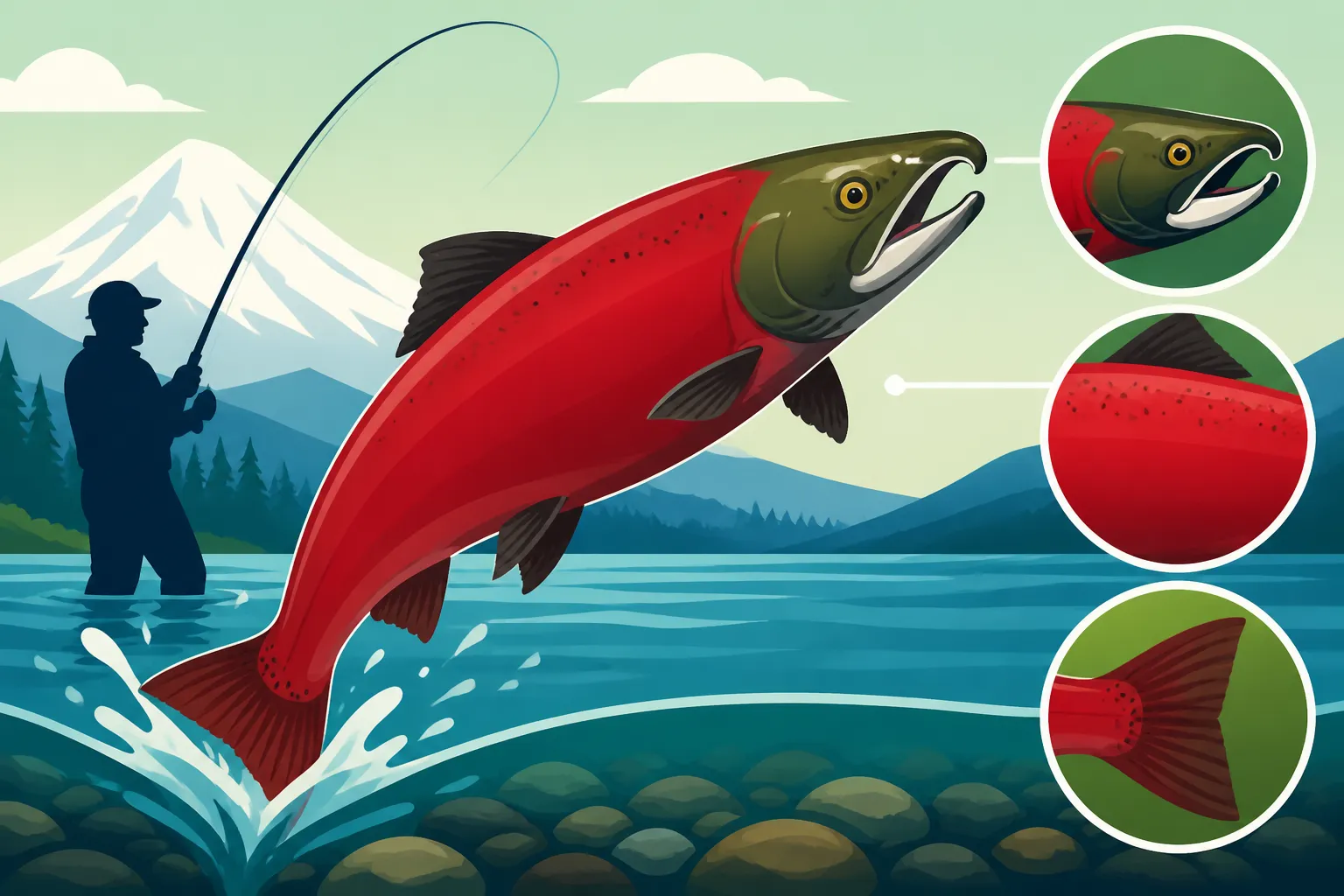
Their bodies, from behind the gill plate all the way to the tail, turn a brilliant, unmistakable crimson or brick red. It's not just a tinge; it’s a deep, rich, almost neon red that screams "Sockeye!" In stark contrast to their fiery bodies, their heads take on a dull, olive green color. This green can sometimes appear almost brown or even slightly black, but it’s consistently distinct from the red body. The combination of the red body and green head is the most reliable visual cue for a spawning sockeye and it’s truly a sight to behold. It’s hard to miss once you know what you’re looking for. You might be interested to read more about Why Do Sockeye Turn Red When They Spawn?.
Another noticeable change during spawning is the development of a pronounced hump on the back of the male sockeye, giving them a more robust, almost menacing profile. Their jaws also become hooked (known as a kype), and their teeth, while not as large as a Chinook's, become more prominent and sharp, ready for territorial battles. This makes them look quite formidable, even though their focus is entirely on spawning, not feeding. These physical changes, coupled with their striking coloration, make them much easier to identify once they've entered their freshwater spawning grounds.
Identifying Sockeye in Their Ocean Phase
While the spawning colors are iconic, Sockeye salmon spend most of their adult lives in the saltwater, where their appearance is far more subdued. This is where things can get a bit trickier, as they bear a closer resemblance to other salmon species. In the ocean, a Sockeye salmon is primarily silvery on its sides, with a darker, bluish-green back. They have a sleek, streamlined body shape, often appearing more slender than a Chinook but more robust than a Pink salmon.
One of the key distinguishing features of an ocean-phase Sockeye is the lack of significant spots on its back or tail. Unlike Chinook (often with large, irregular spots) or Coho (smaller, more defined spots mostly on the upper lobe of the tail), a Sockeye's tail is generally spot-free, or if there are any, they are incredibly faint and sparse. This "clean" tail can be a quick visual indicator when you're trying to figure out what you've just brought to the boat.
Their fins are typically dark or dusky, without the clear spotting often found on other salmon. The eye of a Sockeye also tends to be proportionally larger relative to its head compared to, say, a Chinook. When these fish are fresh from the salt, they are absolute torpedoes, renowned for their incredible fight and delicious, deep-red flesh. But because they look so much alike, it’s worth reviewing resources like How to Identify a Washington Chinook Salmon and How to Identify Coho Salmon in Washington's Puget Sound to grasp the differences.
Key Features for Sockeye Identification
Beyond the obvious color changes, there are several anatomical characteristics that can help you confidently identify a Sockeye salmon. These are the tell-tale signs that biologists and experienced anglers rely on when visual cues alone aren't enough, or when dealing with fish that might be in an intermediate stage of their spawning migration. Mastering these can make you feel like a true salmon expert!
Gill Rakers: The Unsung Hero of Sockeye ID
This might sound a bit technical, but the gill rakers are one of the most reliable ways to confirm a Sockeye, especially when they're not in their full spawning colors or if you're comparing them to their landlocked cousin, the Kokanee. Gill rakers are bony, comb-like projections on the gill arches that filter food from the water. For Sockeye, these rakers are numerous, long, and slender, often numbering between 30 and 40 on the first gill arch.
To check for gill rakers, you gently lift the gill cover and look inside. You'll see the red gill filaments, and on the inside edge of the gill arch (the curved bone holding the filaments), you'll find the rakers. Sockeye gill rakers are so tightly packed and fine that they almost look like a brush or a feathery sieve. This is because Sockeye are primarily plankton feeders, and these numerous, fine rakers are perfectly adapted to strain tiny organisms from the water. This is a very different structure than, for instance, a Chinook, which has fewer, stubbier rakers designed for larger prey. It's a precise, scientific way to tell them apart, especially if you're ever in doubt.
Fin Rays and Tail Shape
The fins and tail also offer some valuable clues. While not as definitive as gill rakers, they contribute to the overall picture. Sockeye salmon generally have a relatively high dorsal fin, but perhaps more importantly, look at the anal fin. The anal fin (the fin on the underside near the tail) of a Sockeye usually has 13-15 rays, a count that is quite consistent across the species. While you might not carry a magnifying glass to count fin rays, it's a structural characteristic that contributes to their overall streamlined appearance.
The caudal fin, or tail, of a Sockeye is typically slightly forked, though it can appear more square-cut in older, spawning fish. It's often uniformly colored, without the heavy spotting seen on Chinook or Coho. Contrast this with the deeply forked tail of a Pink salmon or the more distinctly spotted tail of a Chinook. While not every individual fish will fit the mold perfectly, paying attention to the general shape and lack of prominent spots on the tail can help narrow down your identification. Remember, it's about looking at the whole fish, not just one feature in isolation.
Mouth and Tooth Structure Clues
The mouth and teeth of a salmon can also provide useful identification points. While male Sockeye develop a kype (hooked jaw) during spawning, their teeth are generally smaller and less robust than those of a Chinook or a large Chum. Sockeye typically have small, conical teeth that are present on both the upper and lower jaws, as well as on the tongue.
When looking inside the mouth of an ocean-phase Sockeye, the gum line on the lower jaw is usually white. This is a subtle but often consistent feature that distinguishes it from Chinook, which often have black gum lines. Of course, examining the mouth of a live, flopping salmon requires a bit of care, but it’s a quick check that can sometimes seal the deal on your identification. Coupled with the gill raker count, these internal mouth features provide a pretty solid argument for Sockeye. For other species, like the Chum, you'd be looking for much larger, canine-like teeth, which can be quite intimidating! For a comparison, you can look up Chum Salmon Identification and Where They Run in Washington.
Where and When to Spot Washington Sockeye
Sockeye salmon have a fascinating life history that often involves spending a year or two in freshwater lakes after hatching before heading out to sea. This unique aspect dictates where and when you're most likely to encounter them in Washington. Knowing their migration patterns and preferred habitats is just as important as knowing their physical features for successful identification.
Primary Sockeye Runs in Washington
When we talk about Sockeye in Washington, our thoughts often immediately turn to a few key areas known for their impressive runs. The most famous Sockeye fishery in the state, by far, is Baker Lake, located near Concrete in the North Cascades. Here, the Sockeye return to spawn in the Baker River, a tributary of the Skagit River, and eventually make their way into Baker Lake itself. The Sockeye Salmon Identification at Washington's Baker Lake article goes into even more detail about these specific fish. This run is often very strong, and the Sockeye here are prized for their flavor and fighting spirit.
Another significant Sockeye run occurs in the Wenatchee River system, leading into Lake Wenatchee. These Sockeye navigate the mighty Columbia River and then turn up the Wenatchee to reach their natal lake. These fisheries are often carefully managed with specific seasons and limits, so always check the current regulations in the Washington Sport Fishing Regulations Pamphlet before heading out. Test fishery counts on the Columbia often dictate openings and closures for these runs. You'll typically find the peak Sockeye returns in these systems during the summer months, often July and August, though timing can shift year to year. Knowing the timing can give you a heads-up on what species you’re most likely to encounter.
Sockeye vs. Kokanee: The Landlocked Cousin
This is where things can get a little confusing for anglers who frequent Washington's freshwater lakes. Kokanee are essentially landlocked Sockeye salmon. They are the same species (Oncorhynchus nerka) but have evolved to complete their entire life cycle without migrating to the ocean. They are born in freshwater, live in freshwater, and spawn in freshwater. Because of this genetic similarity, a Kokanee will display many of the same physical characteristics as an ocean-phase Sockeye, particularly in terms of body shape, fin structure, and even the tendency to turn red during their spawning phase.
So, how do you tell them apart? Generally, Kokanee are much smaller than their anadromous Sockeye cousins. While a Sockeye can grow to quite a substantial size (you can check out How Big Baker Lake Sockeye Get for specifics), a Kokanee rarely exceeds 16-20 inches, with most being much smaller, often in the 8-12 inch range. They're also often caught in different habitats – Kokanee are typically found in specific lakes where they've been introduced or are native, whereas Sockeye are caught during their river migrations or in the ocean. If you catch a small, silvery, unspotted salmon-like fish in a lake known for Kokanee, it's almost certainly a Kokanee. If you catch a larger version of that fish in a river during a known Sockeye run, it's likely a Sockeye. The key really is the size and the location. For a more detailed look, consult Kokanee vs Sockeye: What's the Difference.
Practical Tips for Anglers
Now that you've got a handle on the physical identifiers and where to look, let's talk about some practical tips to make your Sockeye identification even easier when you're out on the water. These are the little things that seasoned anglers pick up over time.
What to Look for on the Water
Beyond the fish itself, the environment around you can offer clues. During their spawning migrations, Sockeye salmon will often school together, moving upstream in concentrated groups. If you see large numbers of brightly colored, red-bodied, green-headed fish congregated in river pools or staging areas below rapids, you can be fairly certain you're looking at Sockeye. Their behavior is often distinct too; they can be quite feisty, jumping and rolling, especially as they get closer to their spawning grounds.
Water clarity can also play a role. While Sockeye are known for their plankton diet in the ocean, they stop feeding once they enter freshwater to spawn. They'll be focused on their journey, not on chasing your bait. This is why specialized techniques like "flossing" (where you essentially drift line through a school hoping to snag them legally) or very specific lures are often employed in Sockeye fisheries, rather than traditional bait fishing. Observing other anglers and what they're targeting can also give you a strong hint about the predominant species in the area, especially if you're fishing during specific times covered in the Washington Fishing Seasons: A Month-by-Month Guide.
Resources for Further Identification
In today's world, you don't have to be a biologist to identify fish. There are so many fantastic resources available at your fingertips. A good, laminated field guide specific to Pacific Northwest fish is an invaluable tool to keep in your tackle box or boat. Many outdoor retailers carry them, and you can often find a great selection on Amazon. These guides usually include detailed illustrations or photos, along with descriptions of key features, making it easy to compare your catch to known species.
Beyond physical guides, technology has stepped up. The Washington Department of Fish and Wildlife (WDFW) has a wealth of information on their website, including detailed species identification pages. There are also numerous fishing apps available for smartphones that can help with identification, often using photos to help narrow down possibilities. Having access to these resources, perhaps by downloading images or guides onto your phone before you head out, means you're always prepared. Don't underestimate the power of a good set of waterproof scales to properly examine gills and mouth parts if you really need to be sure. Just remember, when in doubt, it’s always better to release the fish if you cannot confidently identify it and are unsure of the regulations. Being a responsible angler is just as important as being a successful one.
Here’s a quick comparison table to help you keep things straight:
| Feature | Sockeye Salmon | Chinook Salmon | Coho Salmon | Chum Salmon |
|---|---|---|---|---|
| Spawning Color | Bright red body, olive green head | Dark olive to black body, often blotchy, dark head | Dark back, reddish-brown sides (males more red) | Mottled green and purple bars, large canine teeth |
| Ocean Color | Silvery sides, bluish-green back, no spots | Silvery sides, dark back, prominent large spots | Silvery sides, dark back, smaller spots | Silvery sides, faint vertical bars |
| Body Shape | Streamlined, somewhat slender | Robust, heavy-bodied | Streamlined, often slightly deeper than Sockeye | Heavy-bodied, deeper than Sockeye or Coho |
| Mouth/Teeth | White gum line, small teeth, kype in males | Black gum line, large, conical teeth, strong kype | White gum line (can be dusky), small teeth, kype | White gum line, large canine-like teeth, strong kype |
| Tail | Slightly forked, generally unspotted | Heavily spotted on both lobes, slightly forked | Spots mostly on upper lobe, moderately forked | Lightly spotted or unspotted, slightly forked |
| Gill Rakers | Numerous (30-40), long, slender | Fewer (18-24), short, stout | Moderate (20-25), moderately long | Fewer (14-19), short, stout |
When you're out there on the water, whether you're targeting Fishing the Columbia River in Washington: A Complete Overview or any other productive fishery, it’s a wonderful feeling to confidently know exactly what species you've connected with. Happy fishing, and may your Sockeye be plentiful and easily identified!
Disclaimer
This article is for general informational purposes only and does not constitute professional advice. Laws, prices and regulations vary by location and change over time. Consult a qualified professional for guidance on your specific situation.