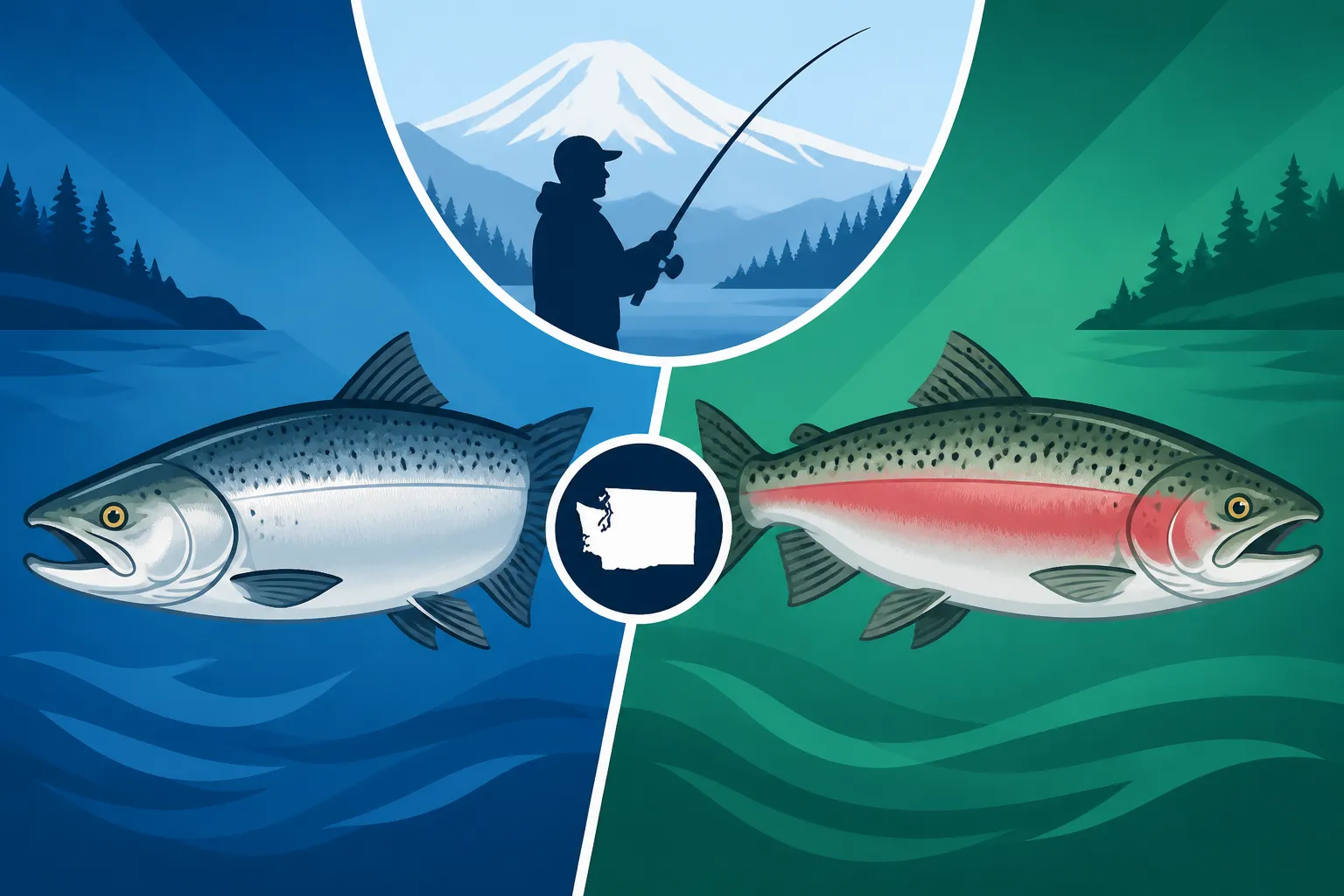
How to Tell a Chinook From a Coho
One of the trickiest parts of salmon fishing in Washington, especially for those new to our incredible waters, is confidently telling the difference between a Chinook and a Coho salmon. It’s a common frustration, believe me. You hook into a chrome bright beauty, adrenaline is pumping, and suddenly you’re staring at it, wondering, "Okay, which one are you, really?" This guide is here to unravel that mystery for you, giving you the practical know-how to make that call with confidence every single time.
The Frustration of Salmon Identification (and Why It Matters)
It's completely understandable why anglers, even seasoned ones, can sometimes scratch their heads when trying to differentiate between Chinook and Coho salmon. They're both magnificent fish, often swimming in the same waters, and sometimes their appearance can be surprisingly similar at first glance. The stakes are often high when you're making that quick decision on the boat or riverbank.
Why Anglers Mix Them Up
The overlap in fishing seasons and locations is a major culprit for confusion. You might be targeting salmon in Puget Sound, for instance, and have both Chinook (often called "Kings") and Coho (sometimes "Silvers") hitting your gear. In the early stages of their ocean life, or when they're particularly bright and fresh from the saltwater, their overall silvery sheen can make them look remarkably alike. Plus, the specific colorations can vary wildly depending on their diet, the water they're in, and how close they are to spawning. A chrome-bright, ocean-run Chinook can sometimes have less distinct spotting than a more mature one, just as a Coho might display heavier spotting in certain conditions. It's not always a clear-cut textbook example when a fish is flopping on your deck.
Another factor is the sheer excitement of the catch. When you've battled a powerful salmon to the boat, your heart is pounding, and you're eager to get it landed, the pressure to identify it quickly for retention or release can make even obvious differences seem fuzzy. We've all been there, second-guessing ourselves in the heat of the moment, especially when you know that a misidentification could lead to problems. This is particularly true if you're trying to quickly verify if it's a legal hatchery fish by checking the adipose fin clip, a common requirement for many Washington salmon fisheries.
The Importance of Correct Identification
Knowing your Chinook from your Coho isn't just about showing off your fish identification skills; it's absolutely crucial for several practical and legal reasons. First and foremost, fishing regulations in Washington often have different bag limits, size restrictions, and even open/closed seasons for each species. For example, Understanding Washington's Daily Bag Limits by Species is vital because you might be allowed to keep two Coho but only one Chinook, or vice versa, depending on the marine area or river section you're fishing. Exceeding a bag limit due to misidentification is a violation, and ignorance is rarely an excuse in the eyes of the law.
Beyond the legal aspect, correct identification is critical for conservation. Fisheries managers rely on accurate catch data to assess salmon runs and set future regulations. If anglers are consistently misreporting their catches, it can skew these numbers, potentially leading to unsustainable fishing practices or unnecessary closures. As anglers, we have a responsibility to be part of the solution, ensuring the health and future of these incredible fisheries. Getting it right helps ensure that populations remain healthy and that future generations can enjoy the same opportunities we do. Plus, there's the personal satisfaction of knowing exactly what magnificent creature you've just tangled with! It enhances your understanding of the ecosystem and your place within it.
Key Visual Differences: A Head-to-Tail Guide
To become a master of salmon identification, you need to know exactly what to look for. While there are some general characteristics, the real keys lie in a few specific, reliable markers. Think of it like a detective looking for clues; you want the most definitive evidence.
Mouth, Gums, and Teeth: The Most Reliable Clues
This is, without a doubt, your number one go-to for telling Chinook and Coho apart. Forget the body color, forget the spots for a second, and go straight for the mouth.
- Chinook Salmon (King Salmon): When you lift the gill plate or gently open the mouth of a Chinook, you'll almost always see a distinctive black gum line where the teeth meet the jaw. This is a solid black coloration, often extending to the base of the teeth on both the upper and lower jaws. It's like they've had a permanent black marker drawn along their gums. Sometimes, you'll also notice small, irregular black spots on the tongue and the roof of the mouth, though the gum line is the primary indicator. Their teeth tend to be more robust, often appearing thicker and more conical than a Coho's.
- Coho Salmon (Silver Salmon): In contrast, the Coho salmon will typically have white or very pale gums along the base of their teeth. There might be some darker pigment, but it won't be that distinct, solid black line you see on a Chinook. If you check their mouth, you'll see a lighter, almost milky white or gray coloration. Their teeth tend to be smaller, sharper, and more needle-like, usually set in a cleaner, less prominent gum line compared to the Chinook. This difference in gum line color is often referred to as the "unconditional rule" by many experienced anglers, as it's one of the most consistent identifiers.
Tail and Caudal Fin Markings: A Close Second
Once you've checked the mouth, your next best bet is to examine the tail, or caudal fin, and the caudal peduncle (the narrow part of the body leading to the tail).
- Chinook Salmon (King Salmon): Chinook often have a somewhat squared-off or slightly forked tail that can appear broader and more powerful. Crucially, they typically have irregular dark spots on both the upper and lower lobes of their caudal fin. These spots can sometimes extend onto the back of the fish, but look specifically at the fin itself. Imagine drawing a horizontal line across the center of the tail; if you see spots above and below that line, it's a strong indicator of a Chinook. Their caudal peduncle (the narrow part just before the tail) is usually thicker and more robust than a Coho's.
- Coho Salmon (Silver Salmon): Coho salmon generally have a more forked or slightly rounded tail. Their most distinguishing tail feature is that they tend to have spots only on the upper lobe of their caudal fin. The lower lobe will usually be clear of spots, or at least show very few, faint ones. It's a subtle but consistent difference that, when combined with the gum line check, can be incredibly reliable. The overall appearance of a Coho's tail might look more streamlined or delicate compared to a Chinook's powerhouse tail. This is another area where you'll want to combine this observation with other clues to be absolutely sure.
Body Shape, Coloration, and Overall Impression
While less reliable as primary identification markers due to variability, the general body shape, coloration, and overall impression can offer supplementary clues, especially once you've gained more experience.
- Chinook Salmon (King Salmon): Chinook are often described as being stockier, more robust, and generally larger-bodied than Coho of comparable length. They tend to have a deeper body from back to belly. When fresh from the ocean, they are typically a brilliant chrome silver, fading to darker backs with distinct, large, irregular spots. Their scales are relatively large. As they get closer to spawning, their coloration can shift dramatically, becoming darker, bronze, or even reddish, especially in the rivers. You might hear anglers refer to them as "blackmouth" if they're still in their bright, immature phase in Puget Sound, which hints at their dark mouth interior.
- Coho Salmon (Silver Salmon): Coho, in contrast, are generally more slender and streamlined, often described as having a more "athletic" build. They tend to have smaller scales than Chinook. Their ocean coloration is also very silvery, but often with a blue-green tint on their backs, sometimes with a more uniform appearance. The spotting on their back is typically smaller and more evenly distributed, and as mentioned, usually concentrated on the upper half of the body and only the upper lobe of the tail. Similar to Chinook, their colors will deepen and change significantly as they approach their spawning grounds, sometimes developing a deep reddish-maroon hue. While these general impressions can be helpful, always defer to the mouth and tail markings for definitive identification.
Here's a quick comparison table to keep handy:
| Feature | Chinook Salmon (King Salmon) | Coho Salmon (Silver Salmon) |
|---|---|---|
| Gum Line | Distinctive black gum line where teeth meet jaw | White or very pale gums along base of teeth |
| Tongue/Roof | Often has small, irregular black spots | Generally clear or very pale |
| Tail Spots | Irregular dark spots on both upper and lower lobes of fin | Spots primarily on the upper lobe only of fin |
| Tail Shape | Usually squared-off or slightly forked, often broader | More distinctly forked or slightly rounded, often narrower |
| Body Shape | Stockier, more robust, deeper body, larger scales | More slender, streamlined, athletic build, smaller scales |
| Overall Color | Chrome silver (ocean), dark back, large spots, can go bronze/red | Brilliant silver with blue-green back (ocean), smaller spots, can go deep red |
Practical Tips for On-the-Water Identification
Knowing the textbook differences is one thing, but applying that knowledge when you're actually fishing can be another challenge entirely. Here are some practical tips to help you make those calls quickly and confidently.
The "Unconditional" Rule and Quick Checks
The absolute best advice I can give you is to always, always start with the gum line. Seriously, make it your first check. As mentioned, the black gum line of a Chinook is almost an "unconditional" rule. If you see black, it's a Chinook. If you see white or pale, it's a Coho. This single characteristic has saved countless anglers from misidentifying their catch. You can gently open the fish's mouth to check, even while it's still in the net, to minimize stress if you plan to release it.
If you're still unsure after checking the gums (which happens, especially in low light or with a particularly feisty fish), then immediately move to the tail spots. Remember, Chinook usually have spots on both lobes, while Coho tend to have them only on the upper lobe. Combine these two checks, and you'll be right almost every time. It's a good habit to develop, almost like a mental checklist, so you don't miss a critical detail. Practicing this on every salmon you catch, even if you already know what it is, will build your confidence for when it truly matters. When you're fishing rivers like the Columbia, where both species are often present, these quick checks are invaluable, especially since you might be fishing for Chinook Salmon: Washington's King of Fish one day and Coho Salmon Fishing in Washington the next.
Carrying the Right Tools
Having the right gear on hand can significantly aid in identification and ensure you stay within the rules.
- Regulation Pamphlet: Always, always carry the current Washington Sport Fishing Regulations pamphlet, either a physical copy or easily accessible on your phone via the MyWDFW App. The pamphlet typically has clear illustrations or descriptions of how to identify various salmon species. When Reading the Washington Sport Fishing Regulations Pamphlet, pay close attention to the identification sections.
- Measuring Device: A reliable measuring tape or ruler is non-negotiable. Many regulations include minimum size limits that vary by species, so quickly checking the length of your fish is essential. You can find excellent, waterproof fish rulers that stick to your boat or tackle box, or even portable tape measures, readily available on Amazon. This is just as important as knowing How Bag and Possession Limits Work in Washington.
- Camera (with caution): While you must identify a fish before deciding to retain it, a camera can be a good tool for learning. If you're completely stumped and you're planning to release the fish anyway, a quick photo can allow you to study the features later. However, never rely on a photo to decide whether to keep a fish. That decision must be made on the water, immediately. For quick reference, many anglers also swear by laminated identification cards, often sold at local tackle shops or even on Amazon, which provide quick visual cues for multiple species.
- Gloves and a net: A good rubber-coated net is crucial for safe handling and keeping the fish contained for identification. Wearing fishing gloves can give you a better grip and protect your hands, allowing you to examine the fish more carefully without it slipping away, whether it's for a quick measure or a mouth check. This also helps protect the fish's slime coat if you're planning on releasing it, which is especially important for wild populations or if you encounter Wild Steelhead vs Hatchery Steelhead in Washington on a catch-and-release river.
Remember, practice makes perfect. The more salmon you handle and purposefully examine, the faster and more accurate you’ll become at distinguishing between Chinook and Coho. It’s an essential skill for any angler looking to responsibly enjoy Washington’s incredible fishing opportunities.
Disclaimer
This article is for general informational purposes only and does not constitute professional advice. Laws, prices and regulations vary by location and change over time. Consult a qualified professional for guidance on your specific situation.