How to Tell Cutthroat From Rainbow Trout
It's a scene many Washington anglers know well: you hook into a beautiful, feisty trout, and for a fleeting moment, you're not quite sure if it's a shimmering rainbow or a distinctive cutthroat. This confusion is totally valid! These two iconic species share many similarities, especially when they're young or in similar habitats. The truth is, telling them apart can feel like a game of "spot the difference" when you're out on the water, and knowing which is which isn't just for bragging rights; it's often crucial for staying compliant with fishing regulations. This guide is here to untangle the mystery, giving you the definitive pointers and nuances you need to confidently identify cutthroat and rainbow trout across Washington's diverse waters.
The "Red Slash" and Other Key Cutthroat Indicators
When you're trying to figure out if you've landed a cutthroat trout, the first thing many experienced anglers look for is their namesake feature. But it's not always obvious, and sometimes, it can even be misleading! Let's break down the subtle — and sometimes not-so-subtle — signs of a true Washington cutthroat.
The Signature Red Slash: What to Look For
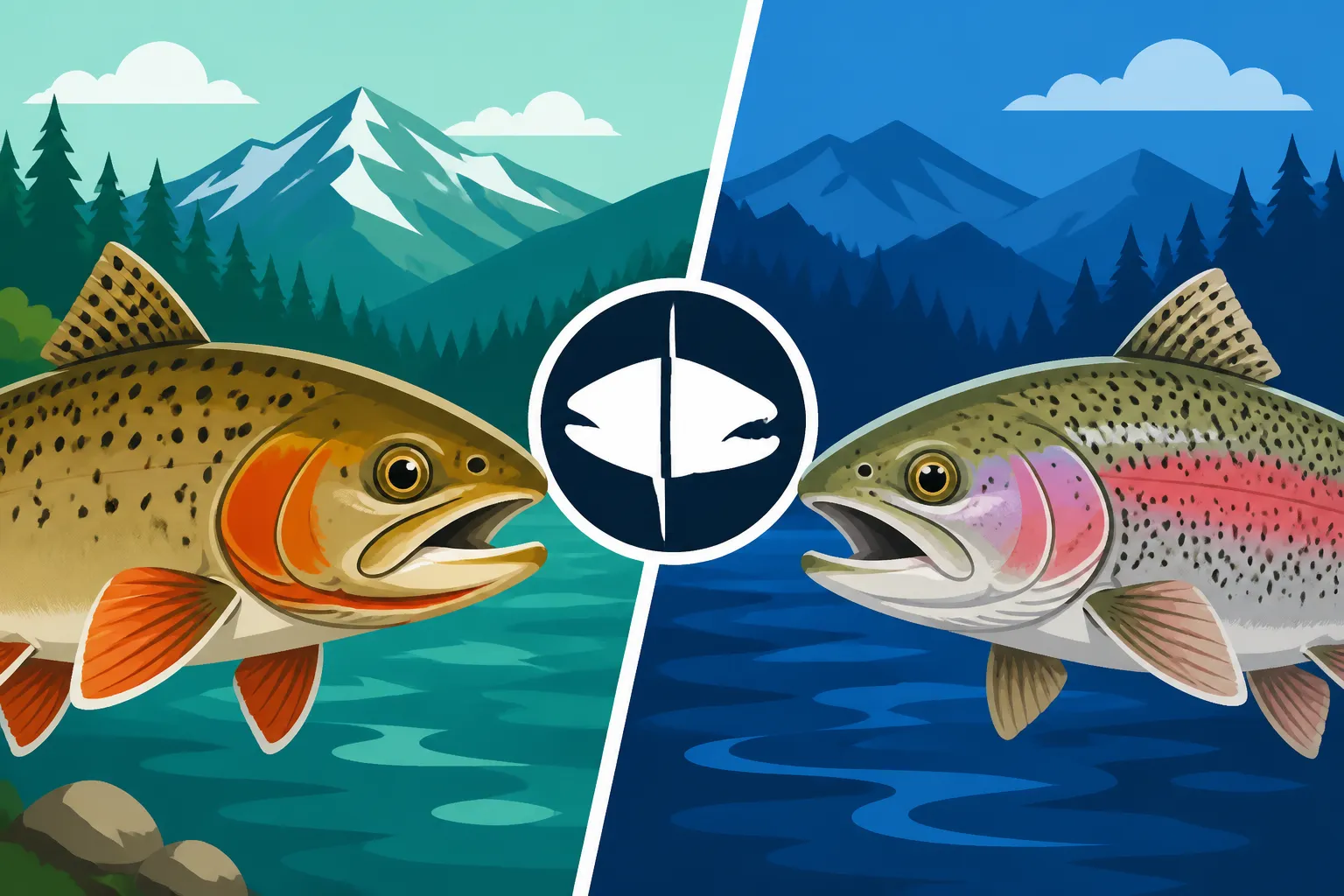
The most famous identifier for a cutthroat trout is, of course, the distinctive red or orange dash found in the fold of its lower jaw. This "cutthroat slash" is often the dealbreaker, but here's where it gets tricky: its prominence can vary wildly. Sometimes it's a vibrant, undeniable streak, glowing like a sunset. Other times, especially on smaller fish or those from certain environments, it might be faint, a pale orange, or even almost entirely absent. I've definitely had moments on the river where I've stared at a fish, angling it just right, trying to coax that slash into view, only to realize it was barely there. Factors like water clarity, diet, age, and even the fish's stress level can influence how visible this mark is. So, while it's the primary indicator, don't let a faint slash be your only decision-maker. It’s a good starting point, but you'll need to consider other features, too.
In some cases, especially with fish that have recently migrated from saltwater or are in brackish estuaries, the entire underside of their jaw might have a diffuse orange or reddish tint rather than a sharp, distinct slash. This can be particularly noticeable on sea-run cutthroat trout, which often have a more silvery appearance overall. If you're fishing in coastal rivers or Puget Sound tributaries, keep an eye out for this broader coloration if the slash itself is ambiguous. It’s like a watercolor painting rather than a sharp line, but it’s still part of that distinctive cutthroat family trait. Remember, these are living creatures, not perfectly printed specimens from a field guide you might buy from a good outdoor retailer like those you can find on Amazon.
Spots and Coloration: How Cutthroat Spots Differ
Beyond the slash, the spot pattern on a cutthroat trout is another major clue. Cutthroat generally have numerous, small, and often irregular spots that are concentrated more towards the tail and typically extend onto the caudal (tail) fin. Imagine a smattering of pepper flakes, densely packed towards the rear. These spots might be a bit larger or sparser towards the head and mid-body, but they definitely become more numerous and noticeable as you get closer to the tail. The overall body coloration can also be quite variable, ranging from olive green to yellowish-brown on the back, fading to silvery or yellowish sides and a whitish belly. Some cutthroat, particularly those found in smaller, clearer streams or alpine lakes, can exhibit truly vibrant, almost jewel-toned colors.
Compare this to a rainbow trout, and you'll often notice a significant difference. While both are spotted, the cutthroat's spots tend to be more uniform in size and often more concentrated posteriorly. Their fins, particularly the dorsal and caudal fins, will almost always have spots, which is a key distinguishing feature. The spots are usually quite dark, almost black, and don't typically have the same halo effect that you sometimes see on larger rainbow trout spots. When you're trying to identify a fish, take a moment to really observe the distribution and density of those spots, especially on the tail. This can be an even more reliable indicator than the jaw slash itself if that slash is faint or hard to see. If you want to dive deeper into their specific habitat, check out our article on Cutthroat Trout in Washington's Rivers and Lakes.
Habitat Clues: Where You Find Them
Knowing where you're fishing can also provide a huge hint. Cutthroat trout in Washington are incredibly adaptable and can be found in a wide variety of habitats. You'll encounter resident cutthroat in many freshwater streams, rivers, and high-mountain lakes across the state, both east and west of the Cascades. They thrive in colder, well-oxygenated waters, often preferring smaller tributaries, undercut banks, and areas with plenty of cover like logs and overhanging vegetation.
However, a significant population of cutthroat in Western Washington are anadromous, meaning they migrate to saltwater and return to freshwater to spawn. These "sea-run" cutthroat are a prized catch in Puget Sound and coastal rivers, and often exhibit a more silvery, ocean-bright coloration when they first enter freshwater. If you're fishing in estuarine areas, tidewater sections of rivers, or even directly in Puget Sound, the likelihood of hooking a sea-run cutthroat is high. Understanding these Sea-Run Cutthroat in Washington's Puget Sound behaviors is vital. Their presence in a particular water body often narrows down the possibilities, making identification a little easier before you even get a close look. They're opportunistic feeders, often lurking in ambush points, which is a classic cutthroat move.
Unmistakable Marks of a Washington Rainbow Trout
Rainbow trout are perhaps the most iconic freshwater fish in Washington, known for their beauty and spirited fight. While they share some features with cutthroat, there are definite visual cues that can help you confidently identify a rainbow. Learning these distinctions will make you a more informed angler and ensure you're following local rules, especially since Steelhead vs Rainbow Trout: What's the Difference? can also be a point of confusion.
The Rainbow Stripe: Its Prominence and Variations
The most defining characteristic of a rainbow trout is, naturally, the rainbow stripe. This lateral band, often iridescent pink, red, or purple, runs along the sides of the fish from gill plate to tail. On some fish, particularly larger, wild specimens or those in pristine waters, this stripe can be incredibly vibrant and unmistakable. It truly looks like a streak of a rainbow caught on their side. However, just like the cutthroat's slash, the intensity of this stripe isn't always consistent. Hatchery-raised rainbow trout, for example, might have a paler, more subdued stripe, or it might be less defined. Fish under stress, or those recently moved to a new environment, can also have their colors "dull down" temporarily.
You'll find that in very clear, cold mountain streams, the stripe might be more vivid, while in some larger lakes or reservoirs, it could be a softer, rosier hue. Sometimes, if the light is poor, or the fish is very fresh out of the water, that stripe can seem to disappear, making identification trickier. It's not uncommon for anglers, myself included, to pause and rotate a fish to catch the light just right, waiting for that tell-tale shimmer of pink to confirm it's a rainbow. It's a hallmark of the species, but like any natural marking, it has its variations, which keeps us on our toes!
Spot Pattern: How Rainbow Spots Differ from Cutthroat
While both species are spotted, the pattern and distribution of spots on a rainbow trout are generally quite different from a cutthroat. Rainbows typically have smaller, more numerous spots that are evenly distributed over their entire body, including the head, gill plates, and all fins. Think of them as having a fine, consistent speckling rather than a concentration towards the tail. These spots are usually black or dark brown. A key differentiator from cutthroat is that rainbow trout spots almost always extend onto the head, gill covers, and often all fins, rather than being primarily on the body and tail fin.
Another subtle but important detail is that on some larger rainbow trout, especially those from wild populations, the spots might have a slight "halo" effect around them, appearing a bit lighter at the edges. This isn't a universal rule, but it's something to observe. The tail fin of a rainbow trout will often be heavily spotted, almost appearing speckled, which is distinct from the more uniform, concentrated spotting on a cutthroat's tail. When you're fishing for Rainbow Trout Fishing in Washington, taking a moment to examine the entire fish, from nose to tail, is the best way to leverage this spot pattern for identification. It's all about the distribution.
Fin Details: Subtle Differences in Fins
While less obvious, there can be some subtle differences in fin characteristics that help distinguish these two species. Rainbow trout tend to have more rounded fins, particularly their pectoral and pelvic fins, compared to the slightly more pointed fins you might observe on some cutthroat. The adipose fin (the small, fleshy fin on the back near the tail) is present on both, but its size and shape can be slightly different, although this is usually too subtle for reliable field identification.
More noticeably, as mentioned with spot patterns, all fins on a rainbow trout are typically spotted, whereas a cutthroat's spots are often less pronounced on the pectoral, pelvic, and anal fins, with the heaviest spotting on the dorsal and caudal fins. The overall robustness of the fins can also vary; a wild, river-dwelling rainbow might have incredibly powerful, broad fins for navigating currents, while a hatchery fish's fins might be more worn or stubby. The tail fin of a rainbow is also typically squarish or slightly forked, whereas some cutthroat can have a slightly more emarginate (slightly indented) tail, though this isn't a hard and fast rule. When trying to How to Tell a Steelhead From a Rainbow Trout, these fin details, combined with other markers, become even more important.
Beyond the Looks: Behavior and Habitat Distinctions
While visual cues are paramount for identifying your catch, understanding the typical behaviors and preferred habitats of cutthroat and rainbow trout can give you a significant advantage. Sometimes, knowing "where you are" helps immensely with "what you caught."
River Dwellers vs. Lake Lovers: General Preferences
Generally speaking, you'll find both species in rivers and lakes, but they often have different preferences that can sometimes aid in identification. Rainbow trout are incredibly adaptable and are stocked extensively in Washington's lakes and ponds. Many of Washington's "put-and-take" fisheries, designed for recreational angling, are dominated by hatchery-raised rainbow trout. They thrive in a wide range of lake environments, from small alpine tarns to large reservoirs like Lake Chelan and Lake Roosevelt. When you're pulling a fish from a lake that gets regular stocking, the odds are often in favor of it being a rainbow.
Cutthroat trout, on the other hand, especially the native Westslope and Coastal varieties, are often thought of as quintessential river and stream fish. They absolutely love smaller, brushy streams and undercut banks. While you'll find them in lakes, particularly high-mountain lakes or those connected to good stream systems, they often don't populate the same kind of large, open-water lake environments as heavily as rainbows do, unless they are the dominant native species. Of course, the sea-run cutthroat are distinctively river-and-estuary fish for much of their life cycle. So, if you're deep in a small, wild mountain stream, a cutthroat is a strong contender. If you're on a popular, easily accessible lake, it's often a rainbow. This isn't a foolproof method, but it's a good general heuristic.
Diet and Feeding Habits: What They Eat
Both rainbow and cutthroat trout are opportunistic feeders, but their typical diets can reflect their habitat preferences. Rainbow trout, particularly those in lakes, will often feed on a wide variety of prey, including insects (aquatic and terrestrial), small crustaceans, minnows, and even zooplankton. If you examine the stomach contents of a lake-dwelling rainbow, you might find a mix of tiny bugs and perhaps some processed pellet food from their hatchery days. In rivers, rainbows are voracious insectivores, readily taking nymphs, dries, and streamers.
Cutthroat trout, especially in river and stream environments, are known for being extremely aggressive and predatory, often having a stronger preference for larger insect patterns, baitfish, and even small rodents or amphibians in some cases. They are famous for their willingness to strike a dry fly, often rising eagerly to consume surface insects. Sea-run cutthroat, while in saltwater, will feed heavily on baitfish like herring and sand lance, building up their size and strength before returning to freshwater. Their predatory nature often means they can be caught on more aggressive presentations, and if you're seeing a fish eagerly smash larger flies or lures in a stream, it very well could be a cutthroat. You can learn more about general trout fishing in our article on Washington's River Trout Limit.
Sea-Run Variations: A Special Case for Both
Washington is unique in having both sea-run cutthroat and sea-run rainbow trout (which we call steelhead). This adds another layer of complexity to identification, as their anadromous phase brings distinct changes. Sea-run cutthroat, when fresh from the saltwater, are typically very bright, silvery fish with a greenish-blue back, and their characteristic red or orange jaw slash might be somewhat muted or diffuse against their silvery scales. They tend to stick closer to the coast and estuaries, entering rivers for shorter periods to spawn.
Steelhead, the sea-run form of rainbow trout, are similarly bright and silvery when they first enter freshwater. The key distinction from sea-run cutthroat is that steelhead still retain the rainbow's typical spot pattern (evenly distributed, including on the head and fins), and they lack the cutthroat's distinctive jaw slash. Steelhead also undertake much longer, more arduous migrations upriver to spawn, often traveling hundreds of miles inland. When a steelhead has been in freshwater for a while, its silvery sheen might start to fade, and its rainbow stripe can become more pronounced, sometimes leading to confusion with resident rainbow trout. But remember, steelhead are much larger, wilder, and built for that epic journey. Understanding that both species have sea-run forms underscores the importance of looking for those fundamental identifying marks rather than relying solely on coloration, which can change dramatically.
Why Accurate Identification Matters for Anglers
Mistaking a cutthroat for a rainbow, or vice-versa, might seem like a minor oversight, but in Washington's carefully managed fisheries, accurate identification can have real consequences. It's not just about knowing your fish; it's about respecting the resource and staying within the rules.
Bag Limits and Regulations: Different Rules for Different Fish
One of the most critical reasons for correctly identifying your trout is the difference in bag limits and regulations. Washington Department of Fish and Wildlife (WDFW) often sets different rules for rainbow trout and cutthroat trout, especially concerning wild fish versus hatchery fish. For example, some rivers or lakes might have a higher bag limit for hatchery rainbow trout, identifiable by a clipped adipose fin, while simultaneously requiring the release of all wild rainbow trout or cutthroat. In other areas, you might have a limit of two cutthroat but five rainbow trout, or even specific slot limits that apply to one species but not the other.
Imagine you're on a river, and you've caught a few fish. If you misidentify a wild cutthroat as a hatchery rainbow and keep it, you could be in violation of the law. These rules are put in place to protect fragile wild populations and ensure sustainable fishing for everyone. It's why carrying a copy of the current Washington Fishing Regulations Every Angler Should Know is so important, and why I often recommend a good laminated field guide (easily found on Amazon, by the way) that you can refer to on the water. Taking the time to properly identify your catch ensures you're fishing responsibly and legally. Pay close attention to the specific rules for the waterbody you're fishing.
Conservation and Ethical Angling: Protecting Wild Populations
Beyond legal compliance, accurate identification is a cornerstone of ethical angling and conservation. Many of Washington's cutthroat trout populations, particularly the native Westslope and Coastal varieties, are considered more sensitive than some of the widely stocked rainbow trout. Wild populations of both species contribute significantly to the genetic diversity and ecological health of our waterways. By understanding which fish you've caught, you can make informed decisions about whether to keep it or release it, especially when regulations allow for retention of hatchery fish but require the release of wild ones.
Catch and release, when practiced properly, is a powerful conservation tool. If you accidentally catch a fish that needs to be released, knowing how to identify it ensures you handle it minimally and return it to the water quickly. This respect for the resource helps preserve fishing opportunities for future generations. Our goal as anglers is not just to catch fish, but to ensure there are healthy fish populations thriving in Washington's waters for years to come. Understanding the distinctions between species is a vital part of that commitment. For information on general catch and release practices, see Catch-and-Release Rules During Wild Steelhead Closures.
When In Doubt: Catch and Release
Let's be realistic: even with all the knowledge in the world, sometimes you're going to catch a fish that just makes you scratch your head. Maybe the light is bad, the fish is small, or its markings are simply ambiguous. What do you do in that situation? The golden rule of ethical angling is: when in doubt, release the fish. It's far better to err on the side of caution than to accidentally violate a regulation or negatively impact a vulnerable fish population.
If you're unsure, treat the fish with the utmost care. Minimize handling, keep it in the water as much as possible, use wet hands, and use a de-hooking tool if needed. If you want to get a better look, use a clear, shallow net or a transparent fish-friendly viewing container to confirm its identity without stressing it out of the water. Take a quick photo if you want to identify it later, but prioritize the fish's health. Releasing an unidentified fish is always the safest and most responsible choice. It ensures you're not breaking any rules, and it contributes to the health of Washington's amazing trout fisheries.
Here's a quick comparison table to help you keep things straight:
| Feature | Cutthroat Trout | Rainbow Trout |
|---|---|---|
| Jaw Slash | Red/orange slash in the fold of the lower jaw | No slash or distinct markings on the lower jaw |
| Body Spots | Numerous, small spots, often concentrated near tail | Numerous, small spots, evenly distributed |
| Head Spots | Usually few to no spots on head/gill plates | Spots often extend onto head and gill plates |
| Fin Spots | Heaviest spotting on dorsal and caudal (tail) fins | Spots typically on all fins, including pectorals |
| Lateral Band | Usually absent or very faint | Distinct iridescent pink/red/purple stripe |
| Overall Color | Olive green/brown back, silvery/yellowish sides | Dark back, silvery sides, often with colorful stripe |
| Tail Fin | Often heavily spotted, can be slightly emarginate | Heavily spotted, typically squarish or slightly forked |
| Common Habitat | Smaller rivers, streams, high-mountain lakes, estuaries | Wide variety of lakes, larger rivers, stocked waters |
Disclaimer
This article is for general informational purposes only and does not constitute professional advice. Laws, prices and regulations vary by location and change over time. Consult a qualified professional for guidance on your specific situation.