How to Read Water for Bank-Fishing Salmon
Have you ever stood on the bank of a beautiful Washington river, rod in hand, staring at the water and feeling completely lost? It's a common, utterly frustrating experience. You know salmon are in there, you might even see a few roll, but trying to figure out where to cast, why they're holding in one spot over another, and how to present your lure or bait effectively can feel like trying to solve a puzzle with half the pieces missing. This guide is all about giving you those missing pieces, showing you how to "read the water" like a seasoned pro so you can confidently target those elusive salmon from the bank.
Understanding Salmon Behavior and River Dynamics
Before you can truly read the water, you need to step into a salmon's fins for a moment. What drives them? What makes them choose one spot over another? It's all about energy conservation, safety, and opportunity. Salmon migrating upstream are constantly battling currents, looking for places to rest, hide from predators, and occasionally feed, even if they aren't actively eating in the same way they do in saltwater.
Current Breaks and Eddies: Salmon's Resting Spots
Imagine swimming against a strong current for miles – you'd get exhausted quickly, right? Salmon feel the same way. They are masters of energy conservation, and that's why current breaks and eddies are their absolute favorite hangouts. A current break is anything that disrupts the main flow of the river, creating a softer water seam or a pocket where the current is significantly slower, or even swirling upstream (an eddy).
Think of a large boulder in the middle of a swift run. On the upstream side, just in front of the rock, there's a cushion of slower water. Immediately downstream, there's a larger, often circular eddy where the water spins back upstream before joining the main current again. Both of these spots are prime real estate for salmon. They can hold here with minimal effort, letting the current bring potential food or debris to them, or simply resting before tackling the next section of fast water. Sometimes, a subtle seam that looks like nothing more than a ripple change on the surface is actually a significant current break below, created by underwater structure or a change in depth. These are often overlooked but incredibly productive spots.
Depth and Cover Preferences: Safety and Opportunity
Salmon are also keenly aware of their surroundings, particularly when it comes to depth and cover. Deeper water provides a sense of security, protecting them from overhead predators like eagles or ospreys, and offering a stable, often cooler, environment. This is why pools, deep runs, and even surprisingly deep pockets close to the bank can be salmon magnets.
Beyond just depth, physical cover is crucial. Overhanging trees, submerged logs (often forming log jams, a classic salmon hold in many Washington rivers), large boulders, and undercut banks all provide vital hiding spots. These areas give salmon a place to retreat if they feel threatened and can also offer shade on bright days. A log jam might look like an impenetrable mess, but it often creates a fantastic current break and deep water pockets on its edges, or even within its structure if there are clear lanes. When you're bank fishing, always scan for these features. A seemingly innocuous bend in the river that creates an undercut bank on the outside corner is a textbook salmon lie. Even something as simple as a dark patch of water under a bridge can offer the cover and depth salmon seek.
Key Features to Look For: Identifying Prime Salmon Holds
Once you understand why salmon hold where they do, the next step is to train your eyes to spot those prime locations. It's like learning to read a secret map laid out by the river itself.
Seams and Current Lines: The Invisible Highways
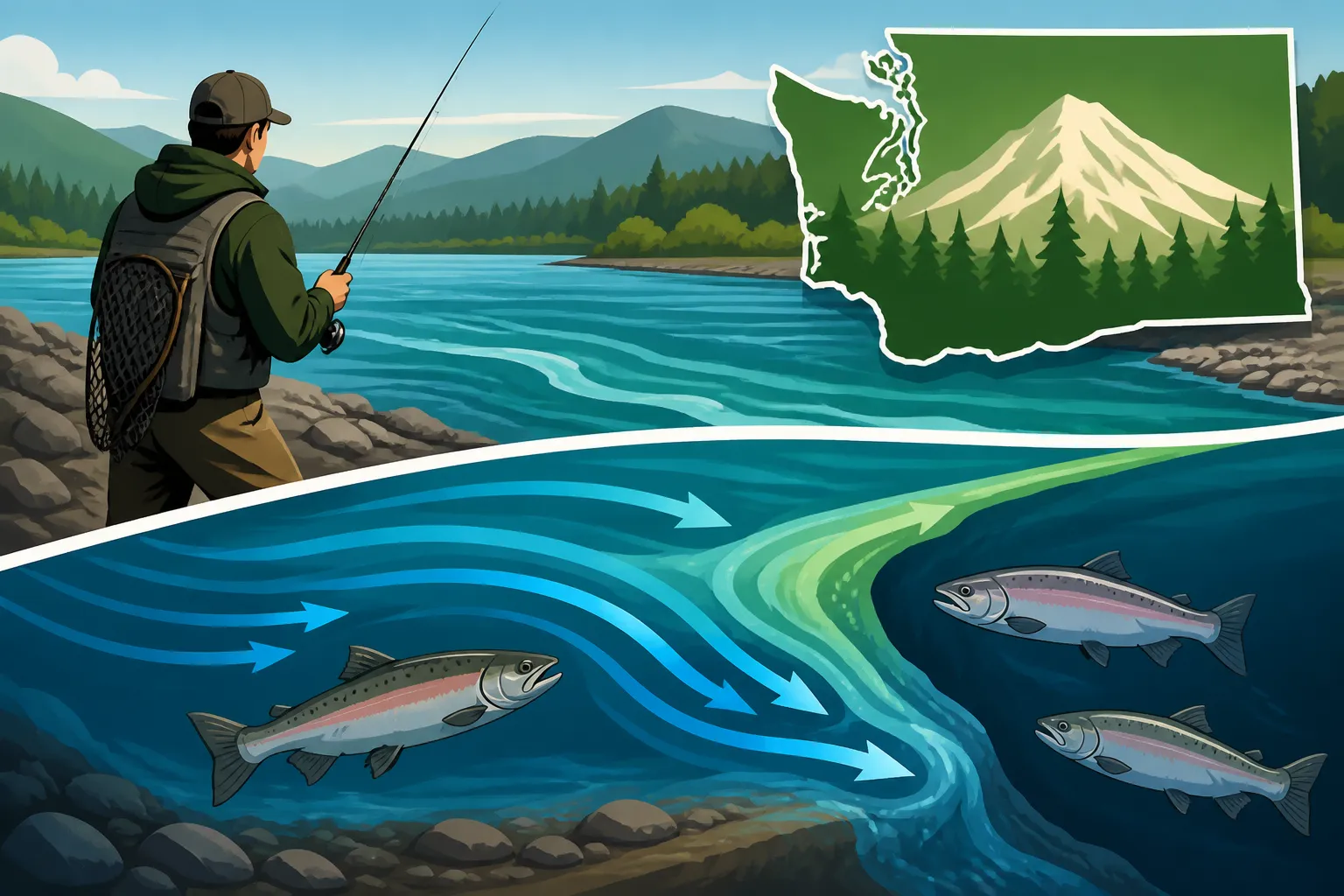
Seams are perhaps the most crucial feature to recognize. They are the visible (or sometimes invisible) lines where two different currents meet. Often, one side will be faster water, and the other slower. These are like the highways for migrating salmon. Fish will travel along these seams because they offer a path of least resistance while still providing access to the main current if they need to move quickly.
You'll often see these as distinct lines on the water's surface, sometimes marked by a foam line or debris collecting along them. A classic example is the seam created at the edge of an eddy, where the swirling water meets the downstream flow. Another is the line where the swift main channel meets a slower, shallower section near the bank. These seams are not only travel lanes but also ambush points. Salmon will hold in the slower water just off the seam, waiting for food items to drift by in the faster current. Learning to identify these subtle transitions, especially where a faster current brushes past a slower pocket of water, will dramatically improve your success. This is often where you'll find fish holding for an opportunity.
Riffles, Runs, and Pools: The River's Anatomy
Rivers naturally arrange themselves into a sequence of riffles, runs, and pools, each offering different conditions that salmon exploit.
- Riffles: These are shallow, fast-moving sections of water, often with a broken, turbulent surface. While salmon typically don't hold in the fastest part of a riffle, they are crucial feeding zones because the fast water oxygenates the water and dislodges insects and other food sources. Salmon will often stage in the deeper water just below a riffle, waiting for food to wash downstream, or at the head of a riffle, anticipating their next push upstream.
- Runs: These are deeper, smoother sections of flowing water, often with a consistent current. Runs are prime travel corridors and holding areas. They offer a good balance of depth, current, and oxygen. When you're bank fishing, pay close attention to the most consistent, deep sections of a run, especially where the current flows uniformly. These are often excellent places to drift bait or cast spinners and spoons. Many seasoned anglers consider a long, deep run to be the most productive type of water for consistently finding salmon.
- Pools: These are the deepest, slowest sections of the river. Pools are primarily resting and staging areas. Salmon will often congregate in pools, particularly after navigating a difficult stretch of river or before entering another. The deepest part of a pool, often near an undercut bank or submerged structure, is a prime holding spot. On sunny days, pools also offer refuge from bright light. They are often targeted with weighted presentations that can get down to the fish holding deep in the slower current.
Understanding the transition zones between these different features is also key. The tail-out of a pool (where it shallows and speeds up into a riffle) and the head-out of a riffle (where it deepens into a run or pool) are especially productive.
Log Jams, Boulders, and Undercuts: Natural Havens
Beyond the general river anatomy, specific structures provide critical cover and current breaks.
- Log Jams: These are formidable masses of fallen trees and debris. While they can be frustrating to fish around, their edges and the pockets they create are salmon magnets. The water around a log jam is often deeper, slower, and provides excellent cover. Always approach with caution, as snags are common, but don't ignore them. Look for lanes of fishable water alongside or just downstream of the main jam.
- Boulders: Even single large boulders in a river create a distinct current break directly in front of and behind them. The "cushion" water upstream and the eddy downstream are classic salmon lies. If you see a series of boulders, the lanes of slower water between them are also worth exploring. These are micro-habitats that offer everything a salmon needs to rest and avoid the main current.
- Undercut Banks: These occur when the river's current erodes the bank beneath the surface, creating a cavern-like overhang. Undercut banks offer incredible cover and shade, often with significant depth right against the bank. Salmon love these spots for safety and shelter. They are notoriously difficult to fish effectively from the bank without snagging, but they are absolutely worth the effort. A precise cast that allows your presentation to drift naturally into the undercut can be incredibly rewarding.
Pinch Points and Channel Constrictions: Bottlenecks for Fish
Anywhere the river channel narrows or is constricted creates a natural "pinch point." This forces all the water, and consequently, all the migrating fish, through a smaller area. These are critical ambush points for anglers.
Pinch points can be caused by natural rock formations, large gravel bars pushing into the main channel, or even man-made structures like bridge pilings. In these areas, the current usually speeds up, and the water often deepens. Salmon will either move through these quickly or hold in the eddies and slower water just above or below the constriction, gathering their energy before pushing through. They're forced to funnel through a smaller area, making them more concentrated and predictable targets. Fishing these spots often requires a heavier presentation to get down quickly in the faster current or lighter gear to meticulously work the edges of the slower pockets. If you find a spot where the river suddenly narrows, you've likely found a place where migrating salmon will stack up, making it a hotspot for those targeting Washington fishing.
Putting It All Together: A Step-by-Step Approach to Bank-Fishing
So, you've got the knowledge about where salmon hold. Now, how do you apply it systematically on the riverbank? It's about observation, strategy, and patience.
Starting Broad: Scanning the River
When you first arrive at a new stretch of river, don't just immediately cast. Take a moment, or ten, to simply observe. This initial scan is crucial for reading the water.
Stand high on the bank if possible, or move along it slowly, looking for the big picture. Where is the main current flowing? Are there any obvious current breaks, large boulders, or log jams? Can you spot any distinct seams or foam lines? Look for changes in water color, which might indicate depth changes or different bottom compositions. Pay attention to surface activity – any jumping fish, nervous baitfish, or even the subtle dimples that might indicate a fish rising or rolling. Even in a strong current, a salmon roll is unmistakable and immediately tells you that fish are present in that general vicinity. You might even find it helpful to use polarized sunglasses, which you can easily find on Amazon, to cut the glare and see into the water better. This broad scan helps you prioritize which areas to focus on first, rather than just blindly casting everywhere.
Focusing In: Targeting High-Probability Spots
Once you've done your initial scan, it's time to narrow your focus to the most promising spots. These are the "high-probability" areas where salmon are most likely to be holding.
Based on your observations, identify the most obvious current breaks, the deepest sections of runs and pools, the edges of log jams, and any visible seams. Mentally map out your target zones. If you see a particularly good eddy downstream of a large rock, that's where you'll want to concentrate your efforts. If a section of river flows past an undercut bank, you'll want to figure out how to get your gear into that zone without immediately snagging. When you consider Bank Fishing Techniques for Washington Salmon, these targeted casts are far more effective than simply fanning casts across open water where fish are less likely to hold. Remember that salmon are often found in predictable locations, so once you start recognizing these features, you’ll find them in similar spots on different rivers.
Working the Water Systematically
After identifying your target spots, approach them systematically. Don't just make one cast and move on. Think of it like a grid, covering every potential holding lie.
Start at the upstream edge of a promising area and work your way downstream, or fan your casts to cover the entire width of a run. Adjust your casting distance and angle to allow your lure or bait to drift naturally through the prime holding lies. If you're drift fishing with bait, try different sinker weights or leader lengths to ensure your presentation is getting into the strike zone. Sometimes, a slight change in the angle of your cast or a little more weight (consider your Sinker Weight for Drift Fishing) is all it takes to trigger a bite. If you're casting spinners or spoons, vary your retrieve speed and depth until you find what triggers a response. Don't be afraid to experiment with different presentations. Sometimes the fish are higher in the water column, other times they're glued to the bottom. Persistence and methodical coverage of a likely holding area often pay off big.
Seasonal and Water Condition Considerations
Reading the water isn't a static skill; it adapts to the ever-changing conditions of the river. The time of year, water levels, and clarity all play a huge role in where salmon will be and how they'll behave.
Impact of Water Level and Clarity
Water levels and clarity are perhaps the most significant factors affecting bank fishing success. A clear understanding of these can drastically change your approach.
- High Water: When the river is high, the current is stronger, and the water is often off-color or muddy. Salmon will move closer to the banks, seeking refuge from the main current in slower pockets, eddies, and behind any available structure. Focus your efforts on the very edges of the river, in flooded back channels, and behind large obstructions that offer significant breaks. Fish might also be holding closer to submerged cover that would be exposed at lower flows. This is often a time for larger, more visible lures or bait with strong scents to compensate for the reduced visibility.
- Low Water: In contrast, low water levels mean slower, often clearer water. Salmon become much warier and will retreat to the deepest pools and runs, often holding tight to cover. Stealth becomes paramount. You'll need to use lighter lines, smaller presentations, and make longer casts to avoid spooking fish. This is when How Water Clarity Affects Steelhead Fishing, a principle that applies equally to salmon, really comes into play. Extremely clear water requires a much more delicate approach, as fish can see you and your gear much more easily.
- Optimal Water: The "sweet spot" is often when water levels are dropping after a high-water event, but before the river gets too low and clear. This often means good flow, slightly off-color water with good visibility, and fish that are actively moving and less spooky. These are the days we all dream of!
Always check the local river gauges before heading out. Websites like the USGS National Water Information System provide real-time data for many Washington rivers, which can give you a heads-up on conditions.
Time of Year and Salmon Migration
The time of year dictates which salmon species are in the river and where they are in their migration cycle, directly influencing where you should be looking.
Different salmon species have different run timing. For instance, When Chinook Salmon Run in Washington's Puget Sound, they might be found in different parts of a river system than coho salmon, whose runs often peak later in the fall. Early in the run, fresh fish might be pushing hard upstream, often traveling through faster water and resting in mid-river runs and deeper pools. As the season progresses and fish near their spawning grounds, they'll often hold in shallower water with good gravel, closer to areas where they intend to spawn. For example, knowing When Coho Salmon Run in Washington, you might target the lower river sections in September and October, then move upstream to tributaries in November. Reading the water during these different phases means looking for different types of holding water – deep transit lanes versus shallower staging areas. Your knowledge of Washington Sport Fishing Seasons and Emergency Closures, found in the WDFW pamphlet, is essential here, as closures and specific regulations shift throughout the year and by species.
Weather Effects and Barometric Pressure
While less tangible than water levels, weather and atmospheric pressure can also influence salmon behavior and, therefore, how you read the water.
- Rain: Fresh rain, especially after a dry spell, can often perk up salmon activity. It adds fresh, cool water to the system, increases flow, and can bring in new fish from saltwater. It also dirties the water slightly, providing a sense of security for the fish. This is often a time when salmon move more aggressively, and you might find them in slightly shallower water than usual. Remember your Rain Gear You Need for Winter Steelheading, as these prime fishing days often come with a good soaking!
- Bright Sun: Clear, sunny days can make salmon more hesitant and prone to holding in deep, shaded areas. Overcast days, conversely, often encourage fish to move more freely and hold in a wider variety of water types.
- Barometric Pressure: While often debated, many experienced anglers believe falling or stable low barometric pressure can make fish more active, while high, stable pressure can make them lethargic. This isn't something you can visually "read" on the water, but it's a factor to keep in the back of your mind as you observe fish behavior. A subtle shift in pressure might mean the difference between fish sitting tight to the bottom and those willing to move for a presentation.
By combining your understanding of salmon behavior, an eagle eye for river features, a systematic approach, and an awareness of environmental conditions, you'll dramatically improve your chances of success on the bank. It's a skill that takes time to develop, but every outing is a chance to learn and refine your ability to truly read the water.
Disclaimer
Fishing regulations in Washington State are subject to frequent changes, often on short notice due to emergency rule modifications. Always consult the official Washington Department of Fish and Wildlife (WDFW) regulations pamphlet and check for emergency rule changes before heading out on any fishing trip. This guide is for informational purposes only and does not replace official regulations.