Depth Washington Chinook Hold at in Summer
One of the biggest head-scratchers for Washington anglers, especially during those long, sunny summer days, is figuring out just where those elusive Chinook salmon are hiding. It’s incredibly frustrating to be out on the water, seeing acres of open Puget Sound or the vast ocean, and knowing there are king salmon down there somewhere, but not having a clue how deep to drop your gear. You might troll for hours, change lures, adjust your speed, all while wondering if you’re fishing 50 feet above them or 50 feet below them. This guide is dedicated to demystifying that crucial question: how deep do Washington Chinook typically hold in the summer, and how can you increase your chances of finding them?
Understanding Chinook Summer Behavior and Depth Preferences
To truly grasp where Chinook salmon hang out in the summer, you need to think like a salmon. These powerful fish aren't just swimming around aimlessly; they're driven by instincts related to survival, comfort, and most importantly, food. Summer conditions in Washington's marine environments, whether you're in the calm waters of the Sound or out on the open Pacific, create specific environmental cues that dictate where these majestic fish will spend their time.
The Thermocline and Water Temperature
One of the most significant factors influencing Chinook depth in summer is water temperature. Like most salmon, Chinook prefer cooler water, usually in the range of 45-55 degrees Fahrenheit (7-13 degrees Celsius). As the summer sun heats the surface layers, a distinct thermal boundary forms in the water column called a thermocline. Above this line, the water is warmer and less oxygenated. Below it, the water is significantly cooler and often richer in oxygen.
Imagine you're trying to find a comfortable spot on a hot day; you'd probably head for the shade or an air-conditioned room. Chinook do the equivalent in the water. They'll actively seek out this cooler, more stable water beneath the thermocline. In Puget Sound, the thermocline can set up anywhere from 30 to 80 feet, depending on the marine area, recent weather patterns, and freshwater input from rivers. Offshore, the thermocline can be deeper, but the principle remains the same. Anglers often refer to this as the "comfort zone" for salmon. If your gear is above this zone, you're likely fishing in water too warm for active Chinook. If it's too deep below it, you might be missing the bait.
Baitfish Location and Food Sources
Chinook salmon are apex predators, and their movements are intimately tied to the location of their food. In Washington waters, particularly in summer, this means following schools of baitfish like herring, anchovies, candlefish, and juvenile salmon. These baitfish also have their own depth preferences, often congregating along or just above the thermocline, or near underwater structures where they can find cover and food themselves.
Consider a typical summer day in Marine Area 9, near Edmonds or Kingston. If herring are schooling at 80-100 feet, you can bet that the Chinook won't be far behind, likely cruising through or just beneath those bait balls, waiting for an opportunity to strike. Your fish finder is your best friend here, as it will often show you dense clouds of bait. If you mark bait at a specific depth, that's a strong indicator that Chinook could be in the vicinity. Fishing at the wrong depth means you're not putting your lure in front of the hungry fish following their primary food source, making successful hook-ups much less likely.
Light Penetration and Predator Avoidance
Beyond temperature and food, light conditions play a subtle but important role in Chinook depth preferences during summer. In clear summer waters, especially on bright, sunny days, the surface can be quite exposed. Chinook, being large, predatory fish, often prefer lower light conditions. This not only offers them a sense of security from overhead predators (like seals and eagles) but also provides an ambush advantage when hunting baitfish.
Think of it like a hunter in a forest, using shadows and cover to get close to their prey. Chinook use the deeper, dimmer water column for the same purpose. They might rise to hit bait closer to the surface during dawn, dusk, or overcast conditions, but through the brightest parts of the day, they frequently retreat to deeper, darker water. This means on a bluebird summer day, you might need to drop your gear further down than you would on a cloudy, rainy day to find actively feeding fish. Understanding these behavioral nuances is key to knowing when to adjust your depth.
Typical Summer Depth Ranges in Washington Waters
While the exact depth can vary daily, or even hourly, there are some general patterns to Chinook holding depths during the summer in Washington. These patterns differ depending on whether you're fishing in the relatively protected waters of Puget Sound or out on the vast Pacific Ocean.
Puget Sound Dynamics
In Puget Sound, summer Chinook can be found in a wide range of depths, but generally, they'll be deeper than you might expect. Many anglers start their search in the 60-120 foot range, especially in popular spots like Midchannel Bank, Point No Point, or Possession Bar. However, this is just a starting point.
- Early Morning/Late Evening: During low light, Chinook might venture shallower, sometimes even hitting gear trolled at 40-60 feet, particularly if bait is pushed up near the surface by currents or structure. This is often the prime time for a "blackmouth" (resident Chinook) bite.
- Mid-Day Sunshine: As the sun climbs high, expect to find them considerably deeper. It's not uncommon for fish to be caught at 90, 110, or even 130 feet when the sun is blazing. The key is finding that sweet spot where the thermocline meets abundant bait. You might find some useful insights on specific times in our guide to the Best Time to Fish for Chinook in Washington's Puget Sound.
- Structure-Oriented Fish: Chinook also relate heavily to underwater structure, like reefs, humps, and ledges. If you're fishing an area with good structure, the fish might hold at a consistent depth along that structure, regardless of the overall water depth, often positioning themselves on the "up-current" side to ambush bait. For example, near the old Edmonds ferry dock, some anglers focus on a specific depth along the drop-off where Chinook are known to stage.
A good example of this variability is when fishing for Chinook Salmon: Washington's King of Fish in different marine areas. In areas with deep, fast-moving currents like Admiralty Inlet, Chinook might hug the bottom in 150-200 feet of water. In shallower, protected bays, they might still be down 60-80 feet, even if the total water depth is only 100 feet. Always pay attention to your electronics and what local reports are indicating.
Coastal and Ocean Fisheries
When you venture out to the Washington coast, whether from Westport, Ilwaco, or Neah Bay, the depths can be even more pronounced. Offshore Chinook fishing, often targeting migratory fish heading to distant rivers, typically involves fishing much deeper than in the Sound.
- Continental Shelf and Structure: Out on the Pacific, Chinook often relate to the edge of the continental shelf or specific offshore banks and pinnacles. Depths of 100-250 feet are not uncommon for trolling. These fish are often larger, more aggressive feeders, and might be spread out over a wider depth range.
- Bait Balls Offshore: Just like in the Sound, where the bait goes, the Chinook follow. Massive schools of anchovies or herring can be found at various depths offshore. When these bait balls are located, you'll want to target your presentation right through or just below them. Many charter captains will spend a significant amount of time searching for these bait concentrations.
- Temperature Upwellings: Coastal waters can also experience upwellings, where cold, nutrient-rich water from the deep ocean rises to the surface. This can create distinct temperature breaks that concentrate bait and, subsequently, Chinook, often dictating where the fish will stack up. It’s a dynamic environment, and constant monitoring of your fish finder is essential. While not always the same species, some of the techniques for Halibut Fishing Techniques for the Washington Coast also apply to deep-water Chinook, as both require precision depth control.
River Mouths and Estuaries
As summer progresses and Chinook begin their migration towards their natal rivers, their depth preferences can change again, especially as they approach river mouths and estuaries. Here, the mix of freshwater and saltwater, along with strong currents and shallower depths, creates a unique environment.
- Tidal Influence: In river mouth fisheries like Buoy 10 on the Columbia River, or near the mouth of the Cowlitz or Skagit, depth is heavily influenced by tides. Incoming tides often push bait and salmon into shallower channels, while outgoing tides might see fish holding deeper in scour holes or along current breaks.
- Current Seams: Chinook will use current seams and eddies to conserve energy while waiting for favorable conditions or migrating upstream. These seams can be found at various depths, often where fast water meets slower water. Fishing these areas might mean targeting depths of 20-60 feet, but always observing how the fish are relating to the current.
- Transitional Depths: In these transitional zones, Chinook might be more willing to come up for baits or lures presented higher in the water column, especially during periods of low light or heavy overcast. This is a contrast to the deep-water tactics often employed in the open ocean or even in the deeper parts of Puget Sound.
| Area | Typical Summer Chinook Depth Range (Feet) | Primary Factors Influencing Depth |
|---|---|---|
| Puget Sound | 60-120 feet (can be shallower at dawn/dusk, deeper mid-day) | Thermocline, bait balls, underwater structure, tidal currents |
| Washington Coast | 100-250 feet (variable with bait concentration) | Continental shelf, offshore banks, bait schools, upwellings |
| River Mouths/Estuaries | 20-80 feet (highly tide- and current-dependent) | Tidal flow, current seams, localized structure, freshwater plumes |
Strategies for Locating Summer Chinook at Depth
Knowing why Chinook hold at certain depths and where those depths generally are is only half the battle. The other half is actively finding them and presenting your gear effectively. This requires a combination of technology, technique, and observation.
The Role of Electronics
Modern fish finders are indispensable tools for locating Chinook at depth. They provide real-time information about the water column below your boat, allowing you to see bait, thermoclines, and often, individual salmon.
- Interpreting Your Sonar: Look for dense "clouds" or "streaks" that indicate baitfish. Chinook will often appear as larger, distinct arches or marks, sometimes sitting just below or within these bait schools. Pay close attention to the depth at which you consistently mark fish. A quality fish finder, like those from Garmin or Lowrance, available on Amazon, can make a huge difference in your success rate.
- Identifying the Thermocline: Many modern fish finders can help you visualize the thermocline as a distinct layer. It often appears as a denser, sometimes slightly blurred, line on your screen where the water characteristics change. Fishing just above, in, or below this line is often the sweet spot.
- Bottom Contour and Structure: Use your chartplotter and sonar to identify underwater humps, ledges, and drop-offs. Chinook frequently patrol these areas. If you mark fish relating to a specific piece of structure at a certain depth, make note of it. For detailed insights on locating structure, you might also find our article on Electronics That Help You Find Lingcod Structure helpful, as many principles apply across species.
Don't just drive around aimlessly; use your electronics to map out the underwater world and systematically search for signs of life. The time spent interpreting your screen can save you hours of unproductive trolling.
Trolling Techniques for Depth Control
Once you've identified a promising depth range, you need to be able to consistently get your lure to that exact depth. This is where trolling techniques, especially those involving controlled depth, become critical.
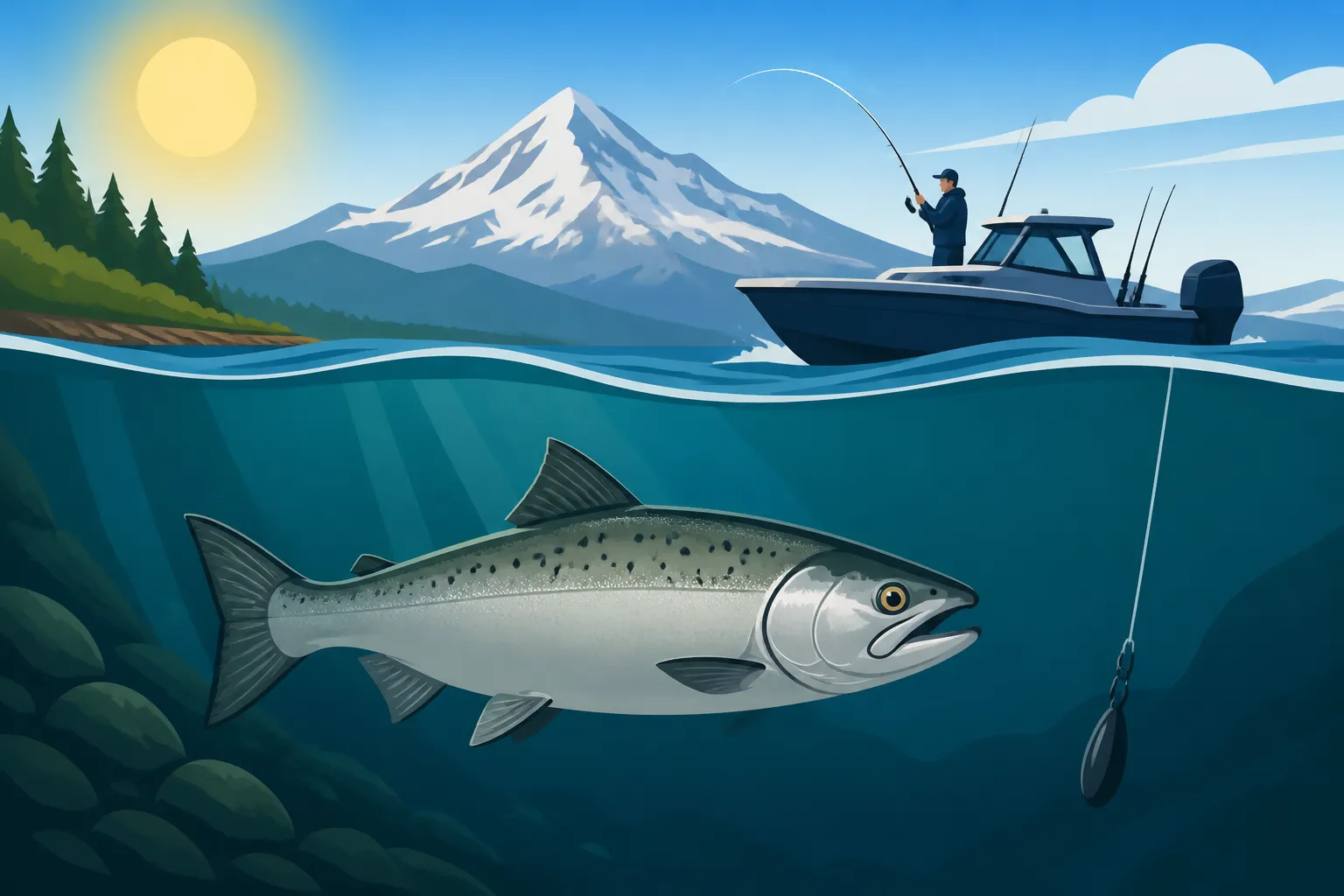
- Downriggers: The King of Depth Control: Downriggers are arguably the most effective way to present your lure at a precise depth. They allow you to send a heavy weight (the cannonball) down to a predetermined depth, and your fishing line is clipped to the downrigger wire, releasing when a fish strikes. This ensures your lure is exactly where you want it. For summer Chinook, common downrigger depths often range from 60 to 120 feet, but as discussed, this can vary significantly. Learning How Deep to Run Downriggers for Washington Halibut offers a similar lesson in precision depth control that is highly transferable.
- Lead Core Line: For those without downriggers or for slightly shallower presentations, lead core line can be effective. This line has a lead core wrapped in a braided sheath, causing it to sink. The general rule of thumb is that one color (usually 10 yards) of lead core will get your lure down about 5 feet at a trolling speed of 2-3 mph. So, to fish at 50 feet, you might need 10 colors out.
- Diver Systems (Dipsy Divers, Jet Divers): These diving planes attach directly to your main line and use water pressure to pull your lure down to a specific depth. They are excellent for targeting fish in the 30-80 foot range without the need for downriggers. Different sizes and settings on divers allow for varied depth control.
- Trolling Speed Matters: Your trolling speed directly impacts how deep your lure runs, especially with lead core or divers. Faster speeds will pull lures shallower, while slower speeds allow them to sink deeper. Maintaining a consistent speed, often around 2-3 mph for Chinook, is important for effective depth control. Our guide on the Best Trolling Speed for Chinook delves into this further.
Experimentation is key. Start with a known productive depth, but be prepared to adjust. If you mark fish deeper, let out more line or send your downrigger ball down further. If you're not getting bites, try moving up or down in 5-10 foot increments.
Reading the Water and Environmental Clues
Beyond electronics and gear, paying attention to what's happening around you on the surface can also provide valuable clues about where Chinook might be holding. This "old school" approach complements modern technology.
- Bait on the Surface: While summer Chinook are often deep, visible baitfish activity (jumping, finning) on the surface can indicate that schools are pushed up, and larger predators might follow. This is more common in low light conditions or if bait is being actively herded.
- Bird Activity: Diving seabirds (like gulls, terns, or murres) are often a strong indicator of baitfish close to the surface. If birds are actively working a patch of water, it's worth checking out, even if Chinook are deeper; they might be below the bait school the birds are targeting.
- Current Breaks and Tide Lines: Look for visible current seams, eddy lines, or tide rips. These areas often concentrate baitfish and can provide ambush points for Chinook. The fish might hold at a specific depth along these lines, waiting for an easy meal to drift by. Knowing Best Tides for Puget Sound Salmon Fishing in Washington can help you predict where these breaks might form.
- Water Color and Clarity: Significant changes in water color or clarity can indicate boundaries between different water masses, which can also influence where fish hold. For instance, a clear line between murky river outflow and clear saltwater might hold bait, and thus Chinook, at a specific depth.
By combining all these observations—your fish finder data, your depth control techniques, and your visual assessment of the water—you'll build a more complete picture of where those summer Chinook are likely to be. Remember, fishing in Washington, especially for salmon, is a constant learning process, and every trip offers new insights. Don't forget to regularly consult the Reading the Washington Sport Fishing Regulations Pamphlet and Washington Fishing Seasons: A Month-by-Month Guide to ensure you're compliant with all rules and fishing during open seasons. You should also make sure to do a What to Check Before Every Washington Fishing Trip.
Disclaimer
Fishing regulations, seasons, and emergency rules in Washington can change frequently. Always consult the latest Washington Department of Fish and Wildlife (WDFW) regulations pamphlet and emergency rule updates before heading out on the water. This article is for informational purposes only and does not supersede official WDFW regulations.