Right Way to Cast a Spey Rod for Steelhead
Learning to cast a Spey rod can feel like a daunting task, especially when you're standing on the bank of a wild Washington river, watching experienced anglers effortlessly send their lines across swift currents. Many of us start out struggling with traditional overhead casts, battling strong winds, limited backcasting room, and the sheer weight of getting a heavy fly and sink tip out there, often leading to frustration and tangled lines. This comprehensive guide is here to demystify Spey casting, offering a clear, step-by-step approach to help you master this elegant and incredibly effective technique for steelhead.
Understanding the Fundamentals of Spey Casting
Spey casting isn't just a fancy way to throw a fly; it's a completely different philosophy of casting that harnesses the water itself to load your rod. It’s a graceful, powerful, and often essential skill for serious steelhead anglers, particularly in the Pacific Northwest.
Why Spey Casting is a Game Changer for Steelhead
Imagine standing on the bank of a majestic river like the Hoh or the Sol Duc, towering trees behind you, a blustery wind coming downstream, and a deep, fast-moving run holding chrome-bright steelhead just out of reach. If you've ever tried to make a long, effective cast in such conditions with a single-hand rod, you know the struggle is real. Traditional overhead casting requires significant backcasting room, and even then, throwing heavy sink tips and weighted flies into a strong headwind is an exercise in futility and fatigue. This is precisely where Spey casting shines.
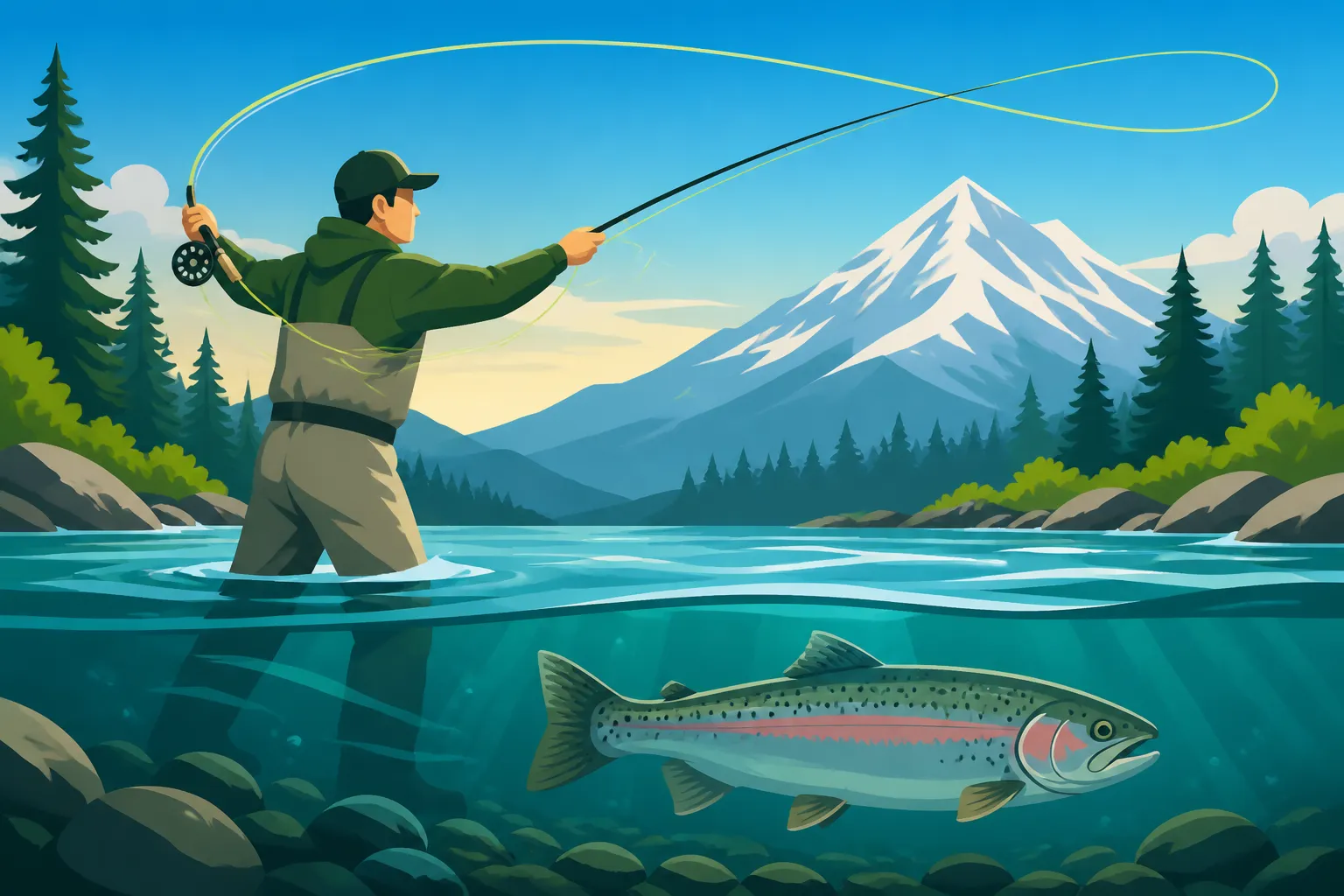
Spey casting eliminates the need for a long backcast by utilizing the water's surface to anchor your line. Instead of sending your line flying behind you into trees or brush, you use a series of dynamic maneuvers to reposition the line, creating a "D-loop" that loads the rod using the tension of the water. This allows for incredibly long casts with minimal effort, making it ideal for large rivers, tight casting conditions, and presenting heavy gear needed to get flies down to steelhead. You can effortlessly cast heavy sink tips and intruder-style flies, which are often crucial for enticing these elusive fish, especially during the cold winter months. It's not about brute force; it's about timing, rhythm, and leveraging the physics of water and line. When you see a seasoned angler on the Skagit River and Its Winter Steelhead Run, seemingly make magic with their two-handed rod, they're not just casting, they're Spey casting, and it's a beautiful thing to witness and even better to master.
Key Components of a Spey Rod Setup
Before you even think about casting, understanding the tools of the trade is paramount. A Spey setup is distinctly different from a single-hand rod setup, and each component plays a critical role in the casting process.
First, there's the Spey rod itself. These rods are noticeably longer than single-hand rods, typically ranging from 11 to 15 feet, sometimes even longer. This extra length provides the leverage needed to handle heavy lines and create those big, efficient D-loops that define Spey casting. The longer length also helps with line control, mending, and fighting powerful fish like adult steelhead. You'll find different actions, from more progressive, flexible rods that are forgiving and great for learning, to faster, stiffer rods favored by experienced casters seeking maximum distance or heavy lifting power.
Next, the reel. While it might look similar to a single-hand fly reel, Spey reels are often larger, heavier, and designed with a wider arbor. The extra weight helps balance the long rod, making it feel less tip-heavy and more comfortable to cast all day. The large arbor also allows for quick line retrieve, which is handy when a steelhead decides to run straight at you. You can find excellent, durable Spey reels on Amazon from brands like Orvis and Redington, designed to stand up to the rigors of big fish and long days on the river.
Finally, the line system is arguably the most complex and crucial component. Unlike a continuous single-hand fly line, Spey lines are modular, consisting of different sections tailored for specific casting styles and conditions.
- Skagit Lines: These are short, heavy, aggressive lines designed to cast very heavy sink tips and large, weighted flies. They excel in tight casting situations and when you need to get your fly deep quickly. Skagit lines are generally considered easier for beginners to learn on, especially for Fly Fishing Techniques for Winter Steelhead in Washington where big flies and deep presentations are common.
- Scandi Lines: Shorter and lighter than traditional full Spey lines, but more delicate than Skagit lines, Scandi lines are designed for graceful, efficient casting and softer presentations. They are fantastic for lighter sink tips and smaller flies, making them great for summer steelhead or situations where a stealthier approach is needed.
- Full Spey Lines (or Long-Belly Lines): These are the longest lines, providing the most delicate presentations and incredible line control for mending. They require more casting room and are typically used by experienced Spey casters.
Coupled with these lines are leaders and sink tips. For steelhead, sink tips are absolutely essential. These are often separate sections of line, typically made of tungsten-infused material (like T-8, T-11, T-14), that attach to the end of your Spey line. They come in various weights and lengths to get your fly down to the fish's level in different current speeds and depths. Understanding the different line options and when to use them is key to effective Steelhead: Washington's Ocean-Run Rainbow Trout fishing.
The Core Mechanics: Setting Up Your Cast
At its heart, Spey casting is about controlled movements that create and leverage tension to propel your line forward. It's not just one big movement, but a series of interconnected steps, each vital to the success of the cast.
The Importance of the Anchor and D-Loop
These two concepts are the absolute bedrock of every successful Spey cast. Without a properly set anchor and a well-formed D-loop, your cast will either collapse, fail to load the rod, or end up in a tangled mess.
The anchor is where the business end of your line—specifically, the fly, leader, and a small portion of your sink tip—briefly makes contact with the water's surface, usually off to the side of your body. This momentary adhesion to the water creates the crucial tension that allows the rod to bend or "load" during the subsequent casting stroke. Think of it like this: if you were pulling a rope, and the other end was just floating in the air, you wouldn't be able to pull against anything. But if the other end was anchored to something solid, you could pull hard, creating tension. The water acts as that solid anchor in Spey casting. The placement of this anchor is critical; if it's too far from your body, it won't create enough tension, and if it's too close, it can impede the forward cast or create a splashy, inefficient anchor. A general rule of thumb is that the anchor should be about a rod-length away from your body, downstream and slightly out from where you intend to cast.
The D-loop is the second half of this dynamic duo. As you sweep the rod to reposition the line, the line forms a distinctive "D" shape behind you, with the rod tip at the top of the D and the anchor point on the water forming the bottom curve. This D-loop is where the energy for your cast is stored. As you move the rod, the weight of the line in this loop creates momentum and pulls against the anchor, causing the rod to deeply flex. This flexion is what effectively "loads" the rod, turning it into a powerful spring ready to launch your line.
Common mistakes often revolve around these two elements. Many beginners struggle with setting the anchor correctly, either slapping it down too hard, placing it too far upstream, or not letting it settle long enough to create tension. Another frequent issue is a "collapsing D-loop," where the loop loses its shape and energy before the forward cast, often due to an inconsistent sweep or pausing too long. Getting these foundational elements right – a precise anchor and a robust D-loop – is paramount to executing any Spey cast gracefully and effectively.
Mastering the Sweep and Forward Stroke
Once you understand the anchor and D-loop, the next step is to learn the movements that create them and then transfer that stored energy into a forward cast. This involves the sweep and the forward stroke.
The sweep is where the magic really begins. After you've lifted your line off the water and established a good anchor, the sweep is the controlled, accelerating movement of your rod that repositions your line and forms that critical D-loop behind you. This isn't a quick, jerky motion; it's a smooth, deliberate arc that typically starts low and moves upward and around, often incorporating a fair amount of body rotation. Imagine drawing a wide, open "C" with your rod tip. The key is constant acceleration, smoothly moving the rod while maintaining tension on the line. The sweep brings the line into position for the D-loop, allowing it to unfurl and store energy. For example, when fishing for a particularly hot Chinook Salmon: Washington's King of Fish that might be holding in a strong current, a powerful, consistent sweep is necessary to get your heavy sink tip into position without losing control.
Following the sweep is the forward stroke, the explosive release of all that stored energy. Once your D-loop is fully formed and the rod is loaded, the forward stroke is a compact, powerful push of the rod forward, aimed slightly upward, stopping abruptly high in front of you. This sudden stop allows the rod to recoil, snapping forward and launching the line across the water. Crucially, the rod tip must travel in a straight line during the forward stroke. Any deviation or "tailing loop" will sap energy and result in a poor cast. Think of it like cracking a whip or throwing a punch: the power comes from a tight, efficient movement that abruptly stops, transferring maximum energy to the target. The goal is to track the rod tip along a perfectly straight path to ensure the line unrolls smoothly and efficiently.
When learning, focus on smoothness and timing over sheer power. The rod and line do most of the work if the mechanics are correct. Many beginner Spey casters try to muscle the line, which actually works against the natural mechanics of the cast. It’s a dance between the angler, the rod, the line, and the water, all working in harmony.
Common Spey Casts for Steelhead
There are several variations of Spey casts, each suited for different river conditions, wind directions, and casting needs. For steelhead, mastering a few key casts will cover most scenarios you'll encounter on Washington's diverse rivers.
Let's break down some of the most common and useful Spey casts:
- The Roll Cast: While technically not a true "Spey" cast (as it doesn't involve an anchor and D-loop in the same way), the roll cast is often the very first cast learned on a Spey rod and serves as a fundamental building block. It's fantastic for simply lifting a submerged line off the water and sending it forward, especially when you have no backcasting room whatsoever. You essentially "roll" the line forward, creating a tight loop that propels the fly. It's excellent for fishing small pockets or when your line has drifted too far downstream.
- The Single Spey: This is often the first true Spey cast many anglers learn after the roll cast. It's primarily used when the wind is coming from your upstream side (e.g., if you're right-handed and the wind is coming from your right, you'd perform a left-hand-down Single Spey). The Single Spey involves a continuous motion where you sweep the line upstream, across your body, and then directly into the forward cast. The anchor is formed off your casting shoulder, and the D-loop forms behind you. It's efficient and effective for changing direction when you have limited space.
- The Double Spey: The Double Spey is an incredibly versatile cast, particularly useful when the wind is coming from your downstream side (e.g., if you're right-handed and the wind is coming from your left). It involves two distinct movements on the water before the forward cast. First, you make a "change of direction" movement that sweeps the line upstream and parallel to the bank, then another repositioning sweep that sets the D-loop. This cast is a bit more complex but allows you to cast directly downstream into the wind safely and effectively, and it's fantastic for large river situations or when you need a significant change in casting angle.
- The Skagit C-Cast (or Perry Poke): When you're dealing with very heavy sink tips and large, bulky flies—think heavy intruder patterns for winter steelhead on the Olympic Peninsula Rivers—the Skagit C-Cast or Perry Poke is your go-to. These casts are designed specifically for Skagit lines and their ability to move massive amounts of weight. They're more direct and less graceful than traditional Spey casts, focusing on brute force line movement to set a powerful anchor and then launching the heavy system. It involves a distinct "poke" or jab of the rod tip to create the anchor before the sweep and forward cast.
Choosing the right cast depends entirely on your position relative to the current, the wind direction, and the amount of room you have for your D-loop. Practicing each of these will make you a far more adaptable and successful steelhead angler.
Here's a quick comparison of when to use each:
| Cast Type | Primary Use Case | Best Wind Direction | Notes |
|---|---|---|---|
| Roll Cast | Lifting submerged line, short casts, no backcasting room, small pockets. | Any, but best in no wind. | Not a true Spey cast, but fundamental. Great for subtle presentations in close. |
| Single Spey | Changing casting direction upstream (e.g., casting across current when wind is from upstream bank). | Wind from casting-side shoulder. | Efficient for modest changes in direction. Anchor sets off the casting shoulder. |
| Double Spey | Changing casting direction downstream (e.g., casting across current when wind is from downstream bank). | Wind from off-casting shoulder. | Highly versatile. Ideal for significant changes in casting angle. Involves two water-borne moves to reposition the line before the D-loop is formed. |
| Skagit C-Cast / Perry Poke | Casting heavy sink tips and large, weighted flies, especially in tight quarters. | Any, but excels in adverse wind. | Powerful and direct. Less elegant, but highly effective for getting heavy gear out quickly and efficiently. Requires Skagit line. |
Practical Tips for Effective Steelhead Spey Casting in Washington
Mastering the mechanics is only half the battle. To truly be effective with a Spey rod for steelhead in Washington, you need to combine your casting skills with a deep understanding of the environment and precise line control.
Reading the Water for Spey Applications
Steelhead are elusive creatures, and knowing where they hold is paramount. A beautiful cast to an empty piece of water is just good practice, not good fishing. When you’re wielding a Spey rod, you’re often covering large sections of water, so efficient reading of the river is critical.
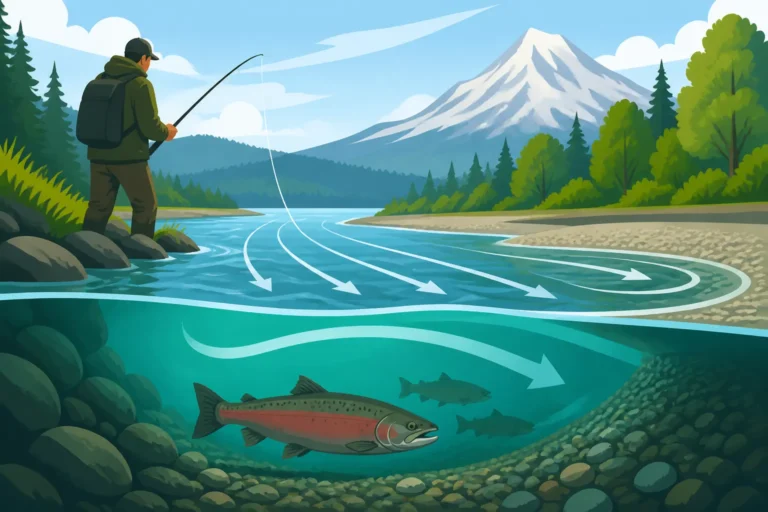
Look for the "steelhead lie"—that perfect combination of current speed, depth, and cover where a steelhead can rest while still having access to the main current to intercept food or move upstream. This often means finding seams where faster water meets slower water, the deeper troughs along gravel bars, or the quiet pockets behind large boulders or log jams. On rivers like the Wenatchee or the Snake, you'll find long, classic steelhead runs that are perfectly suited for Spey casting and swinging flies.
Positioning yourself correctly is also vital. You want to be able to cast across the current or slightly downstream, allowing your fly to swing naturally through the suspected holding water. Understanding how the currents will interact with your line and fly, and how to use them to your advantage, is a learned skill. Take a moment before each cast to observe the water, anticipate the swing, and visualize where your fly will travel. Pay close attention to areas that provide a break in the current, such as behind submerged rocks or changes in bottom contour. You can find detailed information on how to identify these prime spots in guides like Reading the Washington Sport Fishing Regulations Pamphlet, which also often includes maps of various river sections.
Line Control and Presentation
A perfect cast means nothing if you can't control your line and present your fly naturally. With Spey casting, the presentation is all about the "swing."
Mending line is your most important line control technique. As your fly and line hit the water and begin to drift, the current will inevitably pull on your line, causing your fly to swing too fast or too slow. To counteract this, you'll make upstream or downstream mends—small, deliberate flicks of your rod tip to reposition a section of your floating line. An upstream mend will slow your fly down, allowing it to sink deeper and spend more time in the strike zone, while a downstream mend can speed it up. The goal is to keep your fly swinging at the perfect speed, broadside to the current, allowing it to "breathe" and entice a strike. This kind of nuanced presentation is key, whether you're targeting Winter vs Summer Steelhead Runs in Washington, Explained or just fishing a tricky seam.
Controlling depth is also paramount, and this comes primarily from your choice of sink tip and fly weight. Experiment with different T-materials (e.g., T-11 vs. T-14) and fly weights to find the right combination that gets your fly to the desired depth without snagging the bottom too often. The ideal swing often involves the fly slowly descending through the water column as it sweeps across the run.
Finally, the natural swing itself is the presentation. Once your cast is made and your line mended, let the current do its work. The fly should swing in a graceful arc across the river. When a steelhead decides to strike, you won't usually see it; you'll feel a distinct "tug" or "pull" on your line. It's crucial not to set the hook with a sharp, upward motion like you might when trout fishing. Instead, simply lift the rod tip smoothly and let the fish pull the rod bent, often by just holding steady or making a slight downstream sweep with the rod.
Practice Drills and Overcoming Challenges
Spey casting is a journey, not a destination. It takes practice, patience, and persistence. Don't get discouraged by initial struggles; every experienced Spey caster has been there.
A fantastic way to practice without the pressure of fishing is to head to a local park with a large grass field or a calm lake. On grass, you can tie a piece of yarn or flagging tape to your leader to simulate a fly. This allows you to focus purely on the mechanics of your sweep, D-loop, and forward stroke without worrying about snagging or losing flies. On open water, you can practice your anchor placement and line control. Many anglers find practicing the Right Way to Cast a Spey Rod for Steelhead on the water much more effective once the basic motions are understood.
Common issues beginners face include:
- Tailing Loops: This happens when your rod tip dips below a straight line during the forward stroke, causing the leader and fly to "tail" or wrap around the main line. Focus on keeping that rod tip tracking straight.
- Blown Anchors: If your anchor isn't making good contact with the water, or it moves too much before the forward cast, you won't generate enough tension to load the rod. Slow down, ensure your fly and leader are gently placed, and let them settle for a moment.
- Lack of Distance: Often, this isn't about lack of power but poor timing or a collapsed D-loop. Focus on a smooth, accelerating sweep and a powerful, straight-line forward stroke. Let the rod do the work.
- Arm Fatigue: Spey casting is a whole-body motion. If your arm is tired, you're probably using too much arm and not enough core rotation. Engage your body.
If you're really struggling, consider seeking out a local Spey casting clinic or hiring a guide for a day. Many experienced guides on rivers like the Cowlitz or the Klickitat specialize in teaching Spey techniques. They can offer immediate, personalized feedback that can dramatically accelerate your learning curve. You can find excellent Spey casting resources, including instructional DVDs and books, on Amazon to supplement your practice. Remember, consistency and repetition are your allies. Don't chase distance; chase a smooth, efficient, repeatable cast.
Disclaimer
Fishing regulations and seasons, including those for steelhead and other species in Washington, can change frequently. Always consult the latest regulations published by the Washington Department of Fish and Wildlife (WDFW) before heading out. This guide provides general information and should not be considered a substitute for official WDFW regulations.